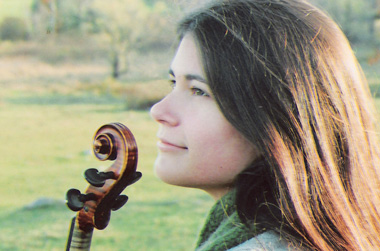
Remember your 18th birthday? Zoë Darrow will remember hers when she reaches that landmark next month. Not only will she have a brand new CD, Fiddle Me This, hitting the streets, she'll be honing her skills at an august location: Willie Clancy's traditional music camp in County Clare, Ireland. Her teachers will include a Who's Who of Irish music: Martin Hayes, Tommy Peoples, Paddy Glackin, Brendan McGlinchey, John Kelly… and, with classes beginning at 10 a.m. and céilis ending after 1 a.m., she'll need an 18-year-old's energy to keep up the pace.
But, as Zoë's fans in western Massachusetts can attest, Darrow has enough energy to light up the Westfield River valley from her home in East Blandford to the Berkshires. Just watching Darrow can be exhausting. She often opens concerts seated, but that doesn't last long. Watch the feet—the first twitch gives way to a windshield-wiper motion, then a seated clogging, clues that she's about to bolt upright, bop across the stage and launch into what can only be described as the whole-body style of Celtic fiddling. To get a vicarious sense of this, fire up Fiddle Me This, close your eyes and listen to the "Dargai" set. After a quiet opening tune, a little bump on "Sleepy Maggie" provides the jog that precedes the sprint to the aptly named "Farewell to Decorum" which completes the tune troika.
Such dynamism—topped with a fondness for Cape Breton tunes—evokes comparisons to Natalie MacMaster. Darrow modestly rejects such analogies. "I'm nowhere near Natalie's level of quality of style and performance. I just go haywire because the music feels so exceedingly happy and natural," says she. But more is afoot than the hyperbole of well-wishers or her own enthusiasm; Darrow might just be that good. Technique can be taught; sensibility is another matter. Give a listen to "Shakins,' o' the Pockey." It's a slow strathspey penned by J. Scott Skinner (1843-1927), a Scottish composer so revered that some performers shy from tackling his tunes. Listen carefully to the harmonies; they're the difference between someone who knows a few Celtic tunes and a stylist who grasps the essence of them.
Darrow is a home-schooled kid. Her parents, Phil and Pam, insist that the decision wasn't ideological. "It was just do-able," notes Phil; he works evenings and Pam during the day at the nearby Blandford library. This gave them the flexibility to allow Zoë to, in her words, "choose what and when to study. I wouldn't have had the time for the violin or to develop my own ideas if I had to stick to a regular schedule."
It was apparent from an early age that Darrow had a gift for the fiddle. Suzuki lessons began at age four, which provided what Darrow calls "an amazing, solid base." One catches glimpses of that training on "The Bee's Wing Hornpipe," in which control within a frenetic pace evokes images of flight. But Zoë recalls that, for her, classical music "lacked vitality and wasn't what I wanted to do." When she was six, she saw Prince Edward Island's Chaisson family in concert at Stanley Park. Zoë turned to her mother and said, "This one here; that's what I want to do." That led to an apprenticeship with Van Kaynor of Amherst.
"He started me with Swedish polska, Scottish music, and traditional American and Appalachian tunes and opened up my world," recalls Zoë. She also began listening to Canadian performers such as the Chaissons, Kimberly Frazier, J. T. Cormier, and Natalie MacMaster, music to which she was attracted because of "really cool turn of phrases, the embellishments, and a sound that is gritty, yet hoppy& with a little jump in the notes that adds so much character to the music." She also learned how some tunes "had strong Scottish influences with bagpipe drone sounds," and how Irish tunes were different because they "don't have the same strong accent on the down beat as on the rest beat."
And where does an aspiring musician way too young to hang out at bar sessions go to hone her skills? Before she was seven Zoë and her father, who plays guitar, were busking in downtown Northampton. Phil notes they were careful to get permits, keep the sidewalks passable, and "not interfere with businesses," but they still managed to raise a ruckus one day when a Main Street therapist complained that the music was too cheerful for her troubled clients. "We just moved on," says Phil, but some of Zoë's admirers booed the therapist! Zoë mainly remembers the streets as a "great opportunity to practice and see what catches attention."
Darrow's talents soon took her from busking to the paid-gig circuit as the centerpiece of The Fiddleheads, along with her father (guitar) and Tom Coburn (piano). It also landed her in workshops where she learned from renowned taskmasters such as Richard Wood, Alisdair Fraser and Liz Carroll. She retains wide-eyed admiration for her mentors and gleefully recalls highlights such as Dougie MacLean borrowing her fiddle, being greeted by Natalie MacMaster with "Hey! You're Zoë the fiddler," getting a penny whistle lesson from Phil Cunningham, and being hugged by Liz Carroll. "How cool is that!?" she asks.
Darrow is poised to leave her own lasting impressions. She intends to study ethnomusicology in college—perfect for someone who also plays the low-D whistle and bagpipes, is learning the Chinese erhu and listens to African and Japanese music with the same zeal as Celtic tunes. Typically, Darrow is modest in her goals: "I want to travel anywhere&everywhere. If music can take me all the places I want to go, I would love that.""
Zoë Darrow and The Fiddleheads play the Orange Town Hall at 7:30 p.m., June 30 and Westfield's Stanley Park July 3. They will be part of the Glasgow Lands Scottish Festival at Look Park July 21.