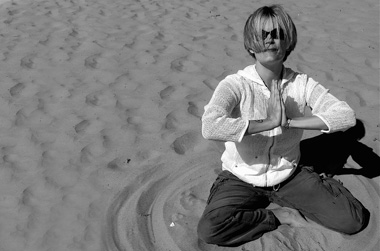
Kathy LeMay says that if you don't "feel horrible" about the injustices of the world and the grinding hardships so many people on the planet are compelled to endure, then you aren't paying attention. Feelings of "shame, guilt and anger" about consuming more than your share are healthy and appropriate responses to what goes on.
Go ahead, says LeMay, explore that sense of despair and helplessness. "Give it the right amount of time," she advises, "but don't let it be self-indulgent, and then ask yourself: What you are going to do about it?"
Consider writing checks.
LeMay devotes her life to moving cash from those who have it to those who need it. Those who have it may (and do) include the fabulously wealthy, but not only. "Over the course of my life I learned that you don't have to have a lot of money to be a donor," said LeMay during an interview in her Northampton office. "I've watched women give $25. It was a stretch for them, but they gave it anyway and they changed somebody's life. I thought to myself, how is that less philanthropy that anything else? If it's giving at your capacity, it is philanthropy."
Usually LeMay avoids the word "philanthropy," preferring to frame her work in terms of "social action plans." She's all about "moving the needle" on issues she cares about. That is to say, she insists that in order to really make a difference, donors should give strategically. LeMay founded her own consulting firm after years of working within and then leading non-profit organizations. It turned out she was very talented at melding vision with "capacity building," or promoting the long-term sustainability and viability of institutions and initiatives. Demand for her services ballooned. "I was turning down three to four people a month," she said. Thus was born Raising Change, LLC (www.RaisingChange.com). She's the president and CEO.
The Raising Change office, in the old National Felt factory on Rte. 66 across from Smith College, is as expansive as is LeMay's vision. She jokingly compares the cavernous yet elegant space to a bowling alley. There is a lot of floor and just three desks in a big room with tall windows hearkening back to the industrial space it once was. A sofa on an island in the middle provides sitting space for guests. The three-person (and growing) operation recently moved from tighter quarters one flight down. A question about whether she plans to install cubicles prompts an expression of mock horror from the relentlessly cheerful and energetic captain of this enterprise. The space won't be wasted, insists LeMay, spinning out visions of workshops and other gatherings that fit into the mission of what she pointedly emphasizes is a for-profit business.
LeMay's personal goals are not very different from what she hopes for her company: to make a lot of money. The difference between her and many people is that she wants to give most of her money away. According to the Raising Change promotional material, in her 36 years LeMay has so far raised more than $100 million for a panoply of progressive organizations and channeled another $100 million by making connections in the course of the focused frenzy that is her life. She and her wife, the artist Michelle Bellici, desire the basic comforts, including a home, a hybrid automobile and the occasional vacation. But what really motivates LeMay is looking forward to the day when she can write her first $1 million check to people who will do great things with it.
Though size matters, part of LeMay's message is that your personal largesse should be measured in proportion to what you have. The other part is that unless you work hard to put your resources ("time, talent, treasure") where they will achieve maximum impact, you won't do as much good as you could. This means looking within, to see what you really and truly care about. "Don't ask yourself what you think you should be giving to, but what it is that keeps you up at night," emphasizes LeMay. "You will stay with those causes forever if they speak to your core values." Stick-to-itiveness, as opposed to supporting the hot cause of the season, marks the difference between charitable givers and great donors.
LeMay maintains an expanding public speaking schedule to spread her message about attitudes towards money. Raising Change advises non-profit organizations on how to meet financial goals. And for a fee of up to $5,000 the company coaches aspiring "great donors" on how to give most effectively. "A big part of the business is training," said LeMay. "We train, train, train."
A breakthrough for LeMay came in February, 2001, when, as acting executive director of Women for Women International, she appeared on the Oprah Winfrey Show to talk about how seemingly small infusions of capital can dramatically improve the prospects of women in distress. The organization encourages women to sponsor "sisters" in rebuilding lives torn asunder by war. The exposure prompted a gush of cash that forced LeMay to become an instant expert on managing exponential growth. "Eighty-five thousand dollars a day started coming in. It was insane," she recalls with more than a hint of glee. "We thought it had finally leveled off, and then they [Oprah's producers] called us and said it is airing in Europe and Australia, the same exact show. So we had everybody in the free world emailing us and saying, 'We want to start a chapter here'." The show launched the organization's growth from an annual budget of $500,000 to its current $10 million range.
That's pretty good for a working class girl from Uxbridge who cut her teeth as a do-gooder going door to door to oppose a proposed factory farm for poultry in her neighborhood. LeMay came as a student to UMass Amherst, where she joined the Animal Rights Coalition, solidifying animal welfare as one of the issues she remained true to once she was in a position to start writing checks—at times for up to $10,000. The other durable focus of her personal giving is building communities by supporting women. She notes that women are more likely to put ethnic and other animosities aside when they control the resources not only to heal the wounds of trauma but to build a new future. "It's women on the ground who work together and say, 'What do we have to do for the greater good?'" said LeMay. "We know that you have the most impact when you invest in women and girls."
LeMay supported her education with a work-study job in the financial aid office at UMass. She majored in history and women's studies. A paper she wrote on rape in times of armed conflict from the Peloponnesian War to the present helped set the course for her future work. Upon graduating she moved to Seattle, where she landed a job as a researcher for a professor who studies institutional violence against women. She told LeMay of an opportunity to travel to Bosnia to work with and learn from survivors of the "rape camps" tied to the "ethnic cleansing" campaigns that accompanied the breakup of Yugoslavia.
Returning from Bosnia to a job as a receptionist at a "widget factory" in a Seattle industrial park, LeMay thought she just might lose her mind. She told her boss that she needed to be alone with her typewriter for a few hours. The stories of women she had met started pouring out. "I actually thought I was going to go insane. I thought it was possible I was going to go crazy," said LeMay. She had bills to pay, including those that had piled up in her absence. She also had to talk about what she had seen. "I was walking around with all of this knowledge and people started bringing me in to speak," she said.
Shopping took on a whole new dimension. "Going to the grocery store and seeing 58 types of cereal" was mindbending. LeMay's response was not, "We should feel guilty about what we have here," she remembers. It was, "We have it, so how can we leverage it for other people?"
This led to a climb through the ranks of a host of non-profit organizations, including the Chicken Soup Brigade (an HIV-AIDS rescue and activist group), Operation First Harvest, the National Law Center on Homelessness and Poverty, and Women for Women International. "I became great at running non-profits, starting as a development assistant, development associate, development director, deputy director, executive director," said LeMay. She achieved the top leadership title at the age of 29. Through it all she kept honing her attitudes toward and understanding of soliciting money.
Laughing, LeMay notes that "doing the ask" is often regarded as the least pleasant task within organizations that are filled with visions of the great things they want to do with the funds. Nevertheless, said LeMay, "You suck it up and you go, you say all the right things and you don't blow it, you get the packet in the mail in 24 hours, you remember to thank them, you give them a plaque, and always spell their name right in the annual report." The nature of the relationship between people who had money to give and people like her, who were asking for it, bothered her. "I didn't see myself as a peer because they worked in numbers that I didn't even know how to count up to," said LeMay. At the same time the burdens of asking for money became more onerous, her position in the organizations meant that the pressure accompanying the fear of failure escalated. "I was worrying that I'm going to say the wrong thing and not get the gift, and if I blow it all of a sudden we can't help women who survived genocide in Rwanda," said LeMay.
Eventually she realized that she wanted to forge a new kind of relationship with donors. She saw that she had gained expertise in something that donors craved: a sense of how to achieve the greatest impact with their gifts. "I didn't grow up with any money at all and I had never been around people with money, so I didn't know what to say or what to do," said LeMay, "but I realized I had a skill that I brought to the table, because I understood that non-profit space that they wanted to be a part of."
Starting her own consulting business meant that she could take risks without feeling the weight of a worthy organization's fiscal health or even survival on her back. As her confidence grew she realized there was a market to tap into. Individuals who had money often had little idea of how to give wisely. She also realized that even people with money could be insecure. "I saw these women who had all this money and were from some of the most powerful families in this world, who would say, 'I have so much to learn from you, could I follow you around for a while?' I would say, 'Are you kidding me? Are you absolutely kidding me? You could bankroll the rest of my life.'"
Experiences like these taught LeMay to value what she had to offer. "Very few people know how to talk to individual donors in a way that says, 'How do I help you meet your philanthropic goals?' versus 'We really need this. How much of a check are you going to write for me?'"
Therein lies her basic message to donors: don't just give money, get involved. Commit to your causes for the long haul. Integrate them into the fabric of your financial life. They will be stronger for the predictability of reliable funds and your impact will be stronger because you are putting something of yourself into the cause.
This approach to giving is not for the faint of heart. Whether you are wealthy or not, LeMay dares you to explore the limits of your comfort level. If you feel the pinch, you will not only pay closer attention, but you will become more connected to the work. "You want to see the organization thrive more, because you didn't just write something that was easy and then walk away," LeMay has noticed. As donors learn more, they become ambassadors for the things that bring meaning to their lives.
Given the tremendous need in the world and the growing disparities in wealth, "Every single one of us is going to have to step it up a notch," she said. "Things are as bad as they are for a lot of reasons. And I'm sure economists and social scientists can speak to that better than I can."
LeMay says that once she has stepped her own commitment to redistributing wealth up a notch, she intends to step it up another, and then another: "Do what you can with what you have, where you are—that's really what the Raising Change values are.""
Raising Change offers a menu of products and services for nonprofits, corporations and individuals/groups. They include a "Corporate Partnership Program," "Trainings for Nonprofit Success," and "Social Action Planning." The latter can be adapted for individuals, couples, families, or groups of friends. Raising Change is hosting an open house Thursday, July 12, from 4-6 at its office at 136 West Street in Northampton.