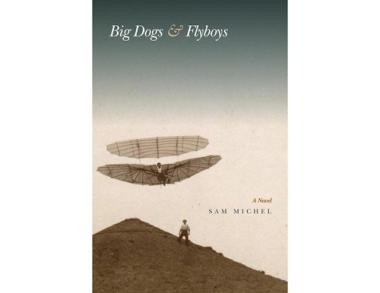
The first sentence of Sam Michel’s novel Big Dogs & Flyboys is: “Flight became me.” From that launching point, it’s clear that your trajectory, unpredictable though it may be, will be trimmed to thread a fine needle. The wordplay is feverish in its sparking and slipping as the main character, Adam Oney, meanders through a narcotic-fueled haze of pain in a burn ward. Sentences like that opener, with its ricochet of meanings, demand a slightly unhinged way of reading, a trust that plot and character will tumble out in the pleasing clamor of Michel’s words.
In this case, after the storm comes the calm. Early on, sentences like these work their magic:
“Way down underneath myself, underneath the blister and the adipose and gristle, it’s there again I can feel me, that little fellow floating several galaxies above. It’s like the egg again, Nurse Sue, the fabled robin’s nest in which I heard the life before the living. The sound that is, that isn’t hinged to any visible effect.”
As Adam recovers, his main obsessions, basketball and flying airplanes, come to the foreground. We learn that two relationships are key for Adam: his friendship with a boy named Mike, and his relationship with his fighter pilot father, who Adam refers to as the General.
Michel never lingers far from his powerful, playful diction and poetry-fired prose, but more complex and unusual passages do give way to propulsive storytelling of a more readily apparent variety. A mix of the straightforward and the tacked-together, near-miss constructions of spoken English often wins the day, and sustains a kind of appeal that makes it irresistible to see where this high-flown novel will lead in both its language and its plot:
“But then the snow fell, and I myself had left off flying till the springtime, and still I hadn’t called. Coach Jerry called. We came up on under a week till tryouts, and Coach’s version, what he told us and the paper was the line on grades.”
Michel teaches at UMass and is married to the writer and UMass professor Noy Holland. He has published a collection of stories, and has written another, so far unpublished novel called Strange Cowboy. In a recent interview, he discussed Big Dogs & Flyboys.
Advocate: Where did the voice of your narrator come from?
Michel: I suppose it’s some kind of combination of colloquial speech I heard growing up and a slightly elevated potential that I might work in there in terms of diction and syntax. It’s largely rhythms that I hear and work with, always. I look back at work that I did five years ago, 10 years ago, and it’s really the same cadences but different dressing on it. It’s surprising. Embarrassing. You think you’re really evolving, and you find out, not really. Not at the heart of it, you’re not.
I know you’ve taken classes with the teacher and writer Gordon Lish—how did that affect the writing of this novel?
He is always one of those readers I have up front in my head when I’m writing. For that reason, Strange Cowboy, the thing I wrote directly after I moved on from his classes, was a book that I was terrified to show him, because what it does, really, I think—or I felt it to be true, that it was going against probably everything that he was teaching me. I was sticking with certain principles in which I agreed intuitively with Gordon in those classes, and yet I was subverting those ideas. The foremost of which is an interior monologue, which is pretty much what the Strange Cowboy book is. Gordon was very much, at the time, teaching surfaces. In other words, sticking to scenes, objects.
How do you begin these longer projects?
I don’t know how to start a smaller project anymore! I would like to start a smaller one, but it’s all a process of investigation. Once I begin with something, I can’t seem to stop asking questions about it. Give yourself one, two, three events or objects, people, places. And then as you begin to investigate the possibilities between those one, two, three objects, events, it becomes inexhaustible, really, when you’re pursuing dramatic potential.
Do you plan to end up in a certain place when you’re writing?
I don’t really plan at all where it’s going to go. I look more to where I’ve been in order to figure where I will go. I don’t understand the process of writing which posits the end and writes toward it. I would become bored and feel dishonest if I began at the end, and I would never be anything more than what I was to begin with, which is something small. The potential to surprise yourself is eliminated if you already know where you’re going. If you trust words, language, have a faith in it, it will deliver you to places which are larger than you are.
Did some of these events and characters come from your own experiences?
There’s an accident in here which really happened, a mid-air collision, so that’s certainly something. Basketball, of course. I play a lot of ball. I don’t want to call it the issue of race, but the fact of race … the strangeness of somebody who is other. I don’t know anything about that—what’s that like? And yet I’m standing there playing ball with them, I’m going to places dancing.
The manager of the basketball team from high school, who I remember was standing at the lip of a cliff, and there was a bonfire underneath him, and a crowd is down there, kids, drunk, shouting, “Jump, jump, jump.”
Scenes—I don’t know what they mean independent from each other, but they seem somehow to be related, and the process of figuring out possibilities makes the novel. Those scenes have been with me for years. So in setting them down on paper, I hope that whatever love or interest, intrigue those things have will sustain me through the writing, through the composition. And that’s mysterious. I don’t know why [the manager]—of all the things that could stick with me, why him?
The style seems to change from more unexpected syntax to something a little more plainspoken as Adam recovers.
I begin in something near to chaos, it’s true. When we encounter anything [new], it’s weird to us—it’s weird to walk into a bar, or to walk into this place, and it’s confusing. You don’t know where things stand in relation to each other, and I suppose that’s the way I begin. I record that state. Also, we begin in a hospital, in a burn unit, with an obviously confused state of affairs and we work our way forward through that as Adam recovers. It’s a risk to begin with that kind of confusion because many readers are looking to be, as we say, grounded and then moved forward through this secure, safe place.
Tell me about this intriguing first line, “Flight became me.” Is that really where you began?
It is where I began. I don’t move things around very much. I don’t have scenes that I move later; not often, anyway. Although the narrative may not proceed linearly, the composition for the most part does. So that was the first line. It’s a good first line! [laughs]
What are you working on now?
It’s a story about a little guy named Early Weeks. He’s 11 and three quarters of an inch tall. He wants to make it to a foot tall. And he never does. His big ambition in life is to cross from one mountain range in the desert through the basin to the other range. That’s all he wants to do. … It comes from how I feel in life. I feel small.
Less than a foot?
Yeah. Smaller, even. Don’t you? Sometimes. Right? I do. Especially in the desert.
Sam Michel reads from his work Thursday, Nov. 8, 8 p.m., at the University Gallery, Fine Arts Center, UMass-Amherst.