
Recording engineers constitute a strange breed—a small coterie of gearheads who wilfully spend most of their waking hours in windowless rooms repeatedly listening to and documenting other people’s music. For over 15 years Slaughterhouse Studio owner and chief engineer Mark A. Miller has done just that, and in the process created an internationally known and respected operation.
During the height of the alternative rock revolution of the ’90s, the Amherst studio—tucked away in a field near the University of Massachusetts—became an epicenter of activity, serving as recording home to bands like Dinosaur Jr., Sebadoh and New Radiant Storm King.
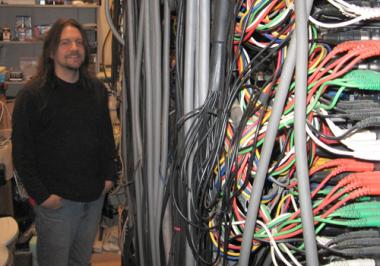
Slaughterhouse recently moved to Westhampton, and continues to record all types of music, from rock to reggae, folk to funk, electronic to metal. Miller gave us a tour of the new digs, and took time out from a recording session to discuss what it takes to sit behind the console.
Advocate: How does the new studio compare to the old one?
Mark A. Miller: It’s different. Being further away from great takeout food is a drawback. But being so close to Amherst and UMass is less relevant now. As my career matured and I began recording more non-UMass bands, my clientele became less centralized. About half the artists now are in the Valley, the other half are outside the region.
The old place was an actual slaughterhouse, and had its own particular charm. People ask where the meat hooks went. The irony of it all is that the current studio is a barn and the former owner used to dress deer in here, so that is similar. But there is an official working bathroom here. [Laughs] And this place is well-built and efficient to heat. The old place’s charm certainly came at an expense.
You have an impressive list of recording equipment on your website.
Our philosophy is to find gear that does the job just as well for less money, which sometimes means giving up a name brand. We do have some boutique pieces, but when you buy expensive gear, you have to pass [the cost] along to the client.
Does that no-nonsense approach apply to your recording philosophy as well?
Yes, unless the recording calls for something flashy. When in doubt, simplicity tends to work better to get the point of a record across, but the philosophy is to try and grasp what the artist is trying to get across and to capture it. If that means setting up a microphone and getting out of the way, do it. Ultimately the goal is to be as unobtrusive to the process as possible unless it is necessary, or unless asked.
Do you think you have heard more bad music than anyone in the entire Valley?
Actually, I don’t. When people walk in the studio, they usually have their act together. The percentage of really bad music is actually low. There’s always something good to focus on. There have been some challenging sessions over the years, but for the most part at the end of the day there’s almost always something I can enjoy in every band’s music. If the person performing is really psyched about what they are doing, that right there is something to feed off of. I’ve got friends that would love to be recording engineers, but their music tastes are so narrow. If you’re not open to hearing something new, you’re dead in the studio. You have to be ready for what comes in that door.
Does it take a particular mindset to be a recording engineer?
Having an open mind to music, and a broad history of listening to different kinds of music. You have to enjoy listening to music. On a personal note, just having the technical chops can yield a really two-dimensional recording—but I hear that on major label records all the time. They are dry, unadventurous and bland, without depth or spirit. But that can be marketable.
Engineers should get credit for listening to music that isn’t their chosen genre, but more importantly for listening to the same single song for eight to 10 hours at a stretch. There is some sadomasochism involved.
I’ve had bands drop behind me, saying, “If I have to listen to that song one more time, I’m going to kill someone.”
I’m like, “It’s your song! You brought it in here!”