
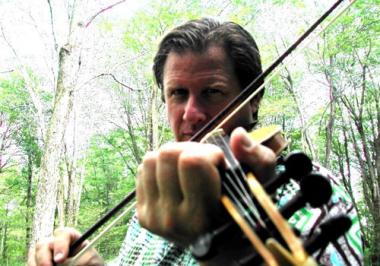
Southern Vermont resident Derrik Jordan is, in the best sense, a restless musician. Not only does he successfully smuggle his violin (or guitar, or most any other instrument) into well-charted and uncharted musical territories; he spends time in the farflung places that inspire his music, like Senegal and Brazil.
He’s been spotted playing with Valley percussionist Tony Vacca, by himself as an electric violinist, and as a guitar-based singer/songwriter. This February, a percussion-and-strings piece he wrote will be performed by Bennington, Vermont’s Sage City Symphony.
Jordan is a prolific songwriter, now on his sixth CD (the latest is Superstring Theory Goes to Senegal, an appealing mix of his violin and many an African instrument). He took some time away from revising his orchestral piece to respond via email to several questions.
Advocate: Your projects are often quite different. What is it that unifies your musical endeavors?
Derrik Jordan: I go where the muse takes me. It’s all music. I guess I get bored easily with one thing. That’s why I play so many instruments. I love variety in music, and have very wide-ranging tastes. Music to me is really just about flow—tension and release. It’s about expression, and the ability of sound to communicate across cultures. It’s apparently infinite. I’m always amazed that there are so many ways to make music, so many styles, so many sounds. It reflects our diversity as humans and the vast amount of species here on Earth.
Do you write a song for a particular genre, or do you write without such concerns?
I started out my musical journey as a singer-songwriter inspired by The Beatles, Jimi Hendrix, James Taylor and Stevie Wonder. I saw The Beatles on The Ed Sullivan Show when I was eight years old and thought,“That looks like fun.” I slowly learned the guitar and began writing songs at 15. I feel incredibly lucky to have grown up during the ’60s. Once I got bitten by the songwriting bug, I just kept on going with a passion. I’ve written hundreds of songs with lyrics and spent eight years part-time in NYC in the ’90s collaborating with some great songwriters and singing jingles. I’ve never had a hit song, but I’ve had my songs covered a few times. It’s a great feeling when someone likes your song enough to want to record and perform it.
I’ve written songs in many styles: funk, rock, blues, folk, reggae, Afro-pop, soca, Latin, jazz, samba and probably a few others. I’ve put out five CDs of my own—three of them are singer-songwriter-oriented. Brazilliance features my best original sambas and bossa novas. Touch The Earth is a concept album that is a celebration of nature and a call to environmental action, and has a lot of different world music styles on it. Expecting A Miracle is a collection of songs in various pop styles—acoustic pop soul.
I’ve seen that you’ve been booked as a solo performer with violin. How do you accomplish a solo set as a violinist?
I perform on a five-string electric violin that uses a low C string, so it’s really a combination of a violin and viola. It was made by Tucker Barrett, who lives in Brattleboro and makes his own style of electric fiddles. I use a looping station when I play solo so I can create the illusion of many violins playing at once. It’s a challenging and fun form of instant composition and improvisation.
I’ve released two mostly instrumental CDs featuring my violin under the name SuperString Theory. The most recent one I released last May, and I recorded it in Senegal and Vermont. I went over there with Tony Vacca in January of 2006 and spent 10 days working and recording with some great African musicians. I then brought the tracks back and added more instruments in my home studio. I also discovered Helen Kerlin-Smith, a wonderful Ethiopian singer, right here in Brattleboro at the High School. She sings in Amharic on three of the tracks. My daughter introduced her to me right after I got back from Senegal. The beautiful irony of finding such an amazing talent in my own backyard after traveling across the world in search of great musicians wasn’t lost on me.
You’ve travelled a lot, so I’m curious what you gain from hearing such a diverse collection of music.
I love world music, particularly African, Brazilian, Middle Eastern and Asian music. You’ve got to go to the source to get the real thing. CDs are cool, and I’ve learned a lot by listening. Actually, I’ve learned everything I know by listening. I’m interested in combining different elements of music and creating new forms. I’m not a traditionalist by any stretch. I’ve been to Ghana, Senegal, Brazil and Trinidad. I still haven’t been to India or the Middle East.
What are you currently working on?
As a creative stretch, I got the nutty idea earlier this year to write a piece for orchestra, which is something that I’ve never done. I put it out there and quickly (and luckily!) received a commission to write a piece for the Sage City Symphony in Bennington, Vt. What has come out of this is a piece for string orchestra and percussion called Four Unknowns. It is 25 minutes long and is divided into four movements, each about a different unknown thing in our universe (“Dark Matter,” “Tipping Point,” “Quantum Chaos” and “Monkey Mind”). I’m just doing revisions now, clarifying ideas and fixing details—there’s a lot of details when you write a piece like this. It’s a really humbling experience. I’ve been working on this piece since August. It’s going to be performed in Bennington on Feb 24, 2008.