Town after town in Franklin County within 20 miles of the Vermont Yankee nuclear power plant is passing a resolution demanding that the plant close in March, 2012, the end of its originally projected life cyle. The plant's operators, Entergy of Mississippi, have asked the federal Nuclear Regulatory Commission to extend its operating license 20 years, to 2032.
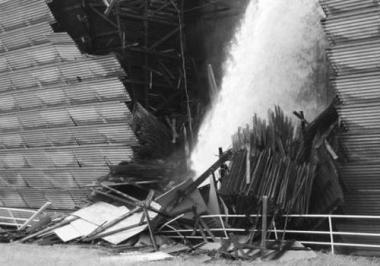
Vermont Yankee is showing its age; photos of a collapsing cooling tower taken in August, 2007 caused a sensation when they were circulated in the media. Many residents of northwestern Massachusetts, southern Vermont and southern New Hampshire also oppose the license extension because, in spite of earlier signs of wear, the plant, under another special dispensation from the NRC, is now putting out 110 to 120 percent of the volume of power it was designed to generate.
The referendum movement raises a vital question: how much does, or should, public opinion influence an issue such as the continued operation of nuclear power plants? Some view input from worried residents as interference with the free market. But nuclear power is not exactly an ordinary business, first because it is heavily subsidized at the taxpayers' expense, and secondly because it retains its own profits while presenting people in proximity to the plants with unique risks: not only the possibility of deadly releases, but the prospect of homelessness and destitution because home insurance policies do not cover damage caused by accidents at nuclear plants. If such a situation were caused by a foreign power or guerrilla group, it would be an act of war.
History provides examples of the application of democratic process to the issue of nuclear power. In 1990, when Poland had recently rid itself of communist rule, construction was almost finished on what would have been the country's first nuclear power plant in a village called Zarnowiec not far from Gdansk. But the new government, strapped for cash and mindful of the Chernobyl disaster four years earlier, took the question of whether to finish the plant to the people. A referendum was held in the area, and 86 percent of respondents voted not to complete the reactor. Construction stopped and Poland moved forward without nuclear power.
Closer to home, in 1989 a public vote shut down the Sacramento Municipal Utility District's 15-year-old Rancho Seco nuclear power plant. The issue was not safety but high cost and low output; 53 percent of the ratepayers voting wanted the plant closed.
In the Valley, in another display of protest against prolonged operation of a plant with documented deterioration, at press time Leverett, Northfield, Gill, Montague, Shelburne, Buckland and Heath had passed the resolution calling for the plant to be shut down in 2012. Only one town, Bernardston, had rejected it; Conway passed a version that did not demand closure but expressed safety concerns. Six more towns have the resolution on their town meeting warrants.
The question of whether local residents can influence the plant's longevity will be played out on another level in 2009, when the Vermont Legislature will vote on the license extension. If the vote is negative, the NRC and the owners will likely not recognize the state's authority; on the other hand, the NRC is also reluctant to fly in the face of public opinion expressed through a channel as official as a vote by a state Legislature."