
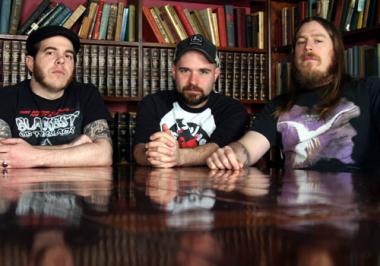
Metal is the cockroach of musical genres. It is often maligned, impossible to kill, and its proponents are usually averse to light. Yet every town in America has its scions of Sabbath, its progeny of Priest, churning out metal's myriad subsets. They thrive in garages, basements and disused warehouses, filling the air with heavy, thick riffs and blazing, ascendant guitar solos.
We talked to Andy Beresky, leader of local metal purveyors Black Pyramid, about his band's new record, the general state of his discipline in the region, and insects.
Valley Advocate: What are the band members' musical histories?
Clay played in Artimus Pyledriver when he lived down in Georgia, so he was pretty well versed in the more Southern heavy rock styles like boogie and sludge. Gein plays in Gein and The Graverobbers, a surf band with really metallic tendencies, and is really into horror punk. Still, though, he's really influenced by bassists like Cliff Burton and Steve Harris, so he's got the sound.
I played with Palace In Thunderland for seven years. It was more prog/psych metal. We had a lot of bad breaks and bad luck, and when we called it a day I immediately wanted to start up a new band, but as a three-piece with a more stripped-down and dirty sound. I wanted to play heavier stuff that I couldn't have done with Palace. Clay was pretty much on the same page when we met up, so it worked out well. Gein just recently joined up, but he's also on the same level.
Tell me about your songwriting process.
I wrote the first few before we were a band. I got together some of my favorite heavy albums, stuff like Sleep, Eyehategod and Electric Wizard, and listened to them all. Then I sat down with the guitar, the riffs just started coming, and haven't stopped since.
Later on, Clay and I collaborated on writing. He would have some great ideas for arrangements, and sometimes even for what I should be playing. He wrote most of the riffs for our song "Twilight Grave," which is a staple of the live set. Gein is a talented musician and songwriter as well, so expect to hear some contributions from him in the future.
How did Black Pyramid come together as a band?
Well, after Palace dissolved, I didn't have anyone to play with. I put a thread up on stonerrock.com's musician finder to try to find people in this area to jam with. No one responded, but some other guy from Connecticut was also looking for people to jam with. Clay had responded to him, and so did I. He found out I was in Northampton, I found out he was in Williamsburg. We got to talking on the phone and through email about forming a band, a three-piece playing doom and heavy styles we both dug. We finally met up for drinks to discuss things seriously, and it was immediately obvious that our heads were both in the same place.
When we finally jammed, everything fell right into place. We just needed a bassist, and we found Eric, our first bassist. He played our first set of shows with us, and laid down bass on the seven-inch, but unfortunately we parted ways with him, which really bummed everyone out. Gein was going to fill in for the tour, but he has decided to stay on full-time.
What town does the band call home?
Northampton. We practice now in Littleton, out near where Gein resides, but we consider Northampton our hometown because when we play out in Western Mass., chances are that is where it's going to be. The Elevens is like a second home to me.
What's the origin of the band name? Is it named after King Amenemhat's pyramid?
Yeah, that's part of it. Black Pyramid also refers to the British equivalent of Roswell, where UFOs were cited that were shaped like black pyramids. Of course, it also references a specific type of LSD-25 hallucinogen as well. All three definitions describe our sound well, though—vast and monolithic, strange and alien, mind-altering and consciousness-expanding.
Tell me about your new seven-inch record.
We're really stoked on doing this seven. Jelle from Electric Earth has been great to work with, the artwork by D. Sroka looks great, and Matt Washburn, who has worked with Mastodon, Starchild, and Artimus Pyledriver, mixed and mastered the whole ordeal. All in all, it's a great package, and we're proud to have it as our debut. And those who think they've pigeonholed our sound by hearing our demo are going to be in for a surprise when they hear the b-side, "Caravan."
What's the state of metal in Western New England?
Well, it's a lot different out here than most of the cities we play. There are some metal bands around, but most of them are either gravitating towards the sounds you hear on the radio, or towards the more metalcore sounds that also have some commercial acceptance. There's not much of a real underground movement like you find in the bigger cities, and that's the stuff I really tend to love. It's also tough, because, since there isn't a scene for it out here, when those bands do decide to tour, Western Mass. obviously isn't going to be on their itinerary. Bands like Witch, and Cats, from Amherst, are heading in the right direction and bringing something new to the scene, but I'd like to see more bands coming from this area that aren't afraid of breaking the mold.
Do you think heavier music is often overlooked?
Yeah, especially some of the more underground styles. It's not always immediately gratifying like a good pure pop song, and it often requires very active listening; you won't experience it in all of its glory if you simply have it playing as background music. Metal and heavy rock are things you really have to sink your teeth deep into and have a passion for.
Is it fair to say that metal is the cockroach of musical genres?
Heh. I guess that's one way of looking at it. If there is any form of music that could survive a nuclear holocaust, I'd put my bets on metal.
As far as the sensitive to light issue, the drummer from Warhorse once commented that you would probably expect him to be this angry guy who sits in a dark basement all day listening to Black Sabbath, when, in fact, he happily sits in a bright office all day listening to Black Sabbath. A lot of people who listen to doom, and heavier music in general, find it cathartic and even uplifting.
When's the full-length due?
We're going to be doing another seven-inch, this one a split with a band from Portland, Oregon called Roanoke. Portland's Parasitic Records will be putting it out. After that, we're going to concentrate on the full-length. It's already written, the songs are there—it's going to be a matter of getting it on tape, so to speak. We haven't decided on a label for the full-length. Once it is actually recorded, we'll shop it around and make sure it finds a good home with people whose goals and visions are similar to our own. Electric Earth will most likely be handling the vinyl, however.
What does the future hold for Black Pyramid?
Really, only time will tell. We plan to keep touring, to keep recording, and to keep bringing as many different influences to the table as we possibly can. Our long-term goals are to start playing the festivals that cater specifically to heavier forms of music and their fans, and also to try to make it over to Europe."