
When I first heard of the decision to welcome a local military contractor, Kollmorgen Electro-Optical, to relocate to the heart of the new development on Northampton's Hospital Hill, I vented some of my frustration to a friend. I wondered how the Citizens' Advisory Committee (CAC), the group overseeing the development, could decide to do something that ran so counter to their stated goals for smart growth. It seemed crazy. Negligent, even.
My friend told me he'd been to the meeting where the vote had been cast, and many of my concerns (increased traffic, loss of new business opportunities, a monolithic factory taking the place of many small buildings, the hole left by Kollmorgen on King Street, to name a few) had been raised by members of the CAC before they voted.
It was his impression that the people sitting on the CAC were committed local volunteers, dedicated to making certain the new development on Hospital Hill was good for our economic development. Just like me: they wanted what's best for Northampton.
As a result, I've been reading their meeting minutes from the past five years in an attempt to understand the committee and the Kollmorgen decision better. As far as I can tell, what my friend says about the quality of the CAC and their commitment is all true.
*
When the Northampton State Hospital was decommissioned in the '80s, many special interest groups quickly staked a claim to the future of the land.
The Citizen's Advisory Committee was created in 1993 by Beacon Hill legislators to find a development solution that would address as many local concerns as possible. The legislation stated that the committee would have no more than 15 members, and those members should include: "two members … [from] the Alliance for the Mentally Ill of western Massachusetts, two … [from] the Northampton Development Corporation, two … [from] the Greater Northampton Chamber of Commerce, and … at least one member from each of the following: the Northampton Labor Council, the Northampton Housing Partnership, the Northampton planning board, the mayor of the city of Northampton, the Valley Community Development Corporation, the Hampshire Community Action Commission, the Commissioner of the Department of Mental Health or his designee, the City Council Industry Committee of the city of Northampton, and the Franklin/Hampshire Private Industry Council."
To make certain no special interest dominated the decision-making process, the law specified that the "committee shall meet at least six times each year, but may meet more frequently at the direction of the chairman of said committee. The chairman of said committee shall be elected by the membership of said committee by a majority vote and shall serve a one-year term."
This group was to write the request for proposals to attract potential developers, manage the developer selection process, and then manage the developer during the project.
The names of some of the CAC members occasionally appear in the news, but to get the full list you need to call City Hall. It's also the only way to get the group's meeting announcements or minutes. When they do meet (10 times in 2003, once in 2004, and not at all in 2005), typically the public is not permitted to address them.
Though the minutes are not verbatim renderings of the meeting, they are detailed, approved accounts that capture the essence of what a speaker said. The transcripts reveal that a good deal of thought and discussion goes into the CAC's meetings.
Harriet Diamond, who is a representative from the Grove Street neighborhood (a position added to the CAC after its inception), is tenacious in her questioning of the developers, and she appears to be one of the few members who will repeat her question when the answer is evasive or unclear. Last November, when developers announced they were considering making the construction of new homes more concentrated than previously planned (originally 12 homes per acre), she pointed out quickly, "65 units per acre would strain our parks and recreation areas and of course strain the undeveloped section of the Northampton State Hospital." Further, she added, "This would affect all of the South Street and Elm Street neighborhoods."
Bruce Fogel, a long-time member representing the Chamber of Commerce, is also a regular voice in the minutes. As an attorney, he's often carefully parsing the language of the laws governing the process, and he regularly evaluates how small changes will affect the big picture. His response to increased housing density on the north campus was, "Relative to the housing/jobs balance, I fear that in our focus to move from a density of 12 to 65 units per acre, the commercial component may get lost in order to preserve the housing component…"
Dan Yacuzzo, a local business owner, keeps his eye on how plans will affect the local economy. Jack Horner makes certain the builders include ample affordable housing, and Joe Blumenthal speaks for the need for a memorial that allows quiet contemplation.
It is difficult to believe anyone else would have been more effective in determining the course of the project than they have been.
The minutes also reveal that the CAC only meets to review decisions others have already made. As a group, it decides nothing. Representatives from the developers prepare colorful reports anticipating the committee's questions about their decisions, and their answers are rarely probed deeply. The CAC may have once collaborated on stating the community's goals and selecting a developer, but that time of influence was a decade ago. Since then, the committee chairperson has taken charge.
When Mayor Mary Clare Higgins arrives, she brings members of her city staff with her (Terri Anderson, Economic Development Director, and Wayne Feiden, Planning Director regularly attend). They are not members of the CAC, but they speak freely, offering their opinions and advice. By the supporting materials they deliver to the CAC and the accord between them, it's clear the mayor, her staff, and the developers are in regular contact with one another outside the public eye. The CAC is the last stop in the process.
The only question the mayor ever seems to ask is whether the committee is ready to vote.
*
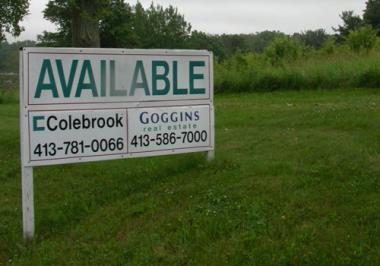
The person who almost never appears in these meeting minutes is the man whose name appears on signs all over Hospital Hill: Patrick Goggins. His realty firm is in charge of selling the homes on the north side of the development and finding businesses for the commercial side.
Goggins was one of the first CAC members in the mid-'90s, but after a year on the committee, he resigned when conflict of interest questions arose.
Presumably to avoid any other ethics questions, Goggins steers clear of the meetings (he's recorded as being at only one since 2003, and he didn't say anything), but as lead realtor, he's far from a passive participant to the planning process. And though not currently deemed in conflict by the authorities, his interests are just the same: Goggins Realty was one of the first local businesses to profit from the development when it made nearly $100,000 on the homes sold on the Ice Pond development a few years ago.
The recent Kollmorgen agreement makes it appear that Goggins has far more sway over the future of the development than the committee from which he resigned. As lead realtor for the Hospital Hill project, Goggins has been involved in efforts to relocate Kollmorgen to Hospital Hill for a number of years. Past attempts to bring the defense contractor to a smaller site on the Hill were unsuccessful though they conformed to the Master Plan, but the recent vote by the CAC to change the plan to allow Kollmorgen's relocation to a larger site gives Goggins the result he'd long been seeking.
It's been presented to the public that Kollmorgen's sudden decision to relocate came about due to a recent, surprising upswing in business for them. Only after an exhaustive search had shown there were no other possible locations in town for their expansion did they settle on Hospital Hill as a last resort. Evidence suggests otherwise.
Kollmorgen wasn't mentioned in the November 2007 meeting that preceded the May 22, 2008 vote, but dramatic change was in the air. Some ideas being floated, like increasing the housing density, made members wary, as they seemed to go against the original plans. Mr. Blumenthal put it this way: "We are being prepared for a time when the CAC will be asked to change the Master Plan; we are being put on notice that such a change would be in compliance with the Sustainable Northampton Plan."
The mayor assured them, "If we ever wish to change the Master Plan, we will need to have a very involved and complicated analysis. It is not worthy of having another discussion on the state and local levels, since the 1993 RFP was drawn up under very different conditions."
A few months later, Governor Patrick showed up in Northampton twice, and the second time he brought $100,000 for the Hospital Hill Development and a promise to expedite the approval process of any new proposed construction on the site, should any happen to appear. In well over a decade, none yet had.
A few weeks after that, though, a completely redone master plan was presented to the CAC, undoing years of work, with Kollmorgen Electro-Optical smack dab in the middle of where a new commercial business district had long been planned. Though it is currently located next to an abandoned mall, the hilltop with southern exposure was the only area with enough room for relocation, the company says.
Though the deal was announced suddenly and rushed in front of the CAC for a vote, it's clear that the real decision makers had been working on it for a while. The mayor had her economic development director prepared to explain why everything that seemed bad about the project was really good, and the developers were confident enough that the CAC would abandon its Master Plan to have drawings made and the report for the state prepared in advance.
*
For Thanksgiving last year, Beth Murphy of MassDevelopment prepared a list of things about the Hospital Hill project for which CAC members could be thankful. Under "economic development" the top item was "Approx. $200 M investment of private and public funds." While this may be good for the developers, as far as the public is concerned, it appears the return on this astonishingly large investment will be negligible. With Kollmorgen occupying space intended for new business, and little gain for the tax base expected from the new housing, the city now stands to make only about $250,000 a year in new tax revenue.
While the CAC was formed to protect the public's varied interests, it's clear from reading their meeting minutes that it's only the chairperson who has any actual power on the committee. As the mayor, Mary Clare Higgins is also the only one on the committee who is not a member of the public.
While members of the CAC have kept their eyes on the details of the plan that interest their particular constituents, the hopes, visions and possibilities for the overall project have been commandeered by others for their own gain. By not holding annual elections for the position of chairperson for the CAC, and not holding the required number of meetings, the mayor not only has been breaking the rules she's supposed to uphold as chair, but she has subverted the purpose and authority of the committee. There is no meaningful public oversight of the project, and recent decisions—made apparently without concern for raising tax revenue for the city—indicate public interests are no longer at the fore.
Questions as to why Higgins has only ever been the chairperson have been raised, but there has been no public response. The meeting minutes reveal, however, that the mayor sought to rectify this oversight. It's on the record that she asked her allegedly equal members:
"At any time the Citizens Advisory Committee may vote a new chair of these meetings. I am quite willing to turn over the gavel at any time. Are there any takers?"
The minutes report, "Nobody volunteered."
It may seem more convenient for the mayor to continue as chair, but this misses the point of the committee. If more people like Harriet Diamond been given an opportunity to steer for a while, invite her own consultants, and hold private meetings with the key players off site, the public would likely now have a lot more to be thankful for.
Author's Note: A copy the official "Notice of Project Change," a report submitted by the developers to the state, outlining the specific alterations to the Hospital Hill plan, is available from Ms. Corinne Snowdon of Epsilon Associates, who prepared the report: csnowdon@epsilonassociates.com, or (978) 897-7100.
The public comment period ends on July 1, 2008. If you have comments, they should be addressed to: Secretary Ian A. Bowles, Executive Office of Environmental Affairs, 100 Cambridge Street, Suite 900, Boston, MA 02114-2524, Attn: MEPA Unit, EOEA 12629