
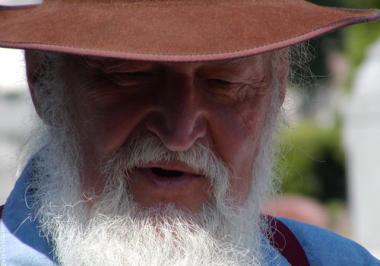
Bruce "Utah" Phillips shuffled off this mortal coil on May 23, eight days after his 73rd birthday. What do you call a musician who spent his youth as a bum, couldn't sing or play guitar very well, told outrageous stories, and spent much of his life immersed in his own self-created character? I called him "teacher."
Phillips wasn't even from Utah; he was born in Cleveland. In a Dean Moriarty moment he ran away, hopped freight trains, wrote songs and did odd jobs. He drifted into Salt Lake City, got drafted, was sent to Korea, and came back disgusted with humankind. He drank heavily and might have ended his days like another Utah legend, Joe Hill, had he not ended up at a Salt Lake City mission named after Hill. There he met Ammon Hennacy, an anarchist Catholic social worker, who dried him out, gave him a job at the mission, cured his misanthropy, introduced him to the Industrial Workers of the World ("Wobblies"), and encouraged his music.
Phillips hit the folk circuit in the 1960s, often with good friend Rosalie Sorrels. He spent some time as the house act at Caf? Lena in Saratoga Springs, and never got around to releasing his first record, Good Though, until 1973. I first encountered Phillips six years later, when I was living in Vermont. A poster tacked to the door of Burlington's Warehouse Hall (R.I.P.) advertised the "Golden Voice of the Great Southwest" and promised an evening of songs, stories and lies. The first lie was the "golden voice" thing. Phillips will never show up on a K-Tel collection of romantic song; in a more truthful moment, Phillips said of his voice, "I can make it loud or soft, depending." His voice sounded like the rails, booze, dust, and hard life of his youth.
But his music was honest and real—songs about tramps, cowboys and working folks, not the self-righteous and self-pitying bourgeoisie. His 1983 We Have Fed You All for a Thousand Years is the go-to source for Wobbly music, and 1997's The Telling Takes Me Home makes a considerable dent in the cowboy repertoire. It's an understatement to say he wasn't welcome in polite society; he'd have been like a polecat in a baby powder factory. He once ran for president on the Sloth and Indolence ticket, promising he didn't stand for anything because "it's damned time people get off their asses and stand up for themselves."
No one—no one—could spin a yarn like Phillips. That's how he became my teacher. I was finishing an M.A. in history when Phillips told stories about the Wobblies. I ended up in the Pioneer Valley because Phillips inspired me to go to UMass for a Ph.D. in labor history.
Much of Phillips's repertoire made you want to go to the barricade—once you stopped laughing. He was that rarest of animals, a light-hearted rebel. If you want to see part of his legacy, check out how chilled Ani DiFranco became after she recorded Fellow Workers with Phillips in 1999.
Phillips only did nine albums; there wasn't much new material after Loafer's Glory in 1997. He always joked that he supported the right to be lazy. By the 1990s he was the favored emcee for folk festivals everywhere, showing up to tell whoppers, make irreverent remarks, sing a few songs, and play the role of a grey-bearded, risqu? Will Rogers. I'll miss his goofiness and the way he cut through the crap. Fed up with high gas prices, crooked financiers and corporate scoundrels? Phillips on the free enterprise system: "The thing about capitalism is, damn, it just doesn't work." If you don't understand the title of this piece, go to YouTube, find his "Moose Turd Pie," and hold onto your keister, lest you laugh it off.
Correction: Producer and musician Phil daRosa's solo CD is distributed by Burnside Records, not Birdside, as reported in last week's column.