
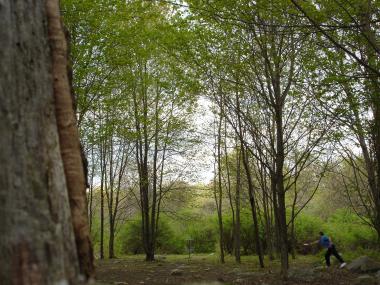
There's a 282-acre parcel of land off Burt's Pit Road in Northampton that's used for a variety of recreational activities, as well as some agricultural ones. Hundreds of apartment dwellers from Northampton and surrounding towns use the community gardens adjacent to the land in the spring, summer and fall. Cross-country runners take advantage of the paths carved into the land's woods, and countless dog walkers use these same paths to stroll behind their bounding rovers.
But few people seem to know that it was the installation of a disc golf course on the land, which was once the property of the old State Hospital, that opened the acreage up and made it a popular recreational destination. What was a labor of love for Felix Harvey and Jason Johnson, the co-designers of the course, has led to the maintenance of the land (parts of which had essentially gone to weed) and the creation of a space that looks more like a park and less like an overgrown forest. The creation of the disc golf course has allowed other users to access parts of the land that might have been inaccessible before.
Dotted throughout woods and fields on the north side of Burt's Pit Road are 18 curious-looking baskets. Each basket is elevated around a metal pole that stands about five feet tall. Chains extend from the center of the basket to a wide ring at the top of the pole to form a triangular shape, resembling a torso. When one writer for the Advocate first saw the baskets years ago, he thought they might be feeders, maybe for deer or the many other critters who call the land home. And like most of the parcel's wildlife, the baskets are almost invisible unless you look closely, because many are set strategically behind hummocks, near streams and on the edges of gullies off the beaten running and walking paths. They can barely be seen from a short distance and are not obtrusive to their surroundings; coming across one is like seeing a tiny sentry in repose at his post.
These baskets serve as goals, or holes, for disc golf, a game adapted from traditional golf. Instead of toting around bags of clubs, players carry small quivers of plastic Frisbee-like discs. The goal of disc golf (casually referred to as Frisbee golf, usually by non-players) is simple, the same as the goal of traditional golf: complete a hole in the fewest number of strokes, or, in this case, throws, as possible. Rather than shooting for a hole in the ground, disc golfers aim their discs at the chains in order to drop them into the baskets below.
The course is dubbed the "Northampton State Hospital Course" on the Professional Disc Golf Association (PDGA) website, and is laid out to take advantage of the natural obstacles and beauty the terrain and flora provide. One exception to this is the first hole, which runs adjacent to the start of the main path. Players assemble at the first "tee" near a picnic table—nothing clear indicates that it is a tee for the first hole—and size up their drives. In their quivers are discs specially designed for distance driving, mid-range throws and even putting (the discs are smaller, heavier and equipped with more streamlined edges than traditional Frisbees, and are made in a variety of weights and slightly varied shapes). As they size up their drives they look like less-toned Greek statues, athletically posed in drawn-back positions, the kinetic energy palpable in their forms. Then, with a motion that resembles those of Olympic discus throwers, the discs are released. Sometimes the discs land in the fairway. Sometimes they disappear into the woods after describing neat, sweeping arcs, turning one way and then back the other. Either way, a few minutes later you can hear the bright tinkling of chains as the final putts are made.
While some disc golf courses are pay-to-play, most are not because they are often located in woody areas that don't begin to approach the level of manicured landscaping required of traditional golf courses. And the prices of pay-to-play courses are significantly cheaper: one course in Turner's Falls suggests $5 per round, which players leave in a box near the first hole. Equipment is also much cheaper. A full set of golf clubs can run from $300 on the low end to many thousands. Discs range from $10 to $20. Ideally a player would need a driver, a mid-range and a putter, but he could just as well get by with one disc.
As different as the two versions of golf are, they have plenty of similarities. Like traditional golfers, disc golfers enjoy discussing and analyzing form. Traditional golf and disc golf are both activities that combine sport and leisure with leisure predominating. And, like golfers, many disc golfers develop a love for the sport that borders on obsession. So finding devoted participants of the game is not difficult, once you find a course. If you build it, they will come.
Years before getting the idea to install a disc golf course in Northampton, disc golf lover Felix Harvey used the land off Burt's Pit Road for cross-country skiing. He was the first to recognize that its diversity of terrain would also be suitable for an exceptional disc golf course full of obstacles. Harvey is an engineer by trade; his early ruminations about the project prompted him to investigate its feasibility. "[The land] is posted as a multi-use area," explains Harvey. "I looked up the zoning bylaws concerning the designation 'Forest Farms and Rivers,' which is the category under which this parcel lies. Under that zoning designation, 'non-commercial recreation' is allowed, which& is the umbrella under which bicyclists, runners, dog walkers, cross country skiers and disc golfers reside."
Trying to understand the transient guidelines and zoning restrictions affecting something as static as a chunk of property is a task that is not a little off-putting (especially considering the recent changes in the development which is slated to take place at the old State Hospital). So whose land is it anyway? A 1993 document from the Northampton Planning Board states that the property itself is designated as permanent agricultural land. It belonged to the Northampton State Hospital until 1986, when it was transferred to the Massachusetts Department of Food and Agriculture (now the Massachusetts Department of Agricultural Resources). It was then leased to Smith Vocational High School on a long-term lease. Remnants of the hospital (originally referred to as the Northampton Lunatic Asylum and later as the Northampton Insane Hospital) can be seen throughout. Old foundations, rusty furniture and a bench memorializing a field where patients who passed away were buried are silent reminders of the land's past.
The land is state-owned and protected by an Agricultural Preservation Restriction, a provision that prevents land from being used for anything except agriculture even if it is sold. The APR program lowers the monetary value of a piece of land by making it ineligible for development, thus providing a tax break for the owner. The APR-protected land by Burt's Pit Road—home to an increasing number of dog walkers, runners and disc golfers—is neither owned privately by a farmer nor is a business located there. It is owned by the state and used as a type of outdoor lab by Smith Vocational High School students, who grow corn, hay and various other crops and use portions of the land for pasturing livestock (the land used for the disc golf course does not overlap any of the farmland).
Besides being used by the school, the land serves as a de facto park or nature reserve. Many people around town refer to it as the "dog path" or the "dog park" because on any given day there are often as many (or more) dogs using the land as people. Technically, there is no suspension of town leash laws, though unleashed dogs are tolerated and an MDAR sign at the parking area near the entrance of the land encourages people to use common sense and leave the land as they found it. The sign also requests that people pick up after their dogs as they would if they were on a public sidewalk or street.
Smith Vocational High School Lands Manager John Szafranski says that while one reported fight between two dogs was recorded, for the most part the area has been without incident and "people have been good about self-policing." Most of the complaints Szafranski receives have to do with people failing to remove their dogs' feces, an offense many may view as mild or unimportant, especially considering the natural setting. But the complaints are important because the balance of the land's use relies on good relations between its users and the concessions they make to one another. "I could see [the use of this land] as a potential for conflicts between constituents," Szafranski explains. He has "had no problems whatsoever with Frisbee golfers," who, he says, have "slipped [the course] in between things nicely."
While it's true that the course does not directly overlap with the paths running through the land, its installation has opened up areas that were not easily accessible to other users in the past. In 2002, when most disc golf courses in the state were located in Central or Eastern Mass., Harvey approached Johnson with his idea for the course. Johnson—who grew up in the Pasadena area of California, where disc golf was invented, began playing in 1985 when he was 14 and started playing professionally in 1999—was enthusiastic, as there was no course in the immediate area at the time, and he signed on as co-designer.
In the subsequent planning, Harvey and Johnson were conscious of the effects their course and its design could have on the surrounding area. "We really focused on trying to preserve the land as much as possible and stay away from areas that would have negative impacts," says Johnson, who is a fish biologist at Palmer's Roger Reed Salmon Hatchery. Their goal, Harvey stresses, was and is "to be a contribution to the community." They were aware of the many species of wildlife like deer, bobolinks and foxes (bald eagles and bears have even been sighted) that live on the land. "Disc golfers are sort of known to be appreciative and respectful of those things, and those things go well with the sport," Johnson said, referring to the wildlife and the idyllic charm of the area. "It's a thinking person's sport." The designers were resolved not to cut down any trees over four inches tall.
According to Johnson, "By 2003 we had discussed with Smith Vocational High School managers and the state's land administration about what we wanted to do, and we submitted a proposal and started doing it." He describes the project as "very grassroots," and "community-minded." The proposal for the course addressed the "removal of exotic and invasive species like multiflora rose, Asiatic bittersweet and Japanese knotweed." This aspect of the proposal "was one of its big selling points because those invasive plants are really moving into parts of those forests, and have taken over a lot of the trees."
Harvey and Johnson were not only able to create a beautiful and natural disc golf course, but contributed greatly, and still contribute, to the maintenance of the land. A core group of volunteers was assembled to help with the initial clearing, and now there are days when users of the course can come and volunteer their time to mow overgrown grass or clear fallen branches. The removal of the invasive species and ensuing maintenance has consequently provided other users of the land with the opportunity to explore previously impassable areas.
Both designers say they've seen a huge increase in the use of the land since they became involved with designing and installing the course. The popularity of disc golf in the area has increased significantly, and more families are playing. Recently Chesterfield graphic designer Leslie Ann Charles (who is married to disc golf pro master Juano Flores) held a disc golf workshop for women. The turnout was impressive, and the event was sponsored by a number of organizations and businesses, including the New England Flying disc Association (or NEFA). But besides disc golfers, other people have started using the land for many other purposes. "The 'dog park' term has really only come into play in the last five years or so," says Harvey. The disc golf course has been around for about the same amount of time.
The identity of the land as a recreational space is a muddled one at best. Lands protected under the APR program are usually farms owned by farmers, though the explanation offered by the MDAR website does include the category "other owners." The Advocate made many attempts to speak with Barbara Hopson, the MDAR field representative for South Western Mass., who redirected inquiries to a press contact for the Executive Office of Energy and Environmental Affairs in Boston (who knew nothing of the specific parcel of land in question, or even about APRs in general). The state failed to provide any comment on why the land was deemed eligible for protection by an APR and how the state views the recreational activities there.
An email from Szfranski helps a little in clarifying the land use question: "The various passive recreational uses that have evolved are an added bonus for the community and have thus far not created significant conflict. The 'uninvited visitors' to the land have been respectful and to a degree, self regulating. As the use and popularity of the area grows it must be realized that we are not maintaining it as a public park and have no mechanism by which to manage people who pass there."
What is certain is that there is some sort of official entity involved in the recreational use of the land that perhaps does not invite but, at the very least, passively encourages its use. The proposal for the disc golf course was approved by both state and Smith Vocational officials, and there is a signboard at the entrance to the land which contains complaint forms and postings printed with the MDAR logo, along with lost dog posters, ads for dog walking services and postings for community events. There are lists of rules explaining that the use of the land is a privilege. A sign states that the trails are reserved Tuesday evenings from April to October for the Mt. Sugarloaf Athletic Club's cross-country races. All evidence points to tacit official approval of the public's use of the land and its amenities, which are valued by many.
The land is a natural respite from the traffic of downtown Northampton only a few miles away. It logically lends itself to recreational use, but is not a park or nature preserve. It is reserved by the state specifically for agricultural use and is partially used for that purpose. Increasingly it is being used for other, more public purposes. The disc golfers have benefited not only the land and themselves by maintaining the grounds and installing this course, but they have opened up fields, glens and alleys between trees for other people as well, inviting the exploration of the land and increasing its use.
The area's unopposed recreational use, poised on an ambiguous management structure, depends on a delicate balance of self-awareness and respect for the surroundings and other users. So far, only a few irresponsible people have soiled the experience for others, and there seem to be more people who appreciate and prize the land—the disc golfers surely among them—than don't."