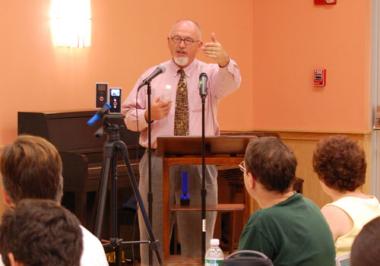
On Sunday night, the Northampton Senior Center hosted the first night of the Northampton Design Forum's urban design charrette. Even though the facility's ample public meeting room was packed, the presenters seemed a bit nervous.
All this week, in the A.P.E. Gallery on Main Street in Northampton, Notre Dame professor Philip Bess and a team of his urban design graduate students will take on Northampton's development issues as an academic exercise. They will survey the city, talk with the public about its goals and dreams for the city's future, and begin working on a plan for growth. The city is in no way obliged to follow the students' findings. Still, the hope is that the free and open charrette will help participating residents better understand urban design principles, and that, with the public working in collaboration with elected officials and the design students, common ground may be discovered.
On the first evening of the exercise, however, the sense of harmony seemed remote.
In her opening remarks, Mayor Clare Higgins acknowledged the tension in the room. Without getting specific, she noted that the students had already had a chance to witness both the beauty and political conflict Northampton has to offer. Forum members and the moderators, Joel Russell and city councilor Bob Reckman, seemed to tiptoe through their introductions. Once he had an opportunity to speak, Prof. Bess announced that he had recently been made aware that "charrette" was a controversial term in Northampton; to appease whomever had been offended, he re-christened the event a "design forum," and then settled into a two-hour lecture on urban design principles.
Bess discussed the idea of space and anti-space, and how urban design was less about a city's architecture and more about the spaces created between the buildings. Cities that worked well were made up of buildings that took this space into account, he explained, creating environments like Northampton's Main Street. They were welcoming, walkable and provided options. He discussed how, after 1945, new American construction generally created anti-space: large, cheaply built boxes facing parking lots, where the only option was to get out of your car to shop or drive off elsewhere. This sprawl drained existing neighborhoods of the shops and services that made them work independently, and it created new housing developments that required a car in order to go anywhere or do anything.
Bess hoped that by reapplying pre-1945 urban design principles to Northampton, the city could fight sprawl and reclaim its neighborhoods.
Toward the end, as he began to talk more specifically about the city's planning past and the current Sustainable Northampton plan, Bess' assured banter stuttered a bit. Initially, the Planning Board had rejected Bess' offer to hold the charrette, due in part to his apparent lack of regard for the sustainability plan. He had been invited by the citizen group Northampton Design Forum independently, without the city's support. Recently, though, city officials had tentatively lowered their defenses and tried their best to seem cooperative.
Bess gingerly tried to draw similarities between the city's plan and the zoning strategies he advocated. It was hard to do. He had an easier time showing their differences: a goal of the sustainability report, he pointed out, was to find tenants to build on available undeveloped space. Bess said that an urban designer, however, would never let the availability of a space determine its worthiness for construction. Concerned more with building neighborhoods than single-use complexes, urban designers would try to find solutions with the lowest impact that met the greatest number of needs.
He was speaking generally, but the distinction he drew could be applied to a good many of the city's recent developments, including the senior center where the meeting was held. Only a few seasons ago, there was a wide swath of lawn where the center and its parking lots are now. While not entirely unattractive, the building takes a bite out of open space and creates anti-space.
It appeared that much of what Bess taught his students was a direct contradiction to the design principles that have been guiding the city.
By the time the meeting adjourned, more than half the audience had left. Those who remained seemed more tired than inspired. Someone wondered what Bess and his team would make of the landfill, and whether their design skills could contend with some of the more sticky planning conundrums the city now faced. Skepticism ran high, and a senior city official who did not wish to be named or quoted directly suggested that the professor's tactics were probably not best suited to Northampton.
Find out for yourself at the design forum taking place this week, ending Saturday, Sept. 13, in the A.P.E. gallery on Main Street in Northampton.