
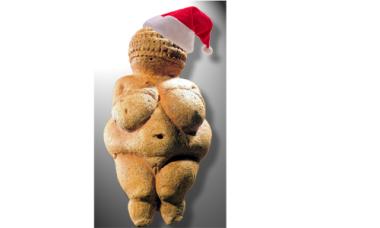
Where art thou, Mother Christmas?
I only wish I knew
Why Father should get all the praise
And no one mentions you.
I'll bet you buy the presents
And wrap them large and small
While all the time that rotten swine
Pretends he's done it all.
So hail to Mother Christmas
Who shoulders all the work
And down with Father Christmas,
That unmitigated jerk.
Roald Dahl, the great, always subtle British writer of the last century, penned his poem "Where Art Thou, Mother Christmas?" with humor in mind, certainly. But there's a quality that all of Dahl's works possess that eclipses their humor, especially those written for children; they promote a moral that uses common sense to defy a common injustice. In the case of this poem, Dahl muses on the British name for Santa Claus and puts forth an uncannily feminist sentiment that questions traditional gender roles, but does so in a way that's hard to disagree with.
I remember Christmas Eves past when I was old enough to know better, but my younger siblings still believed in Santa. I would come into the kitchen late at night and see my mother sitting in her bathrobe and slippers at the table where only hours before we'd had a feast of lamb or beef that she'd prepared. She sat painstakingly creasing and cutting, wrapping and taping—sometimes until two or three o'clock in the morning—as my father snored down the hall (to be fair, he did his part and consumed the milk and cookies left out for the fat man).
So it's easy for me to see what inspired Dahl to write this poem, an ode to mothers and what they do for their children around the holidays, which is everything. Undoubtedly, especially in recent generations and in families with nontraditional parents, fathers contribute more and the lines that separate gender roles become blurrier by the day (at Thanksgiving this year, my fianc?'s father beamed as he held a strainer full of potatoes over the sink, proud to be helping his wife). But the rigidity with which those traditional roles were once observed is no more apparent at any time of year than at this one because, as adults, we reunite with the extended family. The matriarchs are in full force; women whose children have grown up and moved on take on the role of mother, grandmother or aunt once more. They are the ones who make the fragrant, glittering veneer of the holidays possible.
Somewhat contrary to Dahl's complaint, mothers have been at the center of celebratory holiday imagery. Take Norman Rockwell's famous depiction of a holiday meal, "Freedom From Want." At the center of that painting is a matriarch, a mother or a grandmother, with her brood gathered at the flanks. But directly behind her is a man, his hand poised beside his carving tools—ready to "pretend he's done it all"—casting approval over the scene and the turkey his wife has produced.
It seems prudent that we look behind the scenes when we celebrate en masse at the holidays. In the case of Christmas specifically—at its religious root—Christians are meant to believe not only that their Lord and Savior was born, but that a woman experienced the most (literally) visceral bond a mother ever could with her child. And she did it surrounded by the earthiest of domestic chattels.
A significant amount of strenuous toiling in the kitchen has to be done to produce the gleaming final product at holiday time. There remains a certain level of facade that is upheld then, even if there are no more young children and the appropriate myths don't have to be maintained. Still, there are the decked halls, the array of roasted meats and baked goods. These are the product (in my family's case) of a group of matriarchs who do it because they are supposed to and because, I think, they understand its importance.