In October 1991, when the fishermen of Gloucester, Massachusetts set off into the stormy Atlantic aboard the Andrea Gail, they knew the weather was dangerous, perhaps even lethal.
As portrayed in Sebastian Junger's 1997 non-fiction book The Perfect Storm, the six crew members were driven to sea by financial desperation on the mainland that they feared more than the darkening skies and tumultuous waves. Trusting their experience and luck, they gambled on Mother Nature over financial ruin. But global weather conditions not seen in a hundred years conspired to produce freak mountainous waves. The seamen's fate went beyond their control and they died on the job, trying to support their families.
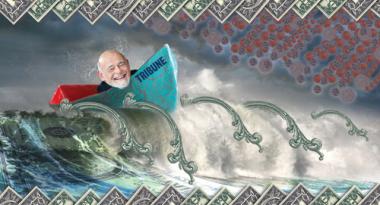
I got a letter recently from the Tribune Company. As a recent former employee of their media empire (I worked for the three Connecticut Advocate weeklies, owned by the Hartford Courant, a Tribune subsidiary), they wanted to make certain I knew they'd gone bankrupt. Anything I thought they might still owe me was now in legal limbo, it read, and if I was crazy enough to want to wrangle with them, I could just wait in line. One of the writers the new Tribune owner, Sam Zell, had not yet fired explained it to me this way:
"We elected to file Chapter 11 in light of the dramatic and unexpected operating conditions we've encountered this year. We have had the perfect storm…"
It appears to be the company line: Steve Carver, publisher of the Hartford Courant, explained the situation as a "perfect storm" in a letter he published in the Hartford Advocate just after the bankruptcy was announced. As the Tribune told me in their letter, Carver assured Connecticut readers, "we are not going out of business."
Clearly, they've missed the point of their crooked comparison.
Unlike the Gloucester fishermen, when it fits their busy schedules, Zell and Carver still drive to work in the morning. There are many problems with the storm analogy, but the worst is its utter lack of sympathy for the situation to which it refers. Though maybe there were fewer shrimp on the party platters this year, no doubt these two had a selection of holiday events they could snub if they wanted, and wherever they woke up on New Year's, it was likely with a soft pillow beneath their heads, near the families who depend on them.
Not so for Captain Billy Tyne, Robert Shatford, Dale Murphy, David Sullivan, Michael "Bugsy" Moran and Alfred Pierre.
Of course, the Tribune speaks metaphorically. Instead of uniquely destructive storm fronts of wind, sea and rain colliding in a way that was unpredictable and hardly believable, they're talking economics. The forces they claim sunk their boat were: "A precipitous decline in revenue, and a tough economy coupled with a credit crisis that makes it extremely difficult to support our debt."
There's no doubt Tribune papers were losing money long before Wall Street's crash this fall, and the sudden downturn in the economy had to cause a nasty financial bruise, but neither the publishing titan's decline nor the popping of the housing bubble were unforeseen.
Three years ago, after I first got hired, I spent several weeks in the Courant's newsroom, training with their Web department. I still regret not sneaking a camera in and taking pictures. Though they'd already suffered some staff cuts, the place was full of the kind of activity you see in a Hollywood newsroom. As I returned on subsequent visits, though, it was like a town just after the mill closed down: first a cluster of empty cubicles with only pushpins on the walls and an old telephone book on the desk. Then dark windows in the offices along the walls. As with newspapers across the world, old-school media companies, unable to figure out a profitable mix between analog and digital sales models, have been bleeding internally for years.
I have no aptitude for economics, but even when my wife and I bought our home just over a decade ago, the simple equation that resulted in our current financial tempest was made plain to me by the loan officer at Easthampton Savings Bank. How much we spent a month in mortgage payments would be affected by the rate at which the bank charged us interest on their loan. Fixed was safe and predictable. The variable rate started low, but, as its name suggests, could be anything. Instead of a payment we could afford, it might be twice that one day. I believe, at the time, I reflected that the seductive option could cause many a world of hurt down the road. I didn't prognosticate world financial ruin, but with only a little prodding, I could have made that leap.
About five years ago we refinanced our home, and in doing so, my wife and I paid off our credit cards. The fees were killing us. Again, given the ease with which I fell into that trap in the first place, as I was using pruning sheers to cut through the identity-protecting hologram of my three maxed-out credit cards, I had the opportunity to reflect on how unsustainable huge amounts of debt can be.
If I, a man who's never willingly picked up a Wall Street Journal, could have recognized the doomed financial trajectories I and my former company were on years ago, it's clear that the "perfect storm" argument is a bit like someone covering themselves in steak sauce, going into the wilds to provoke grizzlies with a stick, and being astonished when they're attacked. If a correlation with the truth and any sense of humility isn't essential, then why not say they'd just been through a financial genocide or economic Holocaust? Why would Tribune want to suggest that their undoing was similar to the one that befell the men of the Andrea Gail?
No one's to blame when freak catastrophic occurrences destroy someone. You don't question the judgment of a business owner whose facilities are destroyed by an earthquake, and you wouldn't deny them their right to build anew and manage the company again.
Of course, Tribune was far from the first to use the seriously flawed analogy in defense of its catastrophic choices.
Increasingly, "perfect storms" have been cropping up across the economic seascape. On November 18, for instance, Ford Automobile CEO Alan Mulally explained the SUVs floating belly up on the dealers' lots by saying his company was in "a perfect storm now with the banks and the economy and the credit crisis." In September, Lehman Brothers' disappearance beneath the waves was often described as being the result of such a storm, and back in January, CitiBank issued a client advisory forecasting a "perfect storm in which finance, transactional, and litigation work" all loomed, threatening to crush them.
The irony in this choice of metaphor is perhaps starkest as we watch these businesses reach for multi-billion dollar life preservers from the government, or run for the safe harbor of bankruptcy protection.
Unlike on the Andrea Gail, many corporate captains haven't gone down with their ships, but stand on their decks ready to take our economy out to sea again. These CEOs of investment firms, banks, car manufacturers and media publishing firms have lightened their loads by throwing America's workforce overboard, and rather than monstrous meteorological conditions dashing their plans to pieces, the economic storms they face are man-made and exacerbated by their own short-term, gluttonous decisions.
As middle-class jobs become scarce and pensions evaporate, I wonder how long the wealthy and powerful will continue to feel safe under the pretext of aligning their lot with that of the wage-earner, feeling his pain and adopting the workforce's tragedies as their own. As stories of a decade's worth of swindles and unstable financial schemes unravel one after another, and the nation's office cubicles and production lines begin to drain of life, accepting the rationale that all that's occurred is merely the result of a passing freak storm seems a decision that can only lead to many more typhoons and tsunamis to come.
The safest place is clearly on the bridge. It's almost enough to put the taste of mutiny in your mouth.