
Just as you might turn a corner in some apparently remote end of the Valley and find a quaint coffee shop or an achingly pastoral farmstand, turning up surprising musical talent here is remarkably easy. And the caliber of that talent is often very high.
Take, for instance, the Windham Orchestra's Listen Local concert this Friday. Not only is the orchestra local, the five pieces on the bill were created by local composers. This is the second Listen Local, and the orchestra's director, David Runnion, has choregraphed quite a convergence of talent.
UMass alumnus David Tasgal offers a multi-level piece called "Overture for the New America," for which the Windham Orchestra will combine with the Brattleboro Music Center's Prima, Junior and Senior Orchestras, a convergence of brand new students and life-long players. Of course, as Runnion explains, that requires some finesse in composition as well as conducting. The overture, in part a nod toward the hope embodied in Barack Obama, slated to be sworn in five days before the concert, promises to make for an exciting first-time orchestral experience for new initiates: composer Tasgal says it follows in the "bombastic tradition" of "Wellington's Victory" and the "1812 Overture."
Runnion, in a recent Advocate interview, recalled his own first time in an orchestra: "It's a thrill for the kids especially to be part of such a big group and to be part of a full symphony orchestra. I still remember the first time I did it—I was 13, and I went to all-state. It blew me away!"
Two of the composers, Zeke Hecker and Maimon Miller, are members of the Windham Orchestra. Hecker's piece is on deck for a second time. It's also intensely local, sporting the moniker "Guilford Festival Overture." Miller's "Mazyk" is the product of the composer's interest in Eastern European music, and borrows heavily from the klezmer tradition. The talented violinist Phil Bloch breaks out the mandolin for "Mazyk."
Things get especially interesting with composer Steven Bathory-Peeler's work called "Film Score for an Unmade Film," originally a 2004 commission for the orchestra. "On this piece, the audience gets a 4×6 index card, and when they're sitting and listening to the music, they're invited to write down the plot of a film that might be suggested to them," says Runnion. "They write a synopsis, and then we're going to choose some to read aloud."
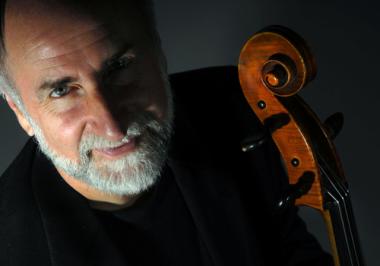
The metafun also gives way to an intriguing improvisational give and take with the work of renowned cellist Eugene Friesen, who plays with the Paul Winter Consort. Runnion says he first met Friesen in a local music shop, and brought him into the orchestra's attempt to foster local connections. Friesen will improvise in a sort of call-and-response with recordings of birds and whales and with the orchestra's part. The piece is called "Creatures Great, Creatures Small."
Friesen, in a recent Advocate interview, explained the genesis of this work. "The Japanese bush warbler has a surprising, intricate, beautiful song that appears three times, and the second [part] features the humpback whale. These sounds trigger personal memories that I have, places in the world that were accompanied by these sounds," says Friesen. "The first part of the piece is related to a record that I made in a beautiful museum, the Miho museum in the mountains above Kyoto."
The museum is housed in a structure designed by architect I. M. Pei and carved into a mountaintop. "From inside the museum, there's a view over many miles of mountains. We did all-night sessions there for about 10 days in a row in 2004. We created a CD called Sono Miho," says Friesen. "Every morning when we left, we were greeted by the sound of this little bird in the mountains. I'm remembering the beautiful architecture of that museum—the music tends to recreate some of the elegance of the museum.
"The second part of the piece relates to an experience face to face with a gray whale on one of my expeditions with Paul Winter. One of the first things I ever did with him was go to Mexico on a whale-watching trip, in the Bay of Magdalena in Baja. It was transformational for a kid right out of music school—it blew my mind. That piece evokes some of the beauty, the mystery, the intelligence of these massive mammals," Friesen says.
Music Director Runnion, also a cellist, has an impressive resume that includes playing all over the world—as the principal cellist for the Barcelona Symphony Orchestra, for example. But he is a product of the organization he now works for. "I started at Brattleboro Music Center. I grew up here. I was one of those kids in the student orchestra. As I progressed, I was in the Windham Orchestra also," he says. "Then I played a solo with the orchestra. Then I went to New York, and around the world for years."
Now he's offering his skills to help create more young classical players in southern Vermont. "When I first started with the orchestra, there was some discussion about how we could incorporate the young people, and about the area's orchestra as a way of building up the string players, giving them a vison and a goal. This is part of it," says Runnion.
Listen Local: Jan. 25, $10/students, $15/general, 3 p.m., Latchis Theater, 50 Main St., Brattleboro, (802) 257-4523, windhamorchestra.net.