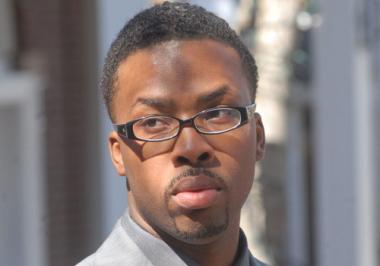
On February 18, supporters of Jason Vassell packed a courtroom in Northampton for a pre-trial hearing in the case of the former UMass student accused of stabbing two men in February of last year after his nose was broken in a fight with them (see "The Eve of Instruction," Feb. 12, 2009).
Hundreds of students, professors and others locally and nationally have lent their support to Vassell's cause. They, and Vassell's defense, claim that the incident for which Vassell is being prosecuted was racially fueled from the start and that both the UMass police department and the prosecutor's office acted under the influence of what defense Attorney David Hoose referred to as "unconscious racism."
A lengthy motion to dismiss the charges against Vassell on the grounds of selective racial prosecution was slated for discussion at the hearing, but Judge Judd Carhart shifted the focus of the hearing to the matter of discovery. Vassell's defense had asked for the right to examine police and prosecution files for other incidents in which racial profiling may have taken place, since Hoose claims there is "&clear evidence of racially motivated decisions being made right from the start [of the Vassell case]." Hoose pushed the prosecutor's office, saying, "It is incumbent upon the Commonwealth to tell us why they've made these decisions if they didn't make decisions based on race."
The defense's argument hinges on the fact that the prosecution charged Vassell, who is black, with two felonies while being lenient with the other two men involved in the incident, Jonathan Bosse and John Bowes, who are white. Bowes is charged with misdemeanors that might bring a four-year jail sentence; Bosse has not been charged with anything.
Vassell was a premed student in good standing at the University at the time. The two men were visiting from Milton and were not affiliated with the school. Vassell claims that these men were the aggressors: that they broke his dorm room window, yelled racial slurs and attacked him.
According to the defense, there are eyewitnesses who will corroborate Vassell's story, but whose statements were largely overlooked by the police. Hoose said that both of the men viewed as "victims" by the prosecution committed provable and prosecutable felonies for which they were not charged, while Vassell faces a possible 30 years in prison.
First Assistant Deputy District Attorney Elizabeth Dunphy Farris claimed that a surveillance video shows that Vassell spent "12 minutes" in the dorm lobby where the incident took place and says that "[the prosecution] believe[s] that there will be no claim for self-defense." Dunphy Farris intimated that Vassell had exited and entered the lobby multiple times before the fight broke out and said that "Bosse was stabbed in the back three times" as he tried to break up the fight. She referred to still photos taken from the video to support the prosecution's claim, but Hoose said that the stills were not accurate and the video would support Vassell's version of events.
*
Hoose cited Commonwealth v. Bernardo B., a case heard by the Massachusetts Supreme Court, in support of his request for discovery. The opinion on the Bernardo B. case, which also claimed selective prosecution, was passed down on February 6 of this year. The defense in that case was granted the right to certain information in the possession of the district attorney's office. Judge Carhart found one line in the opinion especially pertinent: "Defendants raising a claim of selective prosecution may do so by introducing statistical evidence or other data demonstrating that similarly situated suspects or defendants are treated differently by the prosecutor on the basis of impermissible categorizations." Hoose claimed that Bosse and Bowes were "similarly situated" to Vassell and that, in at least one other case involving the same police department and prosecutor's office, a black man was charged while white men were not.
Dunphy Farris, on the other hand, stressed that "the defendant is the only one armed [and] the defendant is the only one who used deadly force." But Judge Carhart agreed that the defense was entitled to some discovery, and will issue an order outlining what materials they are entitled to. In the matter of exactly what they are entitled to in order to mount a defense based on the actions of the police and prosecutors in other cases involving race, Carhart said, "There's no case law to guide me."
Ultimately, the judge granted Vassell an evidentiary hearing, which, Hoose explained, is "a hearing before the court in which you are allowed to produce witnesses and introduce exhibits as evidence." Hoose's associate Luke Ryan added that evidentiary hearings "are often used for resolving matters of fact, where one side is saying one thing, one side is saying another, and it's sometimes helpful to bring in a witness and allow them to testify in court under no cross examination…" The judge will rule on the scope of that hearing on March 2, holding the motion to dismiss in abeyance and postponing the trial once more.
Ekwueme Mike Thelwell, professor in the Afro-American department at UMass and longtime supporter of Vassell, expressed enthusiasm about the decision. "It's not what the judge says," he said, "it's what the judge doesn't say… and he never said a word about not being entitled to discovery, which is what the prosecution wanted. … The motion to dismiss is alive, it's going forward, the prosecution has to get further evidence of what led them to make the decisions they made in this case, and it will go on from there." Thelwell praised the community's support of Vassell and the defense's resourcefulness and pointed up the importance of creating law that has the potential to set precedent in future cases dealing with institutional racism.