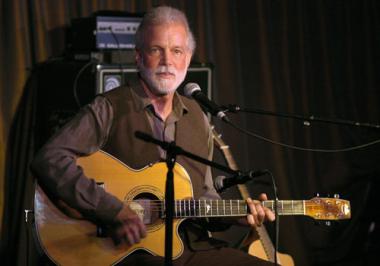
Acoustic guitarist and singer/songwriter Joel Zoss is a busy musician. He's a Valley resident, but he spends most of his time playing elsewhere. Elsewhere as in opening for B.B. King.
Nonetheless, Zoss' recently released album Lila is very much a Valley affair. The players include, among other locals, Guy DeVito on bass and Billy Klock on drums, with whom Zoss sometimes plays as a trio. Lila was produced by June Millington, former member of Fanny and founder of the Institute for the Musical Arts in Goshen.
Zoss' resume is extensive—his songs "Too Long at the Fair" and "I gave My Love a Candle" were recorded by Bonnie Raitt; he's repeatedly received the Special Music Award from ASCAP; his songs have sold so many copies he's got two gold records; he's recorded for major labels; and he's received a National Endowment for the Arts fellowship in creative writing. With cred like that, you might well wonder why he's not a staple at Valley venues.
I asked Zoss about that and about his new album and current touring in a recent interview.
Advocate: How did Bonnie Raitt end up with your songs?
Zoss: Early in the 1970s I played a gig at Passim (Club 47) in Cambridge. I'd been living outside of the United States for years and had no idea who Bonnie was. Her manager, Dick Waterman, happened to show up during my show to try to book a gig for Bonnie. I learned later that the club owner, Bob Donlin, was reluctant to give Bonnie a gig at his club because he didn't approve of her fans—they were rowdy and drank and she had a bad-ass reputation and he ran a respectable coffee house. She never did get the gig!
While Dick and Bob were wrangling about booking her, Dick overheard me sing "Too Long at the Fair." After the show he introduced himself and asked if I had a tape of the song because he'd like to play it for an artist he managed who was about to record her second album for Warner Bros. He asked me if I knew Bonnie and I said no. As it happened, I had recorded a demo of the song that afternoon. So I gave him a reel-to-reel copy and Bonnie loved it. She was living in Cambridge and we met a few days later. We've been in love ever since.
How is playing with B.B. King? How'd that happen?
When my new album Lila was almost finished I was on the phone talking to a booking agent when he excused himself to take a call waiting. A moment later he got back to me and asked me if I wanted to open for B.B. King in Peoria and Columbus the next week. I wasn't sure I would be appropriate for B.B.'s audience—I'm not really a bluesman like John Hammond or Paul Geremia—but eventually he talked me into it, and it worked out really well. It's great working with B.B. He's been incredibly gracious to me, as has his band and his merch guy and the whole outfit, really. We play these beautiful 1,500- to 3,000-seat halls and it's all first class. I do a solo set of my bluesier originals and blues classics, and it feels like old times—I cut my teeth on the blues, played in blues bands, and when I lived in Chicago I was lucky enough to play with Howlin' Wolf and Paul Butterfield and Michael Bloomfield and many great blues men. Anyway, beginning with the first show we did, B.B. calls me out for a curtain call at the end of his set, reintroducing me to the audience after he's introduced all his band members. If they don't applaud for me loudly enough, he says, "I cain't hear you!"
He's just that generous. It's been an honor and a privilege, working with the King.
Your tune "Oh Jerusalem" has a clear political bent—is that typical for you?
I have my point of view and I don't hide it, but "Jerusalem" is unusually and atypically explicitly political for me. I'm not a "protest" or political songwriter. Even so, in this song, the lyrics make it clear that the only side I'm on is the side of life. A lot of people ask me about this song, saying "It's your 9/11 song, right?" but it was copyrighted in 1990 and written a few years earlier, during the Reagan administration. Which makes it somewhat prophetic, too.
What is your songwriting process like most of the time?
I just work here. Mostly I just write down what I hear. I have no idea where it comes from or how I do it. I have the skill to write from idea or assignment, especially if someone pays me to do it, and over the years I've developed a certain level of craft, but I mostly write what I hear. None of it makes much sense to me—it comes from a place where sense doesn't apply.
Last May, the first morning after I got off the road from playing a few dates down south with B.B., I woke up and wrote an 11-verse hymn that sounds like it was written by an 18th-century Anglican bishop. Just what you'd expect from a 21st-century American songwriter coming off a blues tour. My producer, June Millington, shot and put together a video that's posted at my MySpace site [www.myspace.com/musicbyjoelzoss] and I think on YouTube, in which I explain my take on and ponder the never-ending conundrum of how songs get written as illustrated through the vehicle of my song "Pretty Flowers," as it was recorded on the new album.
You chose June Millington to produce Lila—why her? How do you think that affected your sound or your songs?
June's a great guitar player, just a great musician. I was introduced to her by another great player, Lowell George, when her band Fanny was touring with David Bowie. Later we were neighbors in Woodstock, and we always stayed in touch. We found ourselves neighbors again when she moved to Goshen a few years ago. The Lila album is based on a set list my wife Lila wrote out for a show about a year before she died. June knew and loved Lila too, and one night when June and I were sitting by her fireplace in Goshen I told her I'd found a set list in Lila's handwriting and was going to use it for my next album. She said, "Okay, I'll produce."
My music has never fit neatly into any genre and when I record I tend to trust the song to attract what it needs rather than try to control it. When you're working with musicians of the caliber we used on Lila, you want to pretty much trust the process and stay out of the way so they can breath life into the music. You're working with hundreds of years of playing experience. June brought her fantastic energy to the project and we cut all the basic tracks in four or five days, live with the trio. Some of the arrangements on the album are the way I've been playing the songs solo or with the trio for years; some are arrangements I came up with just for this album; some are pure collaborations between me and June; and some are entirely June's creation. The arrangement on "Mother Wanted You Home" is a good example of one that is entirely June's. I was just the guy they brought in to sing it. It's not anything I ever would have come up with, and I think it sounds great.
You don't seem to do a whole lot of local gigs. Is that because you're spending so much time playing everywhere else?
I do tend to work mostly outside the Valley. That's partly because of pay scale, partly because of the music business connections I had before I moved here, and partly because I've always had trouble getting arrested here. I don't know why.
It's hard for me to talk about this without sounding like I'm complaining, and maybe I am. When I moved to North Leverett in 1981 I'd been touring nationally and recording for Arista and other major labels and had two gold records, so I wasn't exactly starting out. Everyone told me the place to play around here was the Iron Horse. So I called Jordi, and he wouldn't give me a gig.
His attitude was, why should I give you a gig just because you're an experienced professional musician with some interesting credits? You're not from here. I didn't get a gig at the Horse until one night when David Bromberg was playing there. David asked me to sit in and I did a couple of songs that were well received, and Jordi broke down and hired me. That experience pretty much set the tone for my performing in the Valley—it's all been uphill. For instance, every once in a while I'll hear a DJ on WRSI play someone performing one of my songs and the DJ will say, "Yup, that was written by our boy Joel Zoss, isn't he great?" But I've never heard them play any of my stuff on the air, and they're certainly not playing Lila. So much for supporting "local" music and local musicians.
Well, maybe they are playing my stuff and I'm too deaf to hear it; maybe I'm deeply offensive and the promoters who hire me are way off; maybe WRSI is performing a public service by keeping me off the airways; maybe WRSI doesn't play me because I'm not on their label. It couldn't be that politics plays any role. I do have a lovely relationship with the dedicated folks at WMUA and I know lots of wonderful musicians here; but as far as working in the Valley, I just don't have the right stuff, whatever that is, and I'm usually left feeling about as welcome as an allergen. I'd love to be working more locally. That would be ideal. Who wouldn't want to work close to home?
And I am booked into the Black Moon in Belchertown, a really nice club, in May. But generally the way it works is, Etta James will give me a gig, B.B. King will give me a gig, the Henry Miller in Big Sur will give me a gig. But some club in Easthampton that seats 12 and pays nothing won't? Okay, I'll just have to live with that. Given the choice of being asked to "prove" myself and having doors slammed in my face versus being invited to play for 2,000 people who like what I do and pay me for it, I'll probably settle for the latter.
Has your writing been a good complement to music? Do you find much crossover between the two?
I've always written music and prose, sometimes one exclusively, sometimes the other, sometimes together, right now mostly music. They complement each other because both keep the fountain of creativity flowing. Using words keeps lyrics sharp and writing music suggests words. I think you have to exercise what you have to keep ready for what is given. When the opportunity arises you might get to play a part in a wonderful creative experience."
Joel Zoss plays with Guy DeVito and Billy Klock at The Black Moon in Belchertown May 8.