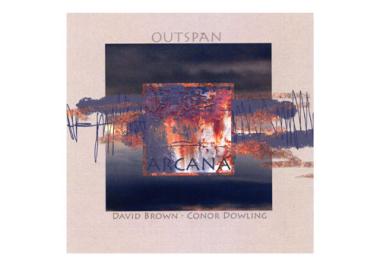
Outspan may be more of a thesis project than a truly raw musical endeavor, but that doesn't keep its constituent composers from incorporating plenty of organic sounds and rhythmic loops with the bones left in. Though primarily structured in loops, both the samples and live passages are strewn with injections of humanity—from virtuosic guitar improvisations to lapping waves of didgeridoo, hand-played synth waveforms and tribal percussion on acoustic drums.
The brainchild of Holyoke-based Conor Dowling and Providence-based David Brown, a pair who apprently formed some semblance of symbiote at Oakland, California's Mills College, Outspan's release Arcana is awash with MFA-encrusted jargon. Terms like "Fibonacci ratios," "ostinado" and "Greek Mixolydian mode" are bandied about in the album's liner notes like common colloquialisms, and, as a relative babe-in-the-woods as far as this sort of stuff goes, I can't help but be impressed by anything that attributes "archaic hexatonic scales" to Terpander of Lesbos (c. 700 BCE).
The soundscapes here do one better than achieving visual suggestions like one might encounter after some gravity bongs and a listen to a Hawkwind epic or Pink Floyd's "Echoes"—these tracks are almost tactile. Sounds sampled from the physical—running water, animal noises and other nature sounds—serve to immerse the listener in an expertly-panned three-dimensional stereo spectrum, and additional instrumentation, such as the extremely harmonically active fujara (a Slovakian "overtone" flute) and the aforementioned didgeridoo, swirls between channels like curious insects or, at times, ominous tonal harbingers of something at once omnipresent and seriously more powerful than you. Strange, distorted spoken word elements appear at times, compounding the listener's sense of encapsulation and enforcing the feeling that one is perhaps taking all of it in from the bottom of a massive metal milk jug, a prisoner of alien captors (who lean over, studying you, speaking in unintelligible dialects and nodding, taking notes… ).
The titling of the pieces, which range in length from seven and a half minutes to almost 20 minutes, is aptly grandiose, with one ("The Death of Socrates") divided into a trilogy ("Veil of Time," "Crito," "Funeral Procession") like a classical piece or a pretense to such, a la Emerson, Lake and Palmer. Other contributors featured include Richard Hawks (fujara), Wayne Eagles (guitar) and Eric Richards (spoken voice), and each displays a pedigreed grasp of his instrument, to say the least.
There are a few less heady elements to the album; Hammond organs, acoustic pianos and human-fingered bass lines make brief, subtle appearances, infusing some traditional jazz-like structures and reminding you that there is, in fact, music amidst this sea of textures. In general, though, it's tone and shape that are regarded as the lofty measures of sound quality here. Every last sympathetic echo of a gong or chime is dutifully captured and smeared broadly onto the sonic canvas, and every nuance of phased Frippian feedback (I love that I just got to write that) is wrangled into a sculpting force of aural terra-forming.
Outspan calls its combinations of loops, acoustic instrumentation and field recordings "sound collages," perhaps a decent stab at self-categorization. Still, "collages" may not go far enough—there's too much of a two-dimensional connotation to the word. Let us call them "dioramas," or, even better, "active environments." Whatever the nomenclature, the work is definitely worth examining, and could even have a commercial future as film music or as a surreal video game soundtrack. The disc contains almost an hour of material, and though it is in some respects slow, a listen goes surprisingly quickly, and the cover art properly conveys the duo's fusion of the ancient and the modern."
Give a listen and/or purchase Outspan's music at http://cdbaby.com/cd/outspan.