
It was September 20, 2007. On the agenda of the Northampton City Council was a revision of the city's regulations on wetland protection. The mayor, Mary Clare Higgins, sat at her desk in front of the City Hall chambers holding a copy of the ordinance as amended, and all nine city councilors had a copy in their packets.
The ordinance allowed development in certain zoning districts as close as 10 feet to the wetlands. When approved, it would be filed with the City Clerk and become part of the law of the city. The document began, "In the year two thousand and seven, upon the recommendation of Mayor Higgins and the Conservation Commission . . . An Ordinance of the City of Northampton . . ."
For more than four years the city's Conservation Commission and the City Council had debated its provisions. Now, following a meeting on Sept. 11 designed to work out a compromise between the Chamber of Commerce, developer Doug Kohl, the Conservation Commission and private conservation organizations, an ordinance was before the Council for a vote.
As debate and discussion ebbed and flowed, the mayor referred to the document frequently. The chair of the Conservation Commission, Paul Wetzel, was in the audience. The ordinance said that the Conservation Commission had recommended it for passage. It was easy to assume that the document was the product of compromise and had been properly approved by the Conservation Commission. But there had, in fact, been no vote by the Commission to approve the many changes made at the last minute.
Now, more than a year later, a cloud hangs over the law. On February 12, the Northampton Conservation Commission created a subcommittee to take a hard look at these new regulations. The commissioners are talking about going back to the City Council and suggesting some changes. The distant glow of political fireworks hovers over the horizon.
*
In 2007, in the biggest spate of acquisition since it bought the land around Fitzgerald Lake, the city, working with developer Douglas Kohl, acquired close to 400 acres in the Mineral Hills district. Doug Kohl is a good guy. He makes his land available for conservation purposes; he masterminded the development of Rocky Hill co-housing up on Florence Road, which had a difficult site and a difficult task in human relations given that 26 households were all involved in decisions, and decisions were made by consensus, which made for many long meetings. The Conservation Commission let them build a road across the wetlands, but the co-housing people had to build a compensatory wetland.
On a rainy day about a month ago, I walked this land with one of the original people involved in Rocky Hill. She was proud of how they had taken care of the wetlands surrounding the main body of buildings. But they had adhered to a 50-foot setback, and it wasn't a crowded site.
It's a different story off North Street. Kohl's land is wet; it has a very high water table. The buildable area is small. Borings done by Kohl's engineers revealed standing water 36 inches or less under the ground. Because of this high water table, there are no cellars and the dry wells designed to hold runoff from roofs only go down 12 inches.
Out in the boondocks, crowding wetlands might not have big repercussions except to the beavers. Around the Industrial Park and King Street you have big parking lots and huge buildings. You have a lot of people living nearby with cellars. You risk having detention structures that don't work as engineers say they are going to. You are risking flooding to nearby built-up neighborhoods when and if the 50- and 100-year storms hit. Sixty feet from the Kohl detention pond there are wetlands at 91 feet of altitude; the floor of the detention pond in his first design was at 88 feet of altitude; there is a creek subject to seasonal flooding not too far away. Will this detention structure become a seasonal pond, breeding mosquitoes? Will it freeze over in winter and let runoff go right into the swamp?
I have a theory that when Kohl is working with conservationists, he does good work. What can change that is the milieu effect. When he is in other company (the inner circle of the Chamber of Commerce, for example), he acts more like an old-fashioned developer. The Chamber knows that with their lawyers and the backing of the mayor and the city planner they can win battles with environmentalists and community activists. They strike fast; they strike hard. (In interviews for this story, Doug Kohl didn't strongly disagree with this analysis, but said he didn't consider himself to be a particularly powerful person in Northampton's political realm—he said he's only had limited interaction with the mayor, for example—nor did he view himself as a Chamber of Commerce insider.)
*
Wayne Feiden, Director of Planning and Development (OPD), is the gatekeeper for development in the city. The beat-up wooden stairs that lead up to his second floor offices take heavy traffic day in and day out from builders, developers, lawyers and reporters. Over the last 18 years, Feiden has been steadily working his way toward being one of the most powerful people in town—more powerful, perhaps, than the mayor. Now with construction going forward on Hospital Hill, the bike trail network in place, and many hundreds of acres of land under conservation restriction in Northampton's outskirts, his legacy is visible. He has changed this town.
The big coup for Feiden's department and the private Broad Brook Coalition was preserving the land around Fitzgerald Lake in the far northern reaches of Northampton. A walk around Fitzgerald Lake is like an expedition to a Maine lake. Not a sign of civilization anywhere.
But if you walk around Fitzgerald Lake, you should also look at the land around the Carlon Drive industrial development off of King Street near the new fire station. A two-track policy by the Northampton planning department favors big setbacks and a conservationist outlook out in the hills, but intense development in industrial and commercial areas and downtown neighborhoods. The planning department likes the broader spectrum of animal life and vegetation life in rural wetlands; they see in-town wetlands as degraded and abused, subject to illegal and legal filling.
It's as if old sexist notions applied to land live on in planning circles. Once treated badly, never to be treated with honor, says our planning department. Neighbors think differently. They like their forested areas. Piles of fill out in the forest don't bother them as long as the forest shrouds these old crimes.
It's the projects that the city itself has an active interest in where you find the big trouble. The senior center, the high school expansion, the hospital expansion, the firehouse—all are projects that build right up to the wetlands and were supported by the city and regulated by city boards.
In 1996 and '97, then-Mayor Mary Ford asked realtor Patrick Goggins, then the Northampton City Council president, to head up a committee to find a new site for a fire station. Goggins found the city a possible site on Stop and Shop land down near Barrett Street, and laid out the first draft of a subdivision plan in city hall offices. In 1991, when Larry Smith was the chief planner for the city, the Conservation Commission turned down a Stop and Shop plan to develop that land because of the danger of flooding, but now with the mayor, Pat Goggins, former city attorney Ed Etheredge and the chamber all pushing, there was enough muscle to get it through the Conservation Commission.
The chair of the panel, Mason Maronn, admitted to Gazette reporter Greg Kerstetter, in "Panel Seeks Advice" (Daily Hampshire Gazette, Sept. 21, 1996), that the issue was "unsettling" because only the Conservation Commission had the power to scuttle the plan. "Because (the plan) is so sensitive politically, we don't want to tread on thin ice," Maronn said, referring to the Commission's decision to "cover their rear ends" and hire an independent consultant.
I remember that the night of the vote there was zero eye contact from the members present and voting. Board members have to face hostility and do disagreeable things from time to time, and generally they are masters at looking blank and avoiding eye contact, like people making a daring turn into oncoming traffic.
The Broad Brook Coalition, the major conservation organization in the city, decided not to attend that meeting. They don't like bucking the town establishment. The neighbors, however, turned out in force and listened while the city's consultant, Baystate Environmental, told the commission that the proposed detention pond wouldn't work. The Conservation Commission still approved the statement of conditions.
The neighbors would appeal, and the Massachusetts Department of Environmental Protection would come up from Springfield and tell the city that they couldn't keep on okaying one development after another in that area without dealing with the high water table. The detention pond was designed to have a dry fore bay, and its shallow main chamber was supposed to have only about six inches of water in it. This was to be a compensatory wetland, full of cattails and wildflowers.
Today if you stand by the pond, you can't even see where they planted the marsh grass and flowers ten years ago. There's no storage to speak of, no discharge, no filtering. The so-called grey water from the parking lots and roofs goes directly into the swamp and eventually into the Connecticut River—which is exactly what might have happened if the Northampton ConsCom had approved some close variant of the plans that developer Doug Kohl brought before them last December for the development off North Street. Both areas have very high water tables and are close to waterways and marshes. But they didn't approve the plans, despite his being one of the biggest property owners in the city and an active friend of the Conservation Commission.
*
Since 2002, conservationists and members of the Conservation Commission have been battling to strengthen Northampton's wetland regulations. They wanted to replace a legally weak "policy" that was often violated with a consistent enforceable ordinance that would (a) establish a 50 foot no-encroachment zone around wetlands in all areas of the city, and (b) establish an ordinance that would protect vernal pools and pockets of standing water in wetlands that often contain small snails, salamanders and other species.
In April of 2005, Teri Anderson, the city's economic development coordinator, weighed in against vernal pool regulations that that she saw as hamstringing efforts to develop an industrial park along Rtes. 5 and 10.
The ConsCom debated and revised the language of its proposed regulations, but was frequently blockaded by the City Council's ordinance committee. Regulations that restrict property owners' rights to develop are not popular in the western part of the city. Starting in September of 2006, members of the Chamber of Commerce were attending meetings of the ordinance committee. The Association of Realtors weighed in. In the May 31, 2005 version of the ordinance, there was a uniform 35-foot no-build zone around wetlands everywhere in the city except in the industrial park. At the June 8, 2005 meeting of the ordinance committee, Wayne Feiden opened a contentious meeting by summarizing proposed changes in the ordinance as "a result of the compromise between the Economic Development Coordinator and the Conservation Commission." "In urban areas you will be able to build closer to the wetlands," Feiden said.
In April of 2006, the ConsCom finally adopted the ordinance that gutted wetlands protection in the areas of the city where most of us live. Developers could now build as close to 10 feet from wetlands if they were able to show "extraordinary mitigation," whatever that is.
These seesaw efforts, striving to strengthen and striving to weaken the wetland regs, have been going on for some time—plenty of time for the mayor, who listens very carefully to the business community, to build and rebuild a Conservation Commission that will play ball with the Chamber of Commerce and prominent realtors. During much of this period, a dedicated conservationist, John Body, chaired the Northampton Conservation Commission. John Body felt that a proposed industrial park along Easthampton Road, as it was then planned, would block the movement of wildlife from the undeveloped land to the north of the city to undeveloped land to the south, including Mount Tom and the Arcadia Wild Life Sanctuary. His campaign to strengthen the protections accorded wetlands ran into opposition from the mayor and the Chamber of Commerce.
In October of 2005, in a message supporting the Community Preservation Act, John Body spoke of proposed amendments to the law as having been "blocked." By whom, he didn't say. According to a former councilor, the mayor called John Body into her office and told him point-blank that he would not be reappointed to the Conservation Commission if he kept campaigning for stricter wetland protections.
I asked the mayor and she said she had "no memory" of doing this. But with all the pressure from the business community, she is vitally concerned with what happens at the Conservation Commission, whose members hold a veto power over many developments adjoining wetlands. Some of her appointees to commissions in Northampton either have city jobs or jobs with firms that contract with city hall or have close relatives who have city jobs.
City government is a close-knit family. Mason Maronn, whose wife, Barbara Maronn, works in the city clerk's office, has been on the Commission for more than 20 years. Commission member Sue Carbin works at the city's Locust Street recycling center. These people may vote against the mayor's wishes, and they have done so on occasion. But it could be a conflict of interest when the mayor, through economic development coordinator Teri Anderson, makes her wishes known to the Commission on an issue such as this one.
Forward to March of 2007. The ordinance committee wanted the ordinance split in half. They didn't like the section that relates to vernal pools, but they were willing to put the rest of it up to a vote. Body and other conservationists wanted to keep it together.
On March 29, 2007, the regular Conservation Commission meeting opened at 5:30 p.m. Body was late, arriving at 5:55 p.m. Just two minutes later, Mike Vito—a board member and political operative who worked for former Mayor Mary Ford and, more recently, for U.S. Sen. John Kerry—motioned to send only the wetlands portion of the ordinance package to the City Council. Maronn, Vito, Reuven Goldstein and Paul Wetzel voted in favor; Body and Carbin voted against it. Body would never attend another meeting.
As 2007 went on, the heat was turned on the Commission. On May 24 Microcal, a firm on Industrial Drive, filed for a determination to expand its parking lot and a building. Attorney Michael Pill showed up representing Route 10 landowners and threatened Conservation Commission members with a lawsuit. Enter lawyers hired by property owners; enter convoluted arguments that any step forward (the 50-foot no-build zone in all areas of the city) would be overturned in court because the ConsCom had been lenient in the past. Mickey Marcus of New England Environmental represented Microcal (in Hadley, Marcus also quarterbacked for Pyramid and Wal-Mart in their permit negotiations for a Wal-Mart Superstore at the Hampshire Hall, where negotiations with the state foundered largely on wetland issues).
In July the Chamber of Commerce commissioned a report from Marcus on the vernal pools ordinance. The Northampton Chamber of Commerce decided to organize a committee on wetlands to defend its interests. Big guns: the committee included Dennis Bidwell of Bidwell Advisors, lawyer Ed Etheredge, Chamber president Rick Feldman, developer Patrick Goggins, Rick Klein of Berkshire Design Group, Doug Kohl of Kohl Construction and builder Jonathan Wright. Not a tree-hugger in the group.
*
Commissioner Paul Wetzel reported Body's resignation to the ConsCom on Aug. 22, 2007. His brief letter of resignation is dated August 24, but the letter from Mayor Higgins acknowledging his resignation is dated July 30. In any case, the Commission lost its leadership in the spring, when he stopped coming to meetings. The first item of business for the ConsCom on that same day, Aug. 22, was the appearance of Douglas Kohl, doing business as Northern Avenue Homes, before the ConsCom for a determination of applicability for his property zoned URB off North Street.
The Chamber hand-delivered its report on the vernal pools issue to the City Council on the night of September 6. The report was confusing and technical enough that it created consternation and demands that the vernal pools section be killed. Calm heads did not prevail. That night Bob Bissell of the Broad Brook Coalition, shocked by the likelihood that the whole wetlands package would go down to defeat, attacked the Chamber for its tactics. The City Council tabled the wetlands ordinance and urged the Commission to meet with the opponents of the vernal pools measure.
The Chamber's attack on the vernal pools ordinance was essentially a diversion, a member of the Broad Brook Coalition told me. The Chamber never intended to kill the measure, just drive a wedge between the BBC and the other conservationists. The Chamber understood that the conservationists' main concern was the vernal pools; they would probably go along with tightening the perimeters around in-town wetlands.
A ConsCom workgroup met at 4:30 p.m. on September 11. Only two out of seven Commission members attended, Mike Vito and Chairman Paul Wetzel. The three other members of the workgroup were Chamber president Suzanne Beck, Doug Kohl, and Molly Hale, a wetland biologist who worked for Kohl. Members of the public who attended wanted to talk about the wetlands section of the ordinance, but they were told to confine their remarks to vernal pools. The Coalition to Save Northampton's Wetlands submitted a report from a respected scientist, Bran Windmiller of Hyla Ecological Services, that concluded that the "proposed ordinance would effectively lessen the current protections of wetland resource areas against injurious encroachment by construction projects." Discussion of the report was not allowed.
For Northampton people, this should ring some bells. Anyone involved in the public hearings and City Council meetings over the Smith College expansion or the State Hospital project will recognize the modus operandi. It's how this city steers through the rocky shoals of public opposition. Unpleasant things are ruled out of order, there are diversions, and people are accused of opposing measures too late or doing things in the wrong manner. Seven days later, the Conservation Commission met to review what had happened. Here are the minutes of the meeting in full:
Northampton Conservation Commission
Minutes for September 18, 2007
Members Present: Paul Wetzel, Sue Carbin, Michael Vito, Leslie King
Staff Present: Bruce Young, Land Use and Conservation Planner Paul Wetzel opened the public hearing at 6:38 p.m.Discussion on the definition of vernal pools and adding the word detention basin to the exception section of the ordinance.
Meeting adjourned.
Holy smokes, Batman. These are minutes? What happened? One of the people attending told me that everyone concluded that the matter was out of their hands, and they never took a vote on approving the package. Bruce Young, their planner, doesn't remember why they didn't vote, but he did acknowledge to me that the matter was out of their hands.
*
Which brings us back to September 20, 2007. When the package of measures came before the next City Council meeting, Bruce Young said: "It seems like everyone is satisfied."
Well, not everyone. There was a lot of bitterness. The Broad Brook Coalition decided to give in and assent to the 10-foot rule, leaving the neighbors and many conservationists in the lurch. The chair of the Conservation Commission resigned, and planning staff stepped into the power vacuum and cut the Conservation Commission out of the picture. The measure came before the Northampton City Council two days later. About 20 people appeared to testify, pro and con, in the public comment section.
Bob Bissell of Broad Brook was fulsome in his praise of the "meeting of the minds" that produced the measure. Former City Councilor Alex Ghiselin, however, was more skeptical.
"It has the look of compromise to it," he said, scratching his white shock of hair, "but it has been entirely an arm-wrestling measure between the mayor and members of the Conservation Commission. And the mayor had all the muscle. Over the four years it took to work out this ordinance, she has had the opportunity to appoint, not appoint, or reappoint every member of the ConsCom. At least one guy, a talented guy, a former chair of the group [Body], resigned because of this process& The planning staff works for the mayor. They are not about to cross the mayor in public. So what sounds like a lot of different voices is really a lot of people working within the parameters set by the mayor."
When the City Council opened its discussion of the measure, the mayor steered the meeting toward talking with the ConsCom staff person, not the chair. After Bruce Young was invited to speak, there was commotion in the rear of the chambers. Young wasn't there. One of the councilors said that he wanted to talk with the chair of the Commission, Mr. Wetzel. "Well, we can also recognize Mr. Wetzel," said the mayor.
The chair of the ConsCom was nervous and was looking toward the back of the room, probably hoping against hope that Bruce Young would arrive. An observer of the Commission commented to me that Wetzel had turned over a lot of his powers and responsibilities to Bruce Young, and that Wetzel, who worked at Smith College as a research associate, knew the science but was a newcomer to small town politics.
The benches in the back of the room were full of dispirited people who knew the game had been lost. Councilor-at-Large Mike Bardsley asked Wetzel to comment on the testimony of people who opposed the 10-foot line.
"I think these people are afraid," Wetzel said, "that these lines will become the defacto boundaries of what petitioners are going to expect when they come before the Commission. What is going to be important is who is on the Conservation Commission. Our jurisdiction varies from 10 [feet] to 35 to 50 and 100 depending on where you live. The jurisdiction gets smaller under these new rules.
"What you are hearing is that these people are afraid that the Conservation Commission is going to be put in a weak position when they ask petitioners to keep further away from the wetlands than these boundaries. You are," he said, "balancing the politics and the biology. The biology says the further you are away from the wetlands, the better. I don't know," he said, seeing that Young had finally arrived. "Let's ask Bruce."
You'd think some councilor might have seen, in the unexpected disorder of the proponents, an opportunity to ask some questions that might have relevance. Someone might have said, "Well, let's not talk to Bruce yet, mayor; let's talk to Paul. Paul, you seem to have some questions about this measure. Did your Commission take a legally binding vote on this ordinance and its amendments? Do you back this ordinance?"
But there was no trouble from the people behind the nine desks. Bruce had finally arrived, bearing maps. For the rest of the time he held forth, talking for the Commission. He was smooth, armed with credible facts and "facts" that were less convincing. Following a debate that ranged widely, it became clear that the Council would vote, as it did, "On the recommendation of the Conservation Commission" for the ordinance, by a 7 to 2 margin. The best speech that night by a city councilor, for my money, was given by Jim Dostal, who made a strong statement on the flooding that he had seen over the years as a DPW employee: "If we have protection, the protection should be for all neighborhoods."
*
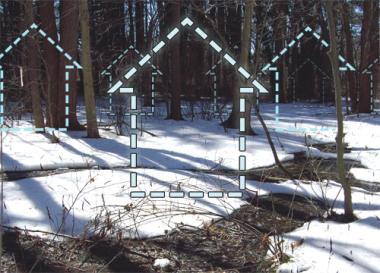
So we had a new law, and a 25-unit development before the ConsCom that would become a kind of poster child, for better or for worse, for the new law, and for the Planning Department's zoning policy on in-fill housing. The 25 townhouses were to be built by Doug Kohl on 5.6 acres off North Street. The parcel is in between Northampton's Industrial Park, the new Northampton/Amherst bike trail extension, and an existing neighborhood of predominantly single-family homes. On the parcel are 2.2 acres of wetlands. It is heavily forested and drained by a branch of Millyard Brook, which runs along the northwest edge of the property. Some of the detention structures and back yards in plans come as close as 12 feet to the wetlands. Kohl was planning to take advantage of the 10-foot rule, just as conservationists had feared.
This land was originally 13 lots that didn't sell when a 65-lot 1907 development was marketed. The popular wisdom in the neighborhood was that the land was swampy and too wet to develop. The popular wisdom is right, I believe. On Dec. 21, 2004 John Body, while chair of the ConsCom, signed an order of conditions on the land and filed it with the Registrar of Deeds. A warning to one man is a sobering thing; to a powerful man it is an invitation to look for allies. Doug Kohl threw his cards in with the group at the Chamber of Commerce to fight for a city policy he could live with.
Pretty much all the good land in Northampton has been developed; now, because of the desirability of so-called "in-fill" projects, we get this kind of pressure on our regulatory boards to roll back the regulations so the junky stuff with wetlands, vernal pools and ledge can be developed, like this parcel. We have wetland regulations that we didn't have in 1915, but we also have a lot of consultants around who can say black is an attractive shade of grey, who generate computerized studies impossible to understand and tell you there is no measurable impact from a development, no matter how massive.
I walked the land with Doug Kohl and it was just the kind of junky wetland that I like. I played cowboys and Indians in swamps like this in Milton as a kid, and they are all gone now. Dotting Kohl's forest are flags, orange for structures, blue for the limits of the wetlands. Where flags are today, tomorrow there will be buildings. I'm a grownup. It's his land and it's probably going to be developed, if not by him, by someone else. I'm not a wetland scientist and I don't know.
Right now there is a heavy stand of Norway spruce where the buildings and detention structure are; with the land stripped of these natural defenses and all the roofs and parking lots shedding water, I wonder if those 12-inch drywells will overflow during northeasters.
*
But the initial plans are being revised. Kohl is going back to the drawing boards. The guys like Wayne Feiden who bulldozed the Conservation Commission into approving these new rules cost him a lot of money and aggravation. "Well," Kohl said to me with a subdued kind of exasperation, "Wayne overreaches himself sometimes. He thinks, because he says things can happen, that they will happen. Things aren't that simple."
The ConsCom is digging in its heels for a protracted fight. In-fill housing in a swampy area cannot be done on the cheap. The two meetings that Doug Kohl and his engineers had with the ConsCom in December and January have produced unanimity: the Commission does not want any man-made structures less than 35 feet from the wetlands, and the things that Doug Kohl has done to show mitigation do not rise to the standard of the ordinance.
Leading the battle against the plans was Wetzel, who was the first member to say that he wanted the developer to push back to 35 feet. With the development further away from the wetlands, we might get fewer units and smaller parking lots. We might get less risk of flooding.
Kohl, at the December meeting, offered to donate other land to the Commission that he would do mitigation on, but Commissioner Maronn told him the problems were here and should be addressed. Members of the ConsCom worry about the water table; they worry about the same things that the neighborhood worries about, like whether the new condo owners with their tiny back yards are going to mow back into the wetlands and chop back the brush. The odds are they will. The commissioners are skeptical that all the mitigation that they order will be forgotten about when the new owners move in.
The Conservation Commission seems to be toughening its standards now because of the financial problems the city has. It really doesn't have the staff or funds to monitor its existing agreements on wetlands. On Jan. 22, EBD Corporation came before the Commission looking for approval of its plantings along the edge of wetlands off Nonotuck Street, and it became clear that ConsCom staff person Bruce Young was sick of the time demands of trying to enforce agreements that protect wetlands. He said that of all the developments he has handled over the last four years, only one had obeyed the rules. Owners mow right out to the edge of the forest, destroying wetland plants. Owners out in one development have destroyed granite bollards (posts) and mowed beyond them, according to Young.
The January, 2009 meeting of the Conservation Commission with Kohl was fun to go to, a real love fest between the neighbors and the ConsCom. At the Commission's February meeting it brought in a new chairman, Kevin Lake, who has set out some new procedural rules and is going to have a training session on conflict of interest.
The ConsCom is talking about going back to the City Council and going into the shortcomings in this law. There are conflicts in the language. And there will be public hearings before they go to the Council. Somewhere along the line, Northampton city councilors and the mayor forgot that the members of the Conservation Commission may know more about the complex network of laws that they are sworn to enforce than they do, and they should butt out.