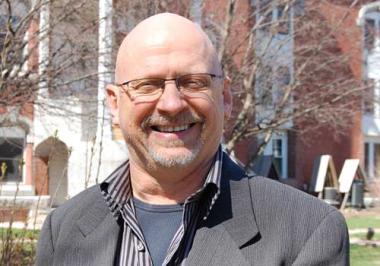
Northampton City Councilor Michael Bardsley hopes that, come Election Day, local voters will see him as the candidate of positive change and will elect him mayor. Even if the climb to the top seat in city hall proves to be too steep for Bardsley, the city will nevertheless see its first real mayoral contest in more than a decade.
The few candidates who have attempted to challenge incumbent mayor Mary Clare Higgins in the past have offered little viable opposition. Largely political novices, often painted, fairly or unfairly, as appealing to ABC voters (Anyone But Clare), previous challengers seem to have only solidified the passionate loyalty of supporters of Higgins, who has won each of her campaigns by a wide margin.
But only months after cake-walking into her fourth term, Higgins did something she'd hadn't done before: nearly two years in advance of this November's election, she declared she would run for a fifth term, filing the papers necessary to start fundraising. Higgins began building her re-election campaign without an opponent on the horizon.
But an opponent revealed his intentions last week. In announcing his planned run for mayor, Bardsley made it clear that his once friendly relationship with Higgins had changed dramatically in recent years. No novice, Bardsley outlined a campaign strategy that will focus heavily on Higgins' use of power in what he views as anti-democratic ways, picking up on criticisms coming from a variety of factions in the city right now. Bardsley, in fact, may himself be a victim of Higgins' brand of power politics.
The Valley Advocate spoke with Mayor Higgins on April 6, offering her a chance to discuss Bardsley's candidacy and to respond to his specific claims about her and her administration. Higgins said she was looking forward to campaigning and debating Bardsley. She said she did not want to address his specific arguments through the press, but would do so directly, to avoid having her views filtered.
"Somehow, after 16 years on the Council, I've wound up being an outsider again," Michael Bardsley said in an interview last week alerting the Advocate ahead of time to his formal April 2nd announcement that he was running for mayor. He'd served first as the councilor for Ward 4, and then as one of the two councilors at-large. For four terms, until last year, he'd been the Council president.
In January, 2008, after the new and re-elected city councilors were sworn in, a vote was held for Council president. Jim Dostal, the other at-large councilor, found the votes to unseat Bardsley. Subsequently, Dostal removed Bardsley from committees he'd long chaired. Bardsley suddenly found himself in the minority on a number of issues that the Council faced.
He's since turned to spending his time on both the Ad-hoc Best Practices Committee and the Northampton Design Forum. He's also been working on wrapping up loose ends and retiring from his decades-held position as a guidance counselor at the Amherst Regional High School.
After school closes for the summer this year, Bardsley will stop his weekday treks across the Coolidge Bridge to devote himself fulltime to Northampton politics. By running for mayor, he is vacating his at-large seat. One nominee, Jesse Adams, has already announced his bid for it.
*
Michael Bardsley was born in Lawrence to a mill family on September 29, 1949.
"My father's family were working class Republicans," he said, laughing. "How's that for a twist? My mom was a British war bride, and she came over in '45, '46, right after the war. They eventually settled down in Methuen, and she's still there in the very same house my dad got out of the G.I. Bill. Dad died years ago when I was a teenager, but last weekend I went home for mom's 84th."
He credits his early interest in civics and politics to his active membership as a teen in the Boy Scouts. "It's kind of a time capsule thing," he says, "and I'm not sure how people relate to it today, but I was in Eagle Scouts, and I spent all my summers at scout camp. It was the thing that got me out of Methuen."
In high school, he remembers being more interested in books than sports. He said he had an affinity for political fiction, citing titles such as The Last Hurrah, Seven Days in May, and All the King's Men among his favorites.
He came to the Valley in the mid-'60s as an undergraduate at UMass-Amherst and became involved in the anti-war movement on campus. He doesn't consider himself a full-fledged hippy, but "more of a student hippy than a hippy's hippy. There was never the thought of living on a commune, for example."
He "kicked around between English and history," eventually graduating with a degree in English. Between college and grad school, he worked various jobs in construction and restaurants, using the Pioneer Valley as his base. During this time, though, he crossed the country three times hitchhiking, spending time in the Rockies and Canada.
After a few years traveling, he got work as a part-time English teacher in Amherst. He taught one English class "for students who weren't really into English that much," he said. "It was called 'Career Explorations,' so it had a kind of a work focus to it. I had a real affinity for the work and the students, and I ended up talking to them a lot about their issues and concerns. Then it just kind of clicked that being a guidance counselor was what I really wanted to do." He returned to UMass' School of Education for a master's in counseling.
After getting accepted in the grad school program, he started working in the Campus Center. At that time, the drinking age had dropped to 18 and there was plenty of work for bartenders, which was a job that fit Bardsley's schedule. One summer, the bar's management changed hands, and the new owners tried to impose a pay cut.
"So I organized the student employees," he said. "I was the chair of an effort to unionize them. I spent a lot of time on that—it reflected in my grades, which is why I don't flaunt my transcript. That was one of my first forays into politics as a young adult."
In the early '80s, soon after beginning to work full-time as a guidance counselor, he became the president of the Amherst teachers' union. He served two terms, the second of which lasted nearly a decade. He became active in human and civil rights issues, and at one point, as a delegate to the National Education Association (NEA) convention in Washington, he took part in a rally to end apartheid in South Africa. He and others got arrested while singing "We Shall Overcome." He also served on the board of directors of the Massachusetts Teachers Association (MTA) for a number of years.
Bardsley first became involved in Northampton politics during the campaign race for governor between Ed King and Michael Dukakis. As someone who lived in Northampton and was involved with education funding issues on a state level through the MTA, he was asked to assemble a delegation from his city ward. Through his work on the gubernatorial campaign, he met Mary Ford and Russell Carrier, and he became active on a local level. Until that time, he says, city and state politics almost operated in two different worlds, one being rather conservative and the other more liberal. He credits Ford for largely changing that, bridging the gap between Main Street and Beacon Hill. Bardsley and Carrier acted as co-chairs on Ford's campaign to become councilor at-large.
Bardsley was elected County Commissioner in 1989, becoming Northampton's first openly gay elected official. Four years later he and Mary Clare Higgins both ran for and won seats on the Northampton City Council. They served under Mayor Mary Ford until Higgins became mayor in 2000. For most of their 16 years serving in political office together in Northampton, Bardsley and Higgins have been allies and friends.
Until Dostal unseated him last year, Mayor Higgins had never worked with another Council president. Though Bardsley says the cracks in their relationship had started to show earlier, the debate over approval of the Smith College Education Use Overlay District, which started in 2005, was the issue that broke them apart.
*
A Massachusetts zoning law known as the Dover Amendment offers educational institutions like Smith College the ability to negotiate their own special zoning parameters with their host municipalities. After a contentious battle, such an overlay was approved by the city a couple years ago.
The limits of these new zoning guidelines extended a few hundred feet beyond where the school owned property, meaning many private residential neighborhoods are now directly vulnerable to the neighboring college's architectural whims, and those abutting the overlay could have any manner of new construction towering over their fences or facing them across the street.
Bardsley was one of the few councilors to engage with the affected residents outside of Council chambers. Attending public hearings about the overlay district, he noticed that very few if any abutters were present. Bardsley remembers, he said, asking City Councilor Paul Spector, the councilor for the ward, whether abutters had been notified. (Spector had recused himself from deliberations because of consulting contracts he had with the college.) Bardsley says Spector told him abutters probably wouldn't have come even if they had been invited.
Councilor Spector told the Advocate that he had no memory of saying that to Bardsley. "Michael Bardsley has a tendency to twist things around so they sound good for Michael Bardsley," Spector said. "It would be great to know what Michael stands for other than what's good for Michael. He won't take a position on anything until he sticks his finger in the air and finds out which way public opinion is blowing. In that way, he's a very good politician."
Bardsley was also concerned, he said, when he found out some of the provisions in the overlay district that were generous to Smith came as a surprise to the college. "I've been part of contract negotiations for the unions I've worked with," Bardsley said, "and you don't typically go out of your way to concede unasked-for stipulations."
During Council meetings, city councilors heard an earful about the Smith overlay during the summer and fall of 2005, and many said they felt they'd heard enough to move on to deliberations. Two city councilors eager to vote were Rita Bleiman and Bill Dwight, who would be leaving office in January, replaced by their newly-elected successors. But as the new year approached, Bardsley argued to keep the public hearings open, leaving a new team of councilors to decide the issue sometime after the inauguration.
During this time, Bardsley also made a speech addressing the Council, charging that his fellow councilors and the mayor were no longer working as transparently as they once had. Bardsley said that instead of serving the city's interests, their work on the Smith overlay had effectively given Smith more power than it had asked for.
The cumulative effect of postponing the overlay vote, thereby denying Councilors Bleiman and Dwight a chance to vote on the issue, and what was seen by his colleagues as a pointed lecture, caused a rift between Bardsley, the mayor and some of his former allies on the Council. After leaving the Council, Dwight became a local radio talk show host; on air he argued that Bardsley had had plenty of time to make his opinions known to the Council. Bardsley had waited, though, Dwight said, until it was politically advantageous for him to speak out but too late to have a meaningful impact on the debate. He charged Bardsley with grandstanding and using public dissent for his own political advantage.
Bardsley says he had always been consistent in his voting about the overlay, and he had been apprehensive from the start.
Under Mayor Mary Ford, he said, debate and dialogue were welcome, and councilors were made a part of the decision-making process. But increasingly under the Higgins administration he had found that, rather than ideas being offered for deliberation and dissection by the Council, the mayor and her staff were making sales pitches. Instead of issues or objections being discovered through inquiry and debate, the mayor's team had anticipated what the challenges might be and prepared arguments against them ahead of time. By trying to shape both sides of the argument first and then offering her considered opinion as the best of all possible options, supported by expert testimony, she fundamentally changed the power dynamic between the mayor and the Council.
Since no councilor had staff to research a second opinion, debate had to be made with the mayor's facts and figures, which had been provided to support a predetermined position, rather than to provide a global perspective. If it took Bardsley a while to pipe up and make his doubts public, he says it was because it took him a long while to sift through the spin and understand what it was that the mayor didn't want him to know.
With regard to accusations that he was playing politics, Bardsley noted that, in the end, the overlay was approved: if he had really had any ability as a political tactician, he said, he wouldn't have found himself unseated from his Council presidency in 2008.
Soon after he became Council president, Dostal made good on a promise he'd made during the 2007 election. Though he knew he didn't have the votes to pass it, Dostal asked the Council to vote on putting a term limit on the presidency. Though he himself had just won the seat, Dostal told the Springfield Republican, "[The position] shouldn't be a stepping stone to becoming mayor."
Bardsley said he believes Dostal's resolution was aimed at the four-term incumbent Council president he'd just beaten. Even without having formally announced his candidacy, it appears the factions against a potential "Mayor Bardsley" may have been forming well over a year ago.
*
Asked whether Bardsley was concerned that his opponent, incumbent Higgins, had nearly a year's head start for fundraising, he said no.
"Given these hard economic times, it feels wrong to solicit campaign funds from those who are struggling," he said. "I hope to appeal to those without large incomes. I'm planning on running a lean campaign, without glitz, and I think it will offer a stark contrast to the mayor's campaign that's being funded by some of Northampton's more well-heeled contributors."
With his union background, he hopes to appeal to Northampton's workforce. Even though Mayor Higgins promotes affordable housing as important to her, Bardsley says he is concerned that many of her decisions, including her support of the newly created Business Improvement District as well as the Smith overlay, stand to make Northampton too expensive for many working class residents. He says he worries Higgins' technique for gaining consensus also threatens Northampton's sense of community, making people feel they may be more welcome elsewhere.
"Stifling dissent doesn't build community. Trust in our city government seems to be steadily eroding," he said. "I remember a time when people in Northampton were skeptical of the feds and what was going on in Washington, but they felt confident in their local government. I'm not sure that's how it is now."
The solution, he says is that "the city needs a different set of leadership skills." He cites a growing sense of disenfranchisement both from the public and from inside city hall itself: "I'm concerned that our local government and our decision-making process has been cutting corners. There seems to be an agreement of a majority of the Council to not exercise the role of the Council in checks and balances. I think the role of the Council—and this is key to democracy—is to ask the hard questions, push things, challenge things, and there's a lot of people who think that doesn't happen any more."
He said his long professional career provides him with the leadership skills he needs to be an effective mayor. "Guidance counseling, I feel, has given me a set of skills that can serve me well [if elected]," he said. "One of them is to be able to listen to people, and having people feel like they've been heard. The other skill is learning how to work in the public sector, and it's why I tend to be very process oriented and think a lot about setting precedents."
If elected, he said he plans to follow up on work done with the Ad-Hoc Best Practices Committee he had been a part of during the last year and conduct a thorough review of how city hall works using this new lens. He said he hopes to make changes in the way it interacts with constituents, and to promote more neighborhood representation in government by promoting neighborhood organizations that already exist and creating them where they don't.
In the past, Bardsley said, Higgins has been commended for her management skills and strong fiscal sense, but given the dire state of the budget, Bardsley wonders if this assessment was accurate. In any case, he believes leadership, rather than just management, is required to fix what is broken.
"The budget isn't an issue we should only bring up every spring when we're wondering how to pay for schools. All it does is put families in a panic, and it doesn't offer a long-term solution," he said. He vowed that he will work on a long-term plan to keep all the Northampton schools open and will not entertain school closure as an option. During his tenure on the Council, he said, he's seen several schools close, and feels that any further closings would leave holes in those communities that would be a "huge loss" that he "staunchly opposes."
A question that Bardsley sees as being central to Northampton's future is how to respond to population decline. For years, the city's population has been shrinking, which has been a key argument Mayor Higgins has made for possibly closing an elementary school. Bardsley is interested in looking at ways to improve the quality of life in Northampton's neighborhoods to keep and attract people.
"I think Northampton is very well situated to be a pioneer community to explore other ways that people can live and communities can grow," he said. "It's not as if we'd be on the cutting edge, necessarily; other communities across the globe have achieved living habits that are much more sustainable and balanced than we've got. But I think we can look at other models of living and see if we can apply them here." He says that he thinks Northampton has almost tapped out the available space for new housing developments, but he points to the work of the Notre Dame urban designers who visited last fall. They illustrated how 50 years ago, Northampton had nearly the same population, but far less construction. The people of that Northampton had found a way to prosper using a much smaller footprint. He recognizes that dramatic change would require an ongoing dialogue with local businesses, builders and realtors, "but I really think there's some opportunities to do things differently."