
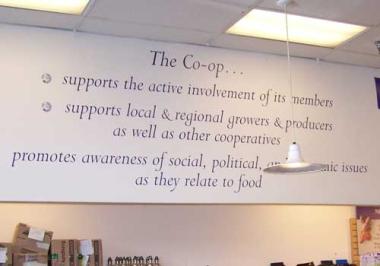
Food co-ops keep consumers' money in the local community, unlike chain supermarkets like Stop and Shop or Price Chopper. The Greenfield food co-op, now Greenfields Market, opened in 1980; the Brattleboro Food Co-op has also been in business for decades, and is the size of a small supermarket. In April 2008, a new food co-op, River Valley Market, opened in Northampton.
Monadnock Farm and Community Connection is a program of the Cheshire County Conservation District in New Hampshire. It has been working to start a food co-op in Keene. On April 2, the Keene City Council voted to spend $5,000 on a Keene food co-op feasibility study, which would cost a total of $21,000. The District has already received a $5,000 grant from the New Hampshire Department of Resources and Economic Development.
The Brattleboro and Greenfield co-ops are located in walkable downtowns, not in strip malls like most supermarkets. There are many other selling points for the Brattleboro co-op. These are highlighted in the store's monthly newsletter, in newspaper ads and on its website. But activist customers and member-owners at the Brattleboro Food Co-op say there is room for improvement, and that they have lessons to teach the new cooperators in the region.
"Our co-op's board needs to start living up to its professed values like transparency and equality," said Richard Davis, who shops frequently at the Brattleboro store but is not a member.
In an interview, John Hatton, a local real estate agent and president of the Brattleboro co-op's board, declined to reveal how much the store's top employee, the general manager, is paid. Hatton has refused requests from the store's member-owners for the same information.
Asked how much the store's lower-paid workers make, Hatton said, "We pay a living wage."
The Vermont Livable Wage Campaign successfully lobbied the state to pass a law that requires the state to publish the state's livable wage and update the figure regularly (the full results are posted at www.vtlivablewage.org.). Assuming that the worker's employer pays 84 percent of the worker's health insurance premium, a single person must make $16.75 an hour to pay for their "basic needs" like food, shelter and transportation, and to pay their taxes.
But according to the workers interviewed for this article, very few employees at the Brattleboro co-op make $16.75 an hour, even if they have worked there for years.
To address that problem, a number of workers at the store tried to form a union in 2003, with the help of community volunteers from the Vermont Workers' Center. The co-op board responded by hiring one of Vermont's largest law firms, Downs Rachlin Martin. Ultimately the Brattleboro effort failed. The board refused to tell member-owners how much of their money it had spent on the law firm.
Schoolteacher Ellen Schwartz has been an owner of the Brattleboro co-op since 1976. "You don't need a lawyer to tell you how to obey federal labor law," she said. "You only need a lawyer if you want to stretch the law to the limit."
During the union drive, the co-op raised starting pay from about $8 an hour to about $10 an hour, according to one worker.
Around the same time that the Brattleboro union drive failed, workers at the food co-ops in Montpelier and Burlington formed a union and successfully negotiated first contracts, also with help from the Workers' Center.
*
"Since the 1960s, the word 'co-op' has been associated with health food," Schwartz said. "But the history of cooperatives is much older. They originated with workers in general strikes in Seattle, San Francisco, and Europe who needed a way to feed themselves during the strikes. It was a peaceful economic revolution—until the National Guard was sent in. That history can remind us why co-ops should be better than Whole Foods."
Schwartz said the Brattleboro co-op rejected her request to post a flier on its bulletin board about an upcoming speech in Brattleboro by United States Senator—and labor activist—Bernie Sanders. "It was not a campaign event," she said. "All the other stores on Main Street that I asked let me post it."
The Brattleboro co-op has been criticized for failing to fully live up to its promise to sell locally grown, organic food.
Even in summer, when local, organic lettuce and peaches are for sale at farm stands and farmers' markets, the co-op sells lettuce and peaches from California.
A farmer in Newfane, Vt., a few miles from Brattleboro, said he tried to sell his local, organic beef to the Brattleboro co-op but was rebuffed. "Now I sell it to Whole Foods in Hadley and Boston," he said. A farmer in Dummerston, bordering Brattleboro, was also rebuffed when he tried to sell local, organic chicken to the co-op.
"Our coolers are full of local meats," said co-op manager Michael Martin in an e-mail. A visit to the store found that claim to be greatly exaggerated. Most of the meat for sale was neither local nor organic.
"If you shop our store in the summer you will notice our produce racks full of locally grown vegetables," Martin said.
Of a proposal to forego charging a profit on local, organic meat, fruit and vegetables, Martin wrote: "Since we sell so much local product, it would be financial suicide to simply sell and not charge a profit. However, we do make arrangements for the local farmers' market to set up and sell their products on Wednesdays during the summer and fall. We don't charge them to do so and we give up valued parking spaces in support of their effort to bring to the community locally grown products."
The co-op allows local Community Supported Agriculture (CSA) farms to post free advertisements at a prominent location in the store for about one month every spring.
*
A final area in which member-owners have criticized the Brattleboro co-op has to do with prices. "If we knew how much they spent on anti-union law firms and executive salaries, and if they really were paying employees a living wage, high prices would be okay," said one member-owner.
On March 24, the cheapest organic rice milk at the co-op was on special sale for $1.99 for a 32-ounce container. The regular price was listed as $3.59. On the same day, the cheapest organic rice milk at Hannaford, a supermarket in Brattleboro, was $1.79 for a container of the same size. That was the normal price, not a special sale. On the same day, the cheapest organic canola oil at the co-op was $12.79 for a 32-ounce bottle. The cheapest organic canola oil at Hannaford was $7.69 for a 34-ounce bottle. Neither was on sale.
"We make it a practice to shop our competition monthly, to watch their advertisements and read their sales flyers," Martin said. "Over and over my shoppers have reported to me that we have them beat in many of the drive items in each category."
Both Hannaford items were Hannaford brand. The co-op's items were not co-op brands. "Having only one store, we cannot buy it at the same price they can with so many locations," Martin said.
One owner-member wondered if the Brattleboro co-op could cooperate with food co-ops around the region to match Hannaford's prices.
Brattleboro co-op member-owners pay a lifetime membership fee of $80 for individuals or $160 for families. The fee can be refunded at any time. Members get a 2 percent discount on all purchases; "working members" get an extra 7 percent off in exchange for 24 hours of work annually. Members elect the board of directors.
This article is reprinted with permission from www.eeshawilliams.blogspot.com.