
Not having known of Dana Roscoe or the possible eminent success of his lofty rail transit goals, I recently took an overnight journey by train from Amherst to Brattleboro with my four-year-old son. (The heartwarming narrative of our mini-adventure can be found in this month's Preview Massachusetts magazine, available for free at many fine newsstands.) We really enjoyed the trip through the wooded hills and farmlands, and I recommended the journey. When I initially heard the trip was likely to be eliminated, I felt defensive on Amherst's behalf.
Last Friday, my wife dropped my son and me off at the train station in Springfield. He and I bought a ticket on the Vermonter to go one stop to Amherst. Fourteen dollars for me, $7 for the child. The train arrived on time, and we left promptly at 3:15, but 100 yards down the track, we came to a halt for 45 minutes that had everyone working their cell phones, letting their rides on the other end know what to expect.
For a long time, the brisk ride east of Springfield ran though a gauntlet of blank walls, warehouses and the backs of strip mall shops, used as a single streaming Technicolor canvas by graffiti artists. There were sandpits, parking lots, dumps, marshlands, a landfill and roads, then suddenly, miles of woods start racing by on one side, a river on the other, all too fast to photograph without everything being a blur. There were beaver dams, backyards, more warehouses and then Palmer.
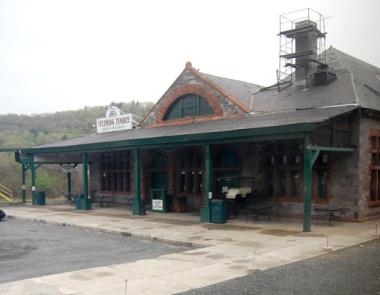
The rail ran right through downtown Palmer. Everything indicated that this was a community that has found identity in the train yard at its heart: the busy restaurant in the renovated former station, the preserved steam locomotive out front, the old men with cameras photographing our train as it passes…
But after a glimpse of this charming scene, our train paused under a modern underpass and my son commented on how many beer bottles were lined up along the track. After a few minutes passed with a steady line of people heading back to the cafe car for refreshments, we started moving again, backwards. There were four or so passenger cars, the cafe car, and two engines, one at either end, and the one that had been in tow behind us from Springfield took the lead.
I'd heard from a few sources that the ride between Palmer and Amherst was prized by local train enthusiasts for the clickity-clack sound the older tracks make [WEB EXCLUSIVE: The sound the train makes can be heard by clicking on the link above, just below the picture] and the beauty of the ride. I was unable to get an enthusiast to fill me on the particulars, but what I saw was less bucolic than I'd hoped. For a long while, the view is largely of backyards and lots, many of them empty and derelict, full of decaying equipment. Even the backs of businesses that were still thriving often had abandoned loading docks with rusty rails running through a clump of briars to join the track we were crawling along on. At least according to the preponderance of forgotten sidings that joined the Palmer-Amherst line, Palmer thrived as a train town long ago when these ghost tracks were alive and feeding the rails with a steady stream of commerce.
The pace picked up near to Belchertown, and there were more woods, rivers and marshes. Stacked along the side of the tracks I often saw mountains of railroad ties, which suggested that money had already gone into improvements. Approaching Amherst, the marshland became expansive and the Holyoke Range loomed through the mist in the distance. On the other side of the marsh, through a thicket, there was farmland, and finally, Amherst College. A bunch of us got off, but the train was still full of many who had been there before my son and I had gotten on for our joy ride. While I envied them the misty hour they had ahead, going through blossoming pastures, narrow, wooded valleys, and over bridges with views of downtown Millers Falls and the Connecticut, I didn't think they'd like to know that on this particular day, the detour to Amherst cost them an hour and a half.