Back in 1988, the Jungle Brothers offered up a very fine disc called Straight Out the Jungle. The music has the expected dose of old-school hip-hop, but the sounds head in an interesting direction, with sampling that borrows from jazz, prefiguring "acid jazz" and "jazz-rap" bands like US3. The often positive messages (from Black is Black": "Judged by both my race and color/ don't you know we need each other?/ I need you and you need me/ if not now you soon will see") and jazzy loops provided a whole new world of possibilities outside the cliches of gangsta rap. They explored that new world with their fellow travellers in the Native Tongues collective, De La Soul and A Tribe Called Quest (among others). There's a sense of exuberance in Straight Out the Jungle that makes it just plain fun to listen to, even 20 years later.
The Jungle Brothers continued releasing new material until as recently as 2002, and while the level of sophistication and the edginess of their sound evolved, the cool aesthetic spanning everything from jazz to house continued, making them historically important to rap and continually vital to moving it into new territory.
One of the Jungle Brothers, Afrika Baby Bam, went on to new projects (over the last few years) in which he expressed his discontent with the state of hip-hop. This led him to found a group called Pagan Society, and to pen opinions tying the underpinnings of hip-hop to a redefined sense of the "pagan":
"Inspired by Afrika Bambaataa of the Universal Zulu Nation I left the streets for a minute to do the knowledge as a brother from the jungle. I came across Rebels without a Pause, Renegades of Funk, Violators, gangsters, thugs, drug dealers, who possee'd [sic] up and rolled Mobb Deep under the Black Moon like an X Clan! OutKast! Public Enemies with a license to ill. Some straight up Pagan shit!
"This thing we call Hip-hop was built on some Pagan shit. Whodini gave us "Five Minutes of Funk." The "Freaks Came Out at Night" and they were all Pagan. Wiln'Out, beef'n, bumrushing, settin' it off, drugs, sex, house parties, punk rockin', orgies, dust, Kurtis "Blow" itchin' for a scratch. All that shit is Pagan. Worshiping the many God's [sic] of Hip-hop—which is polytheistic—is Pagan. Indulging in sensual pleasure like sex, drugs and strip clubs, that's Pagan. Everything is Pagan."
*
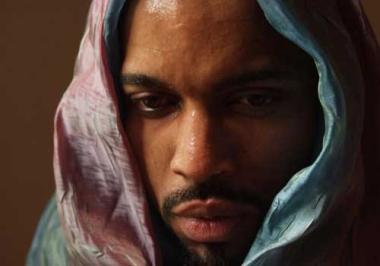
The Valley, a place where pop, folk and metal have provided the majority of musical success stories, may seem a surprising choice of locations for Afrika Baby Bam to inhabit upon moving from Brooklyn. But nonetheless, Baby Bam, who now often goes by his given name, Nathaniel Hall, has chosen to make a new home and a new musical life in Holyoke.
Baby Bam's sense of the Valley is refreshing. As many a newcomer before him, he seems to find it easy to envision the Valley not as a pastiche of far-flung and very different places, but as an easily accessed and tightly packed group of towns. To those of us who have been here a long time, they may seem like extremely different destinations, but Baby Bam is as likely to be found making films in Turners Falls as he is fronting a band in Holyoke.
One of the new directions this Jungle Brother has embraced involves new sounds, created with a live band, Bamboozle, that includes Valley residents B-Boy Danski (drums) and Raulo (keyboards) rather than the usual DJ and MC rap setup.
Visual projects are a key part of Baby Bam's new endeavors, too. He has embarked on playing a series of unusual characters which he then films, characters female and male, normal and even paranormal. He's also produced a "video album" (also called Bamboozle), which he filmed in New Mexico. His embrace of this unusual stable of characters and subsequent Internet posting of photoshoots in drag even led to a negative reception in some less tolerant quarters of the hip-hop community.
But Hall has kept moving, exploring his filmmaking and the new incarnation of his music-making while getting to know the Valley outside the persona of Baby Bam. He's begun a production company (Raven's Claw Productions), a for-profit venture to aid those who want to further their ambitions in the arts and entertainment. We recently spoke to him about his new home and his new projects.
Valley Advocate: How did you end up in the Valley?
Baby Bam: I decided to come up here because I had friends and family up here. It's all here. I've grown—I'm trying as best as I can to go from doing just music to what I'm doing now with film. I'm not the rapper who plays himself in a Hollywood film. I was a personal and a creative spirit before the hip-hop [career] came along. …
The Valley really feeds my soul—it seems like a good film to be in. I'm improvising all the time—filming it, editing it, improvising poetry and music.
I often introduce myself as Nathaniel. This is a good place to have a new face. Not everyone who's into Jungle Brothers could adapt to the Valley.
You're credited with calling the collective you were part of "Native Tongues." What does that term mean to you?
I came up with it because we were like a social group with our own language, with things we'd say—inside jokes, poetic metaphors. We were always coming from our own different perspective. The way we spoke, even the music we listened to, it was like we spoke our own language. It was more organic, not a created group but creative—creative with samples, creative with metaphors.
How about the term "organic hip-hop"?
The music is more and more like fast food—you get it the same way every time. I think of organic hip-hop more like hip-hop that's healthy for your mind. Inspires creativity, different ways of thinking. It's more like homegrown hip-hop.
Why did you decide to use a live band?
About six months ago I decided to give it a try. I wanted to create a more live sound, have more control over dynamics—these guys have a lot of character, too. We're creating a show that's more like a musical. There's more value to a show with visuals, with live musicians interacting with film. It's not like a regular band or a regular show.
Could you tell me more about the Bamboozle video album?
It was shot in Roswell, New Mexico. … There's a video for every song. It's the main concept for everything that I'm doing—I'm giving people something they didn't expect. That's an ongoing project. I'm developing those characters and photographing those characters. It's kind of like punk rock, twisted rock, cool abstract artistic visuals and music.
How will it be released?
I'm working out a deal with Dynamite Records and Sid Vintage in Northampton.
Who do you consider to be your biggest influences?
That changes from time to time—right now, it's Pink Floyd's The Wall, Andy Warhol, and studying music and film.
In the musical project Pagan Society, you rail against a lot of hip-hop. What do you think of where the genre is now?
Hip-hop is thoroughly controlled now. There's a lot of front, a lot of myths—it's about being the top dog. But it used to be ground up. … It's the same thing as mom and pop stores pushed out by big-box corporations.
You're using the term "pagan" in a new way. What does it mean to you?
To me it brings it back to the native, the essence of man—what was society before religious organizations, before the corporate? I felt like that was a perfect word to describe people who are free spirits, open-minded, with no hangups, people who do not identify themselves with mainstream culture, people who are being themselves. … It's not religion—I'm trying to point back in history in a clear way, saying this is what we were, compared to what a lot of us are now. It's coming from an enlightened perspective.
You have a lot of different characters in the photos on your site—are these different aspects of who you are, or do you see them as just roles?
A bit of both. I do have different ways of thinking, different personalities. I guess it's something natural. But sometimes I do find when I'm taping and I touch on a current event, I'm speaking [only] from the character's point of view. Like the character Lucy—she thinks the whole Chris Brown and Rihanna thing is a hoax. She doesn't care about Rihanna or Chris Brown. She knows she's a freak, but she's calling them freaks.
Lucy doesn't know too much about Rihanna. Personally, I would have to do more research.
Is there a guiding principle in your many projects?
Trying to show creativity, show that it's endless. I'm not limited by Afrika Baby Bam, not limited to that. I have eyes for other things in art—for fashion, character development. There's more to me than writing rhymes, recording them and recording albums.
I don't mind showing people I'll wear a dress and makeup, then I'll look like somebody serving ice cream, then look like a reptilian creature in the rain forest. People will pick one thing—he's a cross-dresser! He's gone crazy! People see something that doesn't match the music, and they're outraged.
The video album Bamboozle is available at Dynamite Records and Sid Vintage in Northampton. To see video clips of Bamboozle or Baby Bam in character, check out Raven's Claw Productions on the Web at www.ravensclawproductions.com or www.myspace.com/ravensclawproductions.