Massachusetts is blessed with many magnificent bridges crossing the Connecticut River.
In Springfield, there's the Memorial Bridge with its towering sconces perched upon mighty white pillars. In Northampton, the Calvin Coolidge Bridge's Art Deco eagles welcome drivers to share their aerie for a moment with its breathtaking views of the Holyoke Range. Turners Falls has its Avenue A bridge spanning the powerful falls, and up the road, between Gill and Erving, is the French King Bridge, with its steel deck stretching 140 feet above the river. In 1932, the year it was opened to traffic, the American Institute of Steel Construction named it the "most beautiful bridge" built in America that year.
But the fairest bridge in all the Pioneer Valley is not the tallest, longest or most prominently placed. The Schell Bridge, built in 1903, is a small, unassuming bridge, built not for speed or for industry, but built as a gift to unite a geographically divided community.
These days, unless you're on a boat on the river or in a airplane flying overhead, there are only two places this enchanting span of steel can be easily seen. One is to be sitting on the correct side (right heading north, left going south) of the Amtrak Vermonter traveling between Amherst and Brattleboro: the train crosses a rail bridge in Northfield just south of the much more attractive crossing. On foot, the only place to see the Schell Bridge easily is by standing near the water at the public boat launch just north of town.
Otherwise—unless you've figured out which unmarked road to follow, gotten out when the road fills with foliage, and then trekked by foot through the overgrowth, thick with poison ivy, to where the bridge touches down on either side of the river—it is invisible.
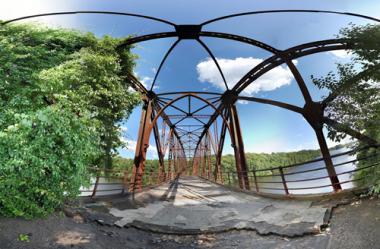
In 1987 the town decided it could no longer afford maintenance on the bridge and voted to demolish it. Two massive steel plates sealed the ends of the bridge. More than 20 years later, the bridge stands cocooned in vines waiting its fate. Some want to see the demolition vote rescinded and the bridge returned to use. Others vehemently disagree. Both philosophically and geographically, since the bridge closed, the town has become divided again.
*
When Northfield native Dwight L. Moody spoke, he attracted crowds.
Big crowds: not hundreds of people, or thousands, but tens of thousands. In the 1860s and '70s, before there were football stadiums, the Evangelical minister was preaching to arena-sized audiences on both sides of the Atlantic. When Moody decided to establish a seminary in his hometown in 1878, said Marie Ferre, current chairman of the Northfield Historical Commission, "the town became the center of the universe."
In its day, the seminary and school Moody built were as important and transformative to the town of Northfield as William Gates' Microsoft has been to the town of Redmond, Washington. The preacher's offices had been in Chicago, and he had been lobbied hard by the wealthy locals to set up his headquarters there. He had other options, too. He was also admired in England and Scotland, and he had an ardent following in Europe, especially in Sweden. Spending so much time in transit on speaking engagements, though, he felt his base needed to be somewhere he could relax and revive himself. Where better than home?
So when Moody wasn't traveling elsewhere, the world came to him in droves. Toward the turn of the century, Ferre said, there were up to 40 train stops every day in the Northfield station, and the enormous hotel that once stood in town was often booked solid. Many of the country's wealthy and influential spent their summers there, including Francis Schell from New York. He was so taken with Moody's work that he built an immense chateau near the Northfield seminary where he could lavishly entertain while he studied scripture. In addition to the chateau, Schell made many financial contributions to Northfield and to Moody's work. His most lasting and possibly important, though, was a bridge.
Northfield has the dubious distinction of being the only town in Massachusetts to straddle both sides of the Connecticut River. Though the town hall, library, post office and shops along Main Street are all on the east bank, many Northfielders live on the west bank. People on the west side who want to buy a slice of pizza or pick up their mail need to drive eight miles out of their way to travel a few hundred yards east.
In Dwight Moody's day, this geographical inconvenience meant the thousands who were arriving to the "East Northfield Station," which was actually on the west side of the river, were also forced to take a less than direct path to cross the river to the seminary and the school. In those days, visitors headed back down the tracks to the train bridge and crossed on a pedestrian and carriage path that had been rigged a level down, underneath the rails. Apparently it was an unpleasant, dingy path, made even more so if a smoking steam engine happened to pass over it while you were underneath. It certainly did not befit the vision the school, the seminary or Schell had of the spiritual work being done in Northfield. In 1901, the wealthy capitalist gave the town $60,000 to build a bridge worthy of the setting.
Designed by the engineer Edward S. Shaw, who was responsible for bridges across the country, the bridge was initially to be a basic truss bridge, which is considered the most efficient and economic. Many covered bridges are truss bridges: a road between two points with struts and bracing encases them, keeping them up and protecting them from the wind. While there are many attractive truss bridges, many look as if they were a crude solution, dropped into place like a plank over a stream. But when Schell decided the bridge would also act as a memorial to his parents, the design was upgraded to a cantilever steel truss bridge. A cantilever is a structure that extends horizontally outward and is only anchored on one end. Typically, cantilever bridges are used to span much wider spaces than the narrow bend in the river that the Schell Bridge occupies, and it's one of the reasons many admire the Northfield bridge.
Balanced on two mighty stone piers, the Schell Bridge has nothing crude about its design. Instead of looking plunked down, it springs across the water effortlessly in a graceful bound. Rather than thick, straight cross-beams and bracing, the arc of the bridge's path blends in with the rolling hills and curving river.
These details can be seen from a distance, but to understand the bridge's real impact, you need to get up close.
Most bridges built for automobiles are integrated into the road system in such a way as to be as unobtrusive as possible: roads enter and exit bridges in a straight line. Driving at night, you might not even know you'd crossed one. The Schell Bridge was built for horse-drawn carriages and pedestrians, though, not for cars. The roads approaching it on either side meander, first taking travelers away from the bridge, and then turning back, approaching it from along the banks and offering a good long look at the span travelers are about to cross.
There are only five other bridges in the country that have similar engineering, but the Northfield bridge is unique in its strong gothic revival aesthetic. Flower shapes like those carved into pews are cut into the steel plating, and the arches over each entrance are detailed similarly to the structure of a stained glass window. Just inside, portal braces arch overhead and meet in a point, much as they would above a cathedral's doors and windows. In fact, standing on the bridge and looking through its steel work at the sky, hills and river, it becomes clear that the intention was to make travelers feel as if they were, indeed, in a sort of cathedral as they crossed the bridge. Instead of murals, stained glass and statuary filling the space between the load bearing shafts and the ribs of the vaulted ceiling, there are the banks of the Connecticut River. As travelers reached the bridge's midpoint, the campus for Moody's school and seminary appeared on a hilltop to the north.
*
Built for horse-drawn carriages and pedestrians, the structure was steel, but the road was made of wood. The base was made up of thick, tightly-packed beams, and then it was covered in blocks of wood acting as cobblestones. Today, less than an inch of asphalt covers that. Despite early intentions, the horse bridge spent most of its 84 years as a two-lane bridge for automobile traffic. Cars, school buses and even logging trucks all crisscrossed it, and it must have been a tight fit. The decking was improved in 1932; in 1977 other updates were recommended. Schell's generous gift didn't include the cost of ongoing maintenance, and under such heavy use, the bridge deteriorated more quickly than it might have.
In 1987 the Northfield Select Board held two votes on the fate of the Schell Bridge.
The first one enthusiastically endorsed doing whatever was necessary to save the bridge. According to historian and president of Friends of Schell Bridge Marie Ferre, the cost of repairing the bridge was re-emphasized to the board, as was the possibility that if the bridge collapsed (some said this was imminent and would occur with the next serious snowfall), the town would be liable for the cleanup to the tune of nearly $2 million. However much people wanted to keep the bridge, there simply wasn't enough state and federal funding, their argument went, especially given how many other pressing needs the town had. With considerably less enthusiasm, the board voted a second time for demolition. Then the state transportation department would pick up the tab for taking it down, and it was no longer the town's responsibility.
State engineers came and looked at the bridge to make recommendations for its dispatch, but Sue Ross, the vice president of Friends for Schell Bridge, said she thought their hearts weren't into it and they were offering their advice without conviction. "Engineers love the bridge," she said. The ones from the state said the most affordable option would be to blow it apart with explosives, and then pick the bits out of the river below.
Much of the town of Northfield is a historic district, and the bridge is covered in that designation. Being such, the Massachusetts Historic Commission's consent was required before the bridge went to meet its maker. Dumping it in the river was unacceptable, they said; it would need to be meticulously disassembled, which was obviously not the most affordable solution.
*
More than 20 years and many snowstorms later, the bridge still remains standing. So does the faceoff between those in favor of preservation and those against.
The documentary video "Both Sides of the Bridge" was recently produced by Kevin Murphy and Bill Marcy for Bernardston Northfield Community Television, and it documents the issues involved and includes interviews of supporters from both sides. Jack Spanbauer of the current Northfield Select Board reiterates the cost and liability issues, adding that if the bridge fell before it was demolished, local taxpayers might see a substantial increase to cover the costs.
"I don't want to sound pessimistic," he says, "but it took 20 years to get design funds for the sidewalk … that is $108,000, I think. We're hoping to get the million dollars for construction, but if that happens, it will be 25 years [since the process began]." He pegs the cost of demolishing the bridge at around $2 million dollars, but preservation costs at between $10 and $25 million.
Also interviewed in the video is Andy Harrison, a Northfield resident and teacher who works in New Hampshire. "My biggest issue is that I think we have a lot of bigger things in this community to take care of, one of which is the Pioneer Regional High School," he says. "We have a relatively new, refinished high school, but like anything, it needs to be taken care of. For the past five years, we have tried to pass more articles to maintain the building as it currently is, and those articles do not get passed. And it seems to me it's ridiculous that we're trying to spend all this time and energy on something that's falling apart when we can't spend the same time and energy on something that's literally brand new."
Though as a social studies teacher, he said he recognized the bridge's historical value, he added, "We're not even taking care of the school. I mean, we're going to take care of past generations, and we're not going to take care of future generations? In a luscious economy, where everything was green, I'd be all for it. But now, I'd have those people who are spending so much time and energy [to save the bridge] to think of their children and their grandchildren."
For their part, the Friends of Schell Bridge remain undaunted. Interviewed by the Advocate, Ferre, Ross and Jenny Tufts, the executive director of the group, said they understand their neighbors' reluctance and inability to pay for the bridge out of local tax dollars, and they've incorporated into a nonprofit with the mission of finding state, federal and private funding to restore the bridge and maintain it into the future. They don't see saving the bridge as taking away from other local funding efforts, but rather enhancing them by drawing attention to the historic town.
"It's always seemed to me that Northfield's left out of a lot of Pioneer Valley planning," Sue Ross said. "Regional planners seem to get up to about Turner's Falls and Barton Cove, and then they stop. We feel like we've been making up for lost time, letting people know not just about the bridge, but the area on both sides that it will link up."
The Friends of Schell Bridge have taken out office space on Main Street on the east side of town, and with a full-color master plan that clearly documents a vision for the bridge, they have been actively looking for partners and grants. They've been finding both.
"We really want to balance historic preservation with 21st-century uses," Jenny Tufts said. "In addition to connecting the town, it's seen as a central connection for a tri-state network of bike paths. The upgrades that would be required to make it safe for pedestrians would also make the bridge stable enough for occasional use for emergency vehicles. A lot of people don't think of us this way, but this is a river town, and the bridge would help connect people to the water front which now is pretty much hidden behind the overgrowth. It would be an ideal place to learn about the watershed, local ecology and the different fauna unique to the region."
The Friends envision the bridge being a center piece in a local network of trails along the river, including paths along the Mill River and into lands near the local golf course. To achieve these lofty goals, they're taking things one step at a time.
Ferre and the Friends of Schell Bridge recently completed and submitted a highly detailed application to put the bridge on the National Register of Historic Places, and they're expecting to hear whether or not the application is accepted by February, 2010. The designation wouldn't affect the town's demolition vote, but could be helpful in fundraising and marketing the group's cause. In 2003, through the Friends' advocacy, the bridge was included on the list of the top 10 most endangered historic sites in Massachusetts, and they have used that to raise funds for the first stage of their plan: paying for a professional engineering study to be done that estimates the cost for accomplishing their goals. Several years ago Smith College conducted an informal student study, and under professional guidance, they determined the bridge's structural integrity was sound and salvageable, but the bridge has not yet been professionally analyzed with a specific reuse plan in mind.
Even with the bridge slated to be demolished, considerable work can be done by the Friends to promote returning the historic bridge to use. But to avoid the wrecking ball and actually start preservation efforts on the bridge, at some point the town Select Board will need to rescind its decision with a third vote on the issue. While the Friends are confident they can one day raise the money to save and maintain the bridge, they're still a long way from having an endowment large enough to assume liability for it.
"Until we have the logistics and funding in place to assume responsibility for the bridge and eliminate the liability problem," Ferre said, "we're not going to ask the board to revisit the issue."