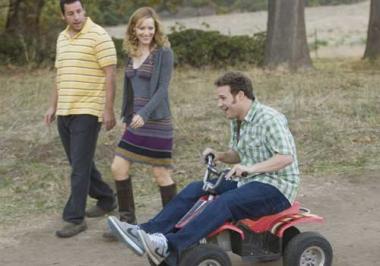
Funny People
Written and directed by Judd Apatow. With Adam Sandler, Seth Rogen, Leslie Mann, Eric Bana, Jonah Hill, Jason Schwartzman, Aubrey Plaza, and RZA. (R)
Any film connected to Funny People director Judd Apatow promises a few sure things: raunchy, juvenile humor; grown men with a stunted emotional side; and an unexpectedly warm-hearted look at the many modes of male bonding. What none of his previous films have been—and since 2004 he has been involved in the making of at least a dozen comedies that mine a similar vein—is too terribly adult.
That changes dramatically, if you will, with Funny People, a film that so reflects Apatow's world view that it allows him the chance to include his own home movies in the opening scenes. For Apatow, funny people aren't simply people who crack jokes; they are their own society, as insular and impenetrable as a cult, gifted with their own means of communication—people who can create entire conversations built on quoting episodes of The Simpsons. That others might find them funny is almost incidental; for them, it's simply how they live their lives.
George Simmons, played by a knowing Adam Sandler, is one of those people. A wildly successful comedian who has parlayed early fame into a series of family-friendly films—I'm talking here about Simmons, but the connection to Sandler should be obvious—Simmons lives alone in an oceanfront mansion, where he slouches around in sandals and leisure wear, an overgrown kid tired of his candy store.
It's an old bit of conventional wisdom that comedians are, at heart, lonely people—the sad clown—and when Simmons gets the news that he has a rare type of leukemia, Apatow (who also wrote the film's screenplay) takes a big risk, chancing that the story won't devolve into an easy sentimentalism, and it pays off. Even as George digests his diagnosis, his natural impulse is to make fun of his doctor's Germanic accent. "I enjoy your movies," he tells the surprised doctor. "Which movies?" "The ones where you try to kill Bruce Willis." It's a great line, made more so because it can't quite cover up the aching isolation George is feeling as he delivers it.
Looking for comfort, George retreats to the closest thing he has to family: an audience. Dropping in for a round of stand-up at the Improv, he meets Ira Wright (Seth Rogen), a talented but unconfident young comic whose set is bumped when the celebrity George arrives. Their initial meeting is less than perfect—George tries to run down Ira with his SUV—but the next day a calmer Simmons calls to offer Ira a job as a joke writer and personal assistant. It's a dream job for Ira, and a way out of the crowded hothouse of an apartment he shares with fellow comedian Leo (Jonah Hill) and low-level sitcom star and lady-killer Mark (Rushmore's Jason Schwartzman, who also composed much of the music for the film).
There's something of Sunset Boulevard in their ensuing relationship, especially as Sandler watches old footage of his act in his lonely mansion. (The home movies that open the film were shot by Apatow when he and Sandler roomed together as neophyte players on the L.A. scene, and the film is populated by a number of comedy club legends appearing in cameos.) But Funny People rarely gets as dark as Wilder's Hollywood noir, opting instead to focus on the good that comes from two isolated people finding each other, and as George and Ira come together as a team—one wonders if Apatow is a fan of the Gershwin brothers—their growing bond has an air of genuine warmth, though one most often conveyed by a steady string of putdowns.
A bit less convincing is the film's third act, where George, convinced of his imminent death, becomes transfixed by the memory of an old girlfriend. Laura ditched a philandering George years ago and married the philandering Clarke (an inspired Eric Bana), with whom she has two children. (In a further moment of art imitating life, Laura and her children are played by Apatow's wife Leslie Mann and the couple's two daughters.) As George pursues his old flame, the film loses some of its sting, and feels more like an older, more formulaic Apatow story. But even with that misstep, he never lets Sandler's character off the hook, and never allows him to transform into something he shouldn't, couldn't be.
*
Also this week: Pleasant Street Theater screens Humpday, an independent comedy about male bonding run amok. Written and directed by Lynn Shelton, it stars Mark Duplass and Joshua Leonard as Ben and Andrew, college friends who reconnect when Andrew unexpectedly arrives at the house Ben now shares with his wife Anna. A self-proclaimed traveling artist, Andrew drags his old friend to a party where a group of artists are making plans to enter films in an amateur pornography contest. Drunk, and drunk on an old sense of rivalry, the pair announce their intention to enter the contest with a film of their own: the story of two straight men having sex together. "It's not gay. It's beyond gay," they explain. "It's not porn. It's art."
When the two sober up, their boundary-crossing plan seems a bit less enticing, but neither is willing to back out before the other. Presumably, much of the tension for audiences—comedic or otherwise—is derived from the question of will they or won't they, but for one of the men, another question should be at least as important: who will tell his wife? Despite its suggestive title, the film doesn't play for easy or homophobic laughs; writing in The New York Times, Stephen Holden calls the film "queasy making, kindhearted and unfailingly truthful."
Finally this week, Northampton's Academy of Music presents Money-Driven Medicine, a behind the scenes look at America's "medical marketplace" from Alex Gibney, the director of the Oscar-winning Taxi to the Dark Side. Inspired by the book of the same name by Maggie Mahar, Gibney's film asks a series of hard questions: Why are 15 million people injured every year in American hospitals—the very place they go to heal? And what are Americans, who spend almost three times as much on healthcare as other developed nations, getting for that premium?
The answers, Gibney suggests, lie in our corporate, profit-driven medical system, where the seemingly backward idea of a fee-for-service model means that doctors are rewarded for doing more procedures, sometimes at a risk to patients who don't understand the system. In exploring his thesis, Gibney visits rural health clinics, suburban hospitals, and major figures in the call for healthcare reform. Money-Driven Medicine screens at 7 p.m. on Saturday, Aug. 8. As a self-employed writer in an era when good health insurance is getting harder and harder to come by, I can attest that it's nothing to sneeze at.