
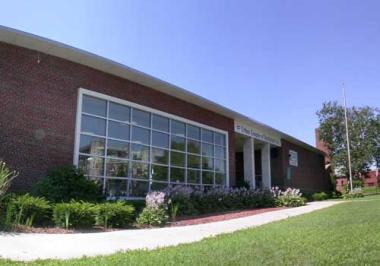
A government land-taking is invariably sticky business, filled with the drama of angry landowners, threats of litigation, nervous politicians.
That's certainly the case in Springfield, where the city appears poised—perhaps—to use its power of eminent domain to take the Urban League's headquarters at 765 State Street and turn the building into a branch library for the Mason Square neighborhood. That site was, in fact, the neighborhood's library until 2003, when the Springfield Library and Museums Association—the private organization that ran the city library system at the time—sold the building to the Springfield Urban League in a secretive deal executed with no public input or notice.
The Urban League moved from a seedy building across State Street to a beautiful space that had undergone a $1.2 million renovation just 18 months earlier. Despite that extensive work, the Urban League paid just $700,000 for the building. Springfield taxpayers, meanwhile, were left to pay off $575,000 in city bonds that helped finance those renovations. And the Mason Square branch was reduced to a significantly scaled-down version, crammed into a small space in what is now the Urban League headquarters.
Under former Mayor Charlie Ryan, the city began searching for a new home for the branch, to be funded, in part, by a $334,000 settlement then-City Solicitor Pat Markey won after suing the SLMA over the sale. As it became increasingly clear that a suitable, affordable spot couldn't be found, more and more voices began calling for the city to exercise its power of eminent domain and simply take the old building.
As public support for a land-taking grew, so did institutional support. The Springfield Library Foundation (a nonprofit that controls a trust fund dedicated to library services in Mason Square) and the city Library Commission both voted to back a taking, while the City Council passed two non-binding resolutions in support. Mayor Domenic Sarno, however, was less enthusiastic, and movement on the proposal stalled for months.
Last week, however, the effort received a new burst of energy when the Library Foundation approved a contract with the city that could kick off a land taking. Under the contract, the Foundation would reimburse the city for the cost of taking the property, as well as for any resulting legal costs, and would contribute to operating expenses at the branch for three years.
But that's only part of the battle. A land-taking also needs the support of the City Council, which is scheduled to vote on the matter later this month. That means city councilors will face their own sticky decision, made stickier by the fast-approaching election: do they listen to residents who are eager to see the restoration of the library? Or do they side with the Urban League, whose politically connected president, Henry Thomas, has vowed to fight a taking?
*
In theory, an eminent domain battle could be completely averted. Before any move is made toward a taking, the Library Foundation has authorized attorney Jack Egan, a local eminent domain expert hired by the group, to approach the Urban League with an offer to buy the building. At deadline, the Foundation was awaiting a response.
Henry Thomas did not respond to an interview request from the Advocate. But in previous news reports, he's said he won't give up his building without a fight. "It's a poor use of eminent domain powers," Thomas told the Springfield Republican in January. "It is unconscionable to think that the city would even think of dislocating the Urban League services. We're prepared to protect our rights."
But Markey, who now serves on the City Council, is confident the city would win a legal challenge by the Urban League. Such challenges are often based on the argument that the land-taking does not serve a public purpose, a standard that must be met for a government taking. In recent years, Markey noted, courts have allowed broad interpretations of "public purpose"—most notably, in a controversial 2005 U.S. Supreme Court decision that allowed the city of New London to take private homes to build a waterfront complex of office buildings and pricey condos.
In that context, Markey said, "It would be virtually impossible to argue before a court that a library is not a public purpose."
In other cases, landowners have sued, claiming that they did not receive adequate compensation for their property. Here again, Markey feels confident that the city could withstand such a challenge, thanks to an agreement signed by the Urban League, the SLMA and the state Attorney General shortly after the 2003 sale. That agreement—which was not disclosed at the time, and was unearthed last year when Markey made a pubic record request to the AG—set a cap on what the Urban League could charge if it ever sold the building.
Under the terms of the agreement, if the Urban League decides to sell the property, the city (which took over the library system from the SLMA shortly after the Mason Square sale) would have the right of first refusal. If the city did opt to buy the building, it would have to pay no more than the $700,000 the Urban League paid for it, plus an additional sum based on Consumer Price Index increases since 2003 and on any improvements the Urban League had made to the building.
While Sarno initially questioned the validity of the agreement, the city Law Department subsequently issued an opinion that it was, indeed, valid. City Solicitor Ed Pikula told the Advocate that the Law Department recently received a city-ordered appraisal on 765 State Street which he would now bring to the mayor, City Council and Library Department.
That appraisal, for $802,000, is based on the terms of the agreement brokered by the AG, Markey said. A second appraisal, based on the current real estate market, found the building's worth to be $850,000, he added. That second appraisal could be used if the AG agreement is found to be invalid—something Markey said he doubts would happen.
Nor, Markey believes, could the Urban League argue in court that the city's move to an eminent domain taking is capricious or politically motivated. The city, he noted, underwent a lengthy and thorough process to find an alternate site for a Mason Square library. Under the Ryan administration, a search committee (on which Markey served) evaluated a number of buildings in the neighborhood, including Muhammad's Mosque #13, the old Mason Square firehouse and a former funeral home across State Street. In each case, the building was found either to be structurally inadequate, prohibitively expensive, or both.
*
While Markey and others believe an eminent domain taking would survive legal challenges, the process still faces significant political hurdles.
A land-taking would still need two crucial approvals from the City Council. At its August 24 meeting, the Council is expected to vote on whether the city should take the land; to pass, the measure needs a simple majority of five votes. In addition, councilors will vote on whether to appropriate the money necessary for the taking (which would subsequently be reimbursed by the Library Foundation). Because it is a financial order, that measure would need the support of six of the nine councilors.
The Council has twice approved non-binding resolutions in support of a land-taking, in both cases by a vote of five to four. This time, the vote would have more import—particularly with elections just three months away.
Based on those earlier votes, Councilor Tim Rooke, who's been a champion of the eminent domain idea for a couple of years, is counting on another solid five votes this time: his own, Markey's, Rosemarie Mazza Moriarty's, Jose Tosado's and Bud Williams'.
For Williams, who is challenging Sarno for the mayor's seat in November, the Mason Square library is shaping up as a promising campaign issue. Interestingly, in 2003, as SLMA leaders were quietly planning the sale, Williams was among a small group of politically connected people handpicked by Thomas and David Starr, president of the Republican newspaper and a longtime SLMA board member, to be privately informed about the plan.
In a deposition taken as part of the city's lawsuit against the SLMA, Starr testified that these "important people" were selected from "the black community" (Mason Square has a large African-American population). "[T]he purpose of the meetings was to say to them that we were going to have to do this," Starr said. If Williams had any objections to the plan then, he certainly didn't voice them publicly.
At the time of the earlier votes, Councilors Kateri Walsh and Bill Foley indicated strong opposition to taking the building by eminent domain. Councilors Bruce Stebbins and Jimmy Ferrera, both of whom voted against the proposal in the past, are regarded as potential swing votes who could tip the balance toward a taking.
Ferrera told the Advocate that he does not oppose a land-taking on principle, but is concerned about the potential economic effect on the city and has questions about who would pay for the taking and relocation costs for the Urban League, legal costs and operating expenses at the branch. "I just want to make sure the city's covered in these tough economic times," said Ferrera, who said he'd make a decision after reviewing the most recent financial information.
Foley, too, has said he's concerned about whether the city would be on the hook for these expenses. (Foley has expressed a desire for the Urban League and the branch library to share 765 State Street. That suggestion has generated little if any enthusiasm; the two have shared the building for six years now, to the great dissatisfaction of many residents.)
The contract approved last week by the Library Foundation should, presumably, answer Foley's and Ferrera's concerns. According to the contract, the Foundation would reimburse the city for all costs related to an eminent domain taking, including property appraisals, legal expenses and relocation costs.
In addition, for the first three years of operation, the Foundation would help cover expenses at the newly expanded branch, providing the difference between what it now costs the city to run the small branch housed within the Urban League and the cost of operating a full library. The Foundation would also pay for any capital improvements needed for the library during that time period.
*
In the past, Sarno has opposed a taking. "I'm not crazy about eminent domain," he told the Advocate last year.
Sarno had earlier proposed another idea—buying Muhammad's Mosque #13, just down the street from the Urban League building, and turning it into a library. That plan, however, met with a generally cool reception, thanks to the attached price tag: in addition to the $950,000 Sarno proposed to pay for the site, the building would have required more than $3 million in renovations, according to an architectural study. City assessors have placed the building's value at $400,000.
Complicating matters is the fact that Thomas, the Urban League president, is a political supporter of Sarno's. Campaign finance records show Thomas gave the mayor a $500 donation (the maximum annual contribution allowed by a donor) last summer, as the eminent domain battle was heating up. He also made a $100 donation to Sarno this April.
Thomas has also made contributions to several sitting city councilors, most recently a $100 donation to Ferrera in April. Records also show Thomas made a $200 contribution to Williams last year, and gave Tosado $100 in 2006.
Earlier this year, Sarno told the Advocate that Thomas' campaign contributions would have no effect on his decisions about the Urban League building. "That's a moot point," the mayor said. "I'm going to do what's best for the city."
When the Advocate asked the mayor's office how Sarno now feels about an eminent domain taking, his spokesman referred questions to the Law Department. Sarno will need to sign off on the Library Foundation contract, which was prepared with the cooperation of his Law Department—a promising sign that perhaps the matter will finally move forward.
After more than six years without a proper library in the neighborhood, Kat Wright, a member of the Mason Square Library Advisory Committee, is more than ready to see that happen.
"Over all this time, more and more folks in the Mason Square community have raised their voices and their objections to the loss of our neighborhood library and the occupation of the library building by the Springfield Urban League," Wright said. And they've been backed like leaders like Ryan, former City Councilor Mo Jones, and community activists Ida Flynn and Ruth Loving, she added.
"[We] are gratified that our ranks have been reinforced," Wright said. "When the people speak with passion, the powers that be had better listen."
Now it's time to see if the City Council will listen, too. "[V]ery soon, Springfield politicians will have the opportunity to do the right thing," said Liz Stevens, another member of the neighborhood library committee. "They will have to put their cards on the table."