
In The Loop
Directed by Armando Iannucci. Written by Jesse Armstrong, Simon Blackwell, Armando Iannucci, Ian Martin, and Tony Roche. With Peter Capaldi, Tom Hollander, Gina McKee, James Gandolfini, and Chris Addison. (NR)
In The Loop, a scathing (and scathingly funny) new film about the people who trod the corridors of power, often seems touched by the comedic spirit of Ricky Gervais, the hilariously inappropriate genius behind the original BBC version of The Office. Documentary-style camera work records a group of ostensibly professional people who are revealed to be witless, easily manipulated fools more concerned with their image than their job. The difference is that the people portrayed in In The Loop aren't working in a paper office: they're running the country.
Armando Iannucci's film is built on the foundation of his own BBC series The Thick of It—think The West Wing dosed with a British sense of humor that is equal parts acid and dry. Fast-paced (much of the action takes place in those corridors of power, with people on the move) and laced with profanity, it's an outrageous take on the behind the scenes shenanigans of government at work—until all at once, and scarily, it doesn't seem that outrageous at all.
The action turns on a single word—"unforeseeable"—uttered by hapless Cabinet Minister Simon Foster (Tom Hollander) when asked during a radio interview about the possibility of a war in the Middle East. Called to the carpet by his superiors, he fumbles his televised spin session and inadvertently sets the wheels in motion for a joint British-American call to war.
Leading the charge is Malcolm Tucker (Peter Capaldi), Director of Communications for the Prime Minister's office. An attack dog with the lean, smoked look of beef jerky, he snarls and snaps his way through his days, leveraging his proximity to the Prime Minister for political clout. When Foster lays an egg, it's Tucker who comes raging into his office to get him back on script and explain that he's already been in touch with the PM. When someone questions that fact, he hisses that "whether it's happened or not is irrelevant!"
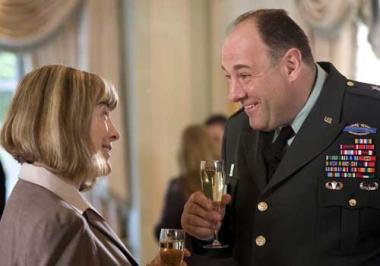
Sent to America to sit in on a series of pre-war discussions with the State Department, Foster and his young aide stumble their way through a mess of internecine squabbles involving an American general and two government officials until Tucker comes to save them. Pawns in someone else's game, they're in over their heads but don't realize it. Nobody in In The Loop ever realizes it: everyone is too busy thinking about looking good to do much else.
Everyone, that is, except Capaldi's Tucker. Calling such a seething, bilious character the heart and soul of a film might seem odd, but that's just what Tucker is—for all his vein-popping, he often seems to be the one person truly interested in his work. Without him, In The Loop would be a fairly amusing but blunt satire about the inner workings of world affairs—Iannucci's one real weakness is that at times he seems a little too enamored with the society he hopes to satirize. With Capaldi, the movie has teeth, and enough bite to leave a mark.
*
Also this week: Films new and old return to the silver screen at the Academy of Music in Northampton this weekend. The venerable venue has the best screen in town, and seeing a movie there, ensconced in a velvety seat, the elegant loges looming above you, is an experience in itself. Those romantic '40s-era stories, where a young couple in love sit in the flickering dark of a palatial moviehouse? That's the essence of the Academy. Sadly, nightly screenings at the venue are a thing of the past, making the theater's occasional special shows all the more special.
On Friday night, they present two screenings of Sugar, a story of immigration and baseball fever from the creative team behind Half Nelson and the upcoming Special Topics in Calamity Physics. The film describes the arc of one young Dominican—Miguel "Sugar" Santos, played by the talented newcomer Algenis Perez Soto—whose entire life has been structured to produce a single goal: a shot at big league ball in America. Sugar and his friends attend American-sponsored "baseball academies," where in lieu of a formal education, they're groomed in the ways of the Stateside game (including how to craft a good sound bite for the media).
When Sugar's pitching arm draws the interest of the American scouts, it seems that his dream is on the verge of coming true; the harsher reality of farm-team life in the States—in particular, the crushing isolation that results from the language barrier—is yet to come. When it arrives, Sugar, who has already watched the system chew up and spit out one of his friends, begins to question the narrow-minded focus of his goals, and wonder if there isn't another path to success on his own terms.
2009 marks the fortieth anniversary of a cultural revolution in microcosm: Woodstock. To commemorate the event, the Academy is presenting two Saturday screenings of Michael Wadleigh's Oscar-winning 1970 documentary about the infamous concert festival. Though the featured musicians, with names like Jimi, Janis and Arlo, form a Who's Who of the counterculture, it's the "400,000 other beautiful people," as one poster puts it, who are the real stars of the film.
Far more than a mere concert film, Woodstock covers every aspect of the festival, from initial preparations through the massive cleanup that was its aftermath. Along the way, Wadleigh's cameras focus on both the good and bad that naturally arises in an impromptu city of half a million people—including the surprise sight of National Guard helicopters descending on the crowds to dispense food and medicine to the ragged horde. With Ang Lee's fictionalized Taking Woodstock arriving in theaters soon, it's a fine time to see the real thing.
Also worth seeking out is The Hurt Locker, which continues its run this week at Amherst Cinema. What The New Yorker's David Denby called "the most skillful and emotionally involving picture yet made about the conflict" focuses on a subset of soldiers whose work is so intrinsically dramatic it's surprising more films haven't been made about them: the soldiers who defuse the explosive devices hidden by their enemies.
Directed by Kathryn Bigelow from a script by first-time screenwriter Mark Boal, the film is less a classic war movie than a study in sustained tension. The characters in The Hurt Locker are fighting a new kind of war in hostile land, surrounded by people who certainly distrust them, and may want to kill them—it's not knowing who is who that takes the greatest toll. For verisimilitude, the film was largely shot near the Iraqi border in Jordan; in a darkly ironic twist, the Iraqi roles in the film were filled by refugees who were forced to flee their country because of the actual war just miles away.