
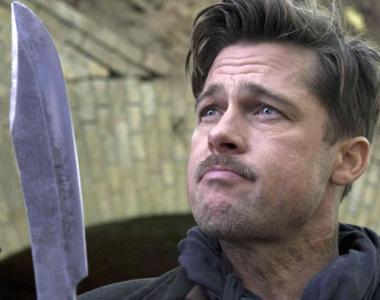
Inglourious Basterds
Written and directed by Quentin Tarantino. With Brad Pitt, Melanie Laurent, Christoph Waltz, Eli Roth, Michael Fassbender, Diane Kruger, Daniel Bruhl, Til Schweiger, B.J. Novak, Omar Doom, August Diehl, Mike Myers, and Julie Dreyfus. (R)
If you've seen Pulp Fiction, director Quentin Tarantino's award winning 1994 tour de force, you might remember a scene where the gangster's wife Mia, played by Uma Thurman, is chiding Vincent, the overly protective bodyguard/henchman portrayed by John Travolta. The pair are on their way to dinner at a '50s style diner, and Mia, chafing under the constraints of life as a kept woman, implores Vincent to stop being such a square. As she says it, her hands trace the shape's outline in the air—actually, she describes an oblong rectangle, but you get the idea—and as her fingers limn the perimeter, a dotted outline appears in their wake, hangs in the air for a moment, and then disappears like a cartoon dream in a soft, bubble-like burst.
It's a small moment in a movie filled to bursting with bigger set pieces, but it speaks to Tarantino's love for a unique power of the cinema—the possibility of a kind of magic that makes normal life infinitely more interesting. It's also a reminder of the director's joyous plundering of pop-culture detritus (the "square in the air" has a long history, dating back at least to a mid-'50s Looney Tunes cartoon) that has come to be recognized as the Tarantino touch: the B-movie and blaxploitation borrowings, the meticulously chosen soundtrack of old film themes and overlooked pop gems, and all of it mashed together with a hyper-articulate script and presented with a vaguely 1970s sheen. The intoxicating, over-the-top movies that result are Tarantino at his best.
But for all his skill, he has never been a particularly deep filmmaker. A Tarantino movie, especially since his Kill Bill series, is generally as thin as the film it's printed on; though it will almost certainly be stocked with bits of cinema trivia and allusions to the director's pet obsessions, the Tarantino movie is generally short on feeling.
For Inglourious Basterds, it's a fatal flaw. The story of a band of American soldiers rooting out Nazis in occupied France, it stars Brad Pitt as Aldo Raine, a part-Apache Army lieutenant who leads his rag-tag group of recruits—the Basterds—on a killing spree designed to spark fear in German hearts (they scalp their kills, and carve swastikas into the foreheads of survivors). But the feel of the film is more spaghetti Western than war movie, and the usual Tarantino tricks seem decades out of place—when one soldier is introduced, his name is plastered onscreen in foot-high gold letters that appear to have been ripped off the cover of a Bee Gees album, something that doesn't really scream "occupied France."
Still, I could forgive that, and even embrace it as a cockeyed take on decades of bad war movies, if Tarantino didn't devote the other half of his film to the story of Shoshanna Dreyfus. A young Jewish girl who, early in the film, escapes an SS killing squad, she grows up to become a liberal intellectual, the owner of a Paris movie theater, and an empty mouthpiece for Tarantino's rather embarrassingly shallow ideas about the redemptive powers of cinema. The film's climax, which, without saying too much, rewrites an awful lot of history, is a juvenile jaw-dropper, the work of a soda-fountain philosopher still waiting on his first mustache.
What keeps it from total self-destruction are some good performances and the fact that Tarantino can still string together a compelling set of images—whatever his shortcomings, as a visual artist Tarantino keeps your attention, and despite the two and a half hour running time of Inglourious Basterds, the film rarely drags. Pitt mugs his way through his role—half of his lines seem to involve the phrase "killin' Nat-zees!"—and when he and his dirty half-dozen have the spotlight it's all too easy to imagine the rollicking good time he could have produced by sticking a bit more closely to the confines of the genre.
He already had a great villain in the SS officer Hans Landa, played to especially good effect by Austrian actor Christoph Waltz. It's a familiar role—the Nazi whose smile is more chilling than his snarl—but Waltz plays it to the hilt. In the film's long opening scene, Landa interviews the French farmer who he suspects is hiding the Dreyfus family. Surprisingly, Tarantino lets the tension build to an almost Hitchcockian pitch before he lets the axe fall. It's the best scene in the film—and it's over too soon.
Also this week: Amherst Cinema screens Adam, a new drama from writer/director Max Meyer, whose film received this year's Sundance Film Festival Alfred P. Sloan Prize for an outstanding feature film dealing with science or technology. The science in Adam is twofold: it explores celestial beauty in Adam's wide-eyed awe of astronomy, but also the inner world of a man living with Asperger's syndrome. Often described as a kind of high-functioning autism—but just as often described as something entirely different—Asperger's generally manifests itself in obsessive behavior coupled with a lack of skill in understanding social interactions.
Adam (Hugh Dancy) lives by himself in Manhattan, alone for the first time in his life after the death of his father, who shared an apartment with his son and protected him from a world that was often at odds with his condition. Into his life comes new neighbor Beth (Rose Byrne), a grade school teacher on the receiving end of a bad breakup with a caddish banker boyfriend. Drawn to Adam's childlike innocence, and the wonder of the worlds to which he introduces her, Beth finds herself falling in love with her new friend. But what first attracts her to Adam—his behavior and way of interacting with his world—begin to cause problems for the couple as their relationship grows closer, and Beth is forced to balance her feelings for Adam with the need to learn more about what it will mean to be with him.
Despite a few overdone touches familiar to any romance—parental interference, over-ripe string sections, a neatly packaged ending—a great success of Adam is its avoidance of many of the unfortunate clich?s in movies about mentally challenged characters. (In other words, Adam is groundbreaking in that it is sometimes just as bland as any other romantic comedy/drama.) These people are not spectacles, supercomputers or piano wizards put here to be marveled at by "normals," but people, trying to do what any of us is trying to do: be happy.