Cold Souls
Written and directed by Sophie Barthes. With Paul Giamatti, Dina Korzun, Emily Watson, David Strathairn, Katheryn Winnick, Lauren Ambrose, and Boris Kievsky. (PG-13)
Cold Souls is one of a recently popular subset of films: the science fiction movie that takes our regular present time and adds just one or two impossible tweaks. Its fellow travelers include films where unwanted memories can be erased (Eternal Sunshine of the Spotless Mind), where immigrant workers control robots from across the border (Sleep Dealer), or where a hole in an office wall leads into the consciousness of an oddball actor (Being John Malkovich). It is not the kind of science fiction of, say, the Transformers series, where giant mechanized beings hurtle across the cosmos to hide out on Earth and pretend that they're dump trucks.
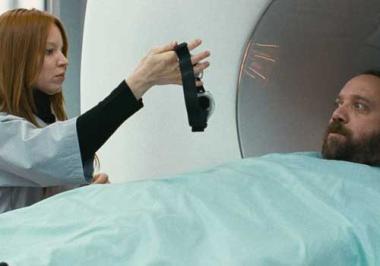
The tweak in Cold Souls is that modern science has made it possible to extract, store and trade human souls. Paul Giamatti (American Splendor) stars as a New York stage actor who, in the midst of a crisis during rehearsals for Chekhov's Uncle Vanya, takes his agent's advice to put his soul on ice—only to discover, to his horror, that his soul takes the form of a chickpea. In its place, he imports the essence of a Russian poet to help him put the role over the top.
It's a smash success, with one small hiccup: at the end of the Vanya run, Giamatti—in an over-used postmodern touch, the character shares the actor's real name—finds that his soul has gone missing. (On the plus side, using his real name lets Giamatti have fun with the constant mangling of its pronunciation.) After discovering that his soul is residing in the starlet wife of a Russian soul-trafficker—she thinks it came from Al Pacino—Giamatti takes off overseas to reclaim himself with the help of Nina, a "soul mule" who transports illicit anima through customs.
The great gift that writer/director Sophie Barthes gives her first feature is understatement: the fact that souls can be extracted and stored, like so many pints of blood, isn't even seen as particularly remarkable; Giamatti gets the details from an article in The New Yorker. And when he finally takes the plunge, the director of the lab (David Strathairn) explains that, should he like to avoid the sales tax, Giamatti can have his chickpea stored in the company's New Jersey warehouse.
But while bits like that are one of the film's charming touches, their lightness is often what keep them from hitting too deeply; Barthes seems torn between Woody Allen and Philip K. Dick, between Sleeper and Blade Runner. In the end, her film is balanced on a sharp edge between absurd comedy and something darker, and while it's an enjoyable ride, it never fully commits to either—much, some might say, like real life.
*
Also this week: Once again it is September in the Valley, a time when thousands of students new and old pour into Amherst, Northampton, and the surrounding towns. They bring with them all the expected exuberance of youth—it surely won't be long before you see a group of students, arm in arm, singing their hearts out as they skip their way through a Friday night in some downtown—but their return also sparks the rekindling of many of the area's college film programs from a period of summer dormancy.
For students and townies alike, it's a boon: not only do the many nearby campuses host a wide variety of films on indoor and outdoor stages, but those screenings are often opened to the public in an effort to build a sense of community between town and gown. To top it off, the movies are more often than not presented free of charge—I'll spare you the "in this economy" line, but you get the idea. Free is good.
First out of the gate this year is Amherst College, whose Department of German has presented an annual film series since 2003. On Thursday, Sept. 17, they screen the 2005 romantic comedy Barfuss (Barefoot) at 4 p.m. and 7:30pm in Stirn Auditorium. By happy coincidence or shrewd programming, the film stars Til Schweiger, who plays a turncoat Nazi-killer for Quentin Tarantino in this summer's Inglourious Basterds.
Here Schweiger plays Nick Keller, the ne'er-do-well stepson of a wealthy man whose short-lived job as a janitor at a psychiatric clinic has long-reaching repercussions. Shortly after he's let go, he finds Leila—one of the clinic's patients—on his doorstep, clad in only a nightgown. As the pair stumble in and out of an impromptu relationship, the film—also written and directed by Schweiger—reflects on the power of love to surprise and to heal.
But maybe you're the type of student who scoffs at mere romantic comedy. Perhaps when the rest of the floor is planning a marathon of John Cusack fluff, you're making plans to douse yourself with red paint for a "die-in" at a busy intersection. Not to worry; the Valley offers plenty of films on political hot topics. To wit: this Friday, two anti-war committees team up to bring Tragedy in the Holy Land: The Second Uprising to the Media Education Foundation in Northampton. The film chronicles the history of the Palestine-Israel conflict, with an emphasis on what the filmmakers say is the often overlooked or dismissed viewpoint of the Palestinians (naturally, a cursory look at the film's reviews reveals that partisans on the Israeli side feel the film is a biased propaganda piece). Whatever your views, healthy debate is a good thing; in that spirit, a discussion will follow the screening.
Still not happy? Maybe you're wondering why you can't have it both ways—a romantic comedy that deals with some social issues beyond the phenomenon of male chest-waxing. If that's the case, you might check out And Then Came Lola, showing on Sept. 12 at the Academy of Music in Northampton as part of the Out! For Reel LGBT Film Series. More a fun riff on a cult hit than a call to arms, the film still offers a welcome change of perspective on the perennial relationship movie.
Inspired by the art house hit Run Lola Run, this remix imagines Lola (Ashleigh Sumner) as a commitment-phobic San Francisco photographer in a new relationship with Casey (Jill Bennet). As Lola caroms around the city on a mission to deliver some designs to her lover, the film plays out three times, giving her three chances to get it right, make the delivery, and prove her commitment to Casey. Advance tickets can be purchased at various locations including Pride & Joy in Northampton and Food For Thought Books in Amherst.