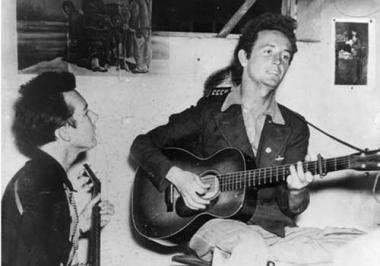
"This song is Copyrighted in U.S., under Seal of Copyright # 154085, for a period of 28 years, and anybody caught singin it without our permission, will be mighty good friends of ourn, cause we don't give a dern. Publish it. Write it. Sing it. Swing to it. Yodel it. We wrote it, that's all we wanted to do." —Woody Guthrie
Despite the wealth of theaters, halls and bars where you can find live music in the Pioneer Valley, the performances I've enjoyed the most haven't been delivered by musicians sitting on a stage.
At my 40th birthday party, sitting at my kitchen table and playing my wife's guitar, my friend and colleague Tom Sturm sang early Joe Jackson songs to me, my family and guests. Hanging out in his basement, with the patter of children's feet running around upstairs, cellist Gideon Freudmann and I used to watch Buster Keaton movies while he improvised soundtracks. One night after dinner I sat with Mark Herschler on his porch, and he told me about his days living on a canal boat outside Paris, singing songs in French and playing his guitar quietly so as not to disturb his neighbors.
Until I moved here, I could count the people I knew who played instruments for fun on one hand, and I didn't know anyone who was bold enough to try to make a living at it. When I was growing up in the Hudson River Valley during the 1970s, my idea of a local musician was Pete Seeger. I saw him perform at Clearwater Festivals and various school- and community-related events. My family was even invited to a dinner party where he was also a guest, and after dessert he pulled out his banjo. To be honest, while I loved the songs he sang, I grew to dread seeing him perform. No matter the venue or for what audience, I knew, with dead certainty, he would insist I sing along.
While our parents made certain my brother and I had no shortage of cultural experiences we could be ungrateful for, we thought ourselves fortunate that they never gave us the opportunity to loathe music lessons. Despite all their other creative pursuits, both my parents were certain they lacked the music-making gene, and until recently I never doubted them. I listened to commercial radio, frequented music stores, and hunted for bootlegged tapes, but no matter how much Seeger swore he didn't care what I sounded like, when he shouted to sing louder, I just opened my lips wider as I mouthed the words.
It wasn't until I'd lived in the Connecticut River Valley for more than a decade, surrounded by peers who relished their senses of rhythm and prized their instruments, that I started to understand what I've been missing.
*
One myth recently dispelled for me is that it's pure anguish to have someone else learning and practicing an instrument in the house. I've found the opposite to be true.
Earlier this summer, my wife started taking guitar lessons. Granted, she played the viola in high school and had already shown some musical aptitude, but she approached the new instrument with almost the same trepidation I would. Until she started practicing, we often had music playing on the stereo, providing a background soundtrack to accompany whatever we were doing. I kind of missed being able to play CDs when she insisted on quiet. For weeks, the sounds coming from her room weren't particularly musical, but they weren't offensive, either. In a month's time, she started working out recognizable tunes, and her repertoire began to grow. Having fresh, live music in the house began to feel as rewarding as eating produce from a nearby farm or drinking beer from a local brewery. Judging by the satisfaction my wife showed at playing for an hour in her room, I began to understand that the quality of her performance wasn't nearly as important as the fun she had playing. I didn't need a farmer or brewer to tap into this local resource, just a teacher to show me how to do it myself.
Though Seeger and others had told me this a thousand times when I was a kid, until I witnessed the power of homegrown music under my own roof as an adult, I didn't get it. Along with the excitement of finally understanding this simple truth, I wondered how I could have been ignorant for so long and how many others there were who thought quality music could only come from someone who got paid to make it. Is there any hope for middle-aged toe-tappers to reclaim a musical heritage that record companies have co-opted from us?
I asked my wife's guitar teacher and local blues guitarist Sue Burkhart what she thought.
Like me, Burkhart grew up without music in her house. The only place she sang was in church, and it was never for fun. Not until she got to college did she get invited to sing for pleasure at friends' homes, and before she actually tried it, the concept seemed "weird." Now, as a music professional, she, too, worries about what it will take "to keep people singing."
While some of the challenge involved with teaching an adult the guitar is overcoming physical limitations ("People who can type usually pick up the guitar the fastest," she said), a lot of her work is dispelling myths and misconceptions that seem to prevent her pupils from getting started.
"I usually start students off by asking what song they would totally like to play," she said, "and once they get comfortable with a couple chords, they start to see just how easy it is. I remember one guy wanted to play a Tom Petty song, but couldn't figure out how to get his sound. I plugged in a distortion pedal for him, and after strumming for a few seconds, he looked at me with this crazy grin and said, 'Hey, I'm Tom Petty now!'"
Though she also thinks the marketplace has made playing music seem less accessible to non-musicians, she points out that several of her current students came to her after playing hours of Guitar Hero and wanting to try the real thing. Some students have been inspired by American Idol.
Still, she says many of the myths that hamper adults from performing their own music are created by an industry that places an emphasis on mega-sales and award ceremonies. Before music returns to the streets or people's living rooms, she thinks there need to be more venues and opportunities to see both professional and amateur musicians play. As much as she loves living in the Pioneer Valley and values being a part of the music community, she points out that many of her performances are played for tips, and because she's so busy scrambling to make a living, she rarely has time to kick back and jam with friends.
*
This summer, I started listening to Pete Seeger albums again, and my son and I have been singing along to his CDs in the car. In an effort to learn what else I didn't understand as a kid at his shows, I've also read a couple of his biographies, as well as some of his own writings.
While he has certainly achieved success as a musician, I hadn't realized that he never intended to make a living selling records. He and his pal Woody Guthrie imagined a career singing for union rallies and being hired to sing at meetings to support political causes. When he asked his audiences to sing along, it wasn't just to be an engaging performer; he believed singing in unison brought people closer together. He thought of song as a political tool that could unite and give strength to those who joined in, whoever they were and whatever they sounded like.
Asked by one biographer to discuss his life's accomplishments, though, it was not the songs he composed or the albums he recorded that rated highest on his list. Rather, he listed writing the book How to Play the 5-String Banjo as one of the projects of which he was most proud, explaining that, to him, there are few gifts more powerful or useful than teaching someone else how to make their own music. As a life-long radical, he thought his banjo instruction manual book was one of his most subversive acts.
"The artist in ancient times inspired, entertained, educated his fellow citizens," Seeger wrote. "Modern artists have an additional responsibility—to encourage others to be artists. Why? Because technology is going to destroy the human soul unless we realize that each of us must in some way be a creator as well as a spectator or consumer."
If you're interested in singing Seeger songs with local artists, be sure to check out A Tribute to Pete Seeger, Saturday, September 26 at Northampton's Academy of Music. It's a benefit for the Pioneer Arts Center of Easthampton. More information and tickets are available at www.pacetheater.com.