
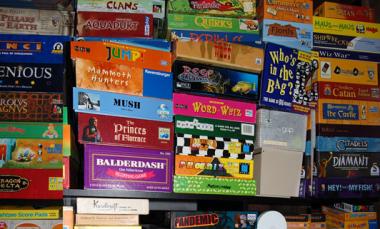
Ah, autumn!
Longer nights, cooler weather, kids back in school and friends home from vacation. After months of slapping at mosquitoes and sitting in front of the fan in your underwear, an evening at home can finally feel like bliss again. There's no better time of year than fall to pull down the blinds, pour yourself a drink and indulge in one of life's intimate pleasures—to stretch out and luxuriate in the company of friends. Imaginations can run wild. It's a time to try out new experiences.
I am, of course, referring to board games.
If all that comes to mind when you read "board games" are Milton Bradley publications like Candy Land, Parcheesi and Monopoly, this introduction may well seem a little overblown, but games have come a long way in the past decade. Their popularity sustains a number of stores in the Valley devoted to games that don't require electricity. While you might have been spending your nights out at the movies, hearing concerts or bar hopping, some of your neighbors were probably deep into strategy, exploration, conquest and camaraderie. Instead of the dozen or so stand-bys (Trivial Pursuit, anyone?), the quantity and quality of games has multiplied like rabbits on steroids. If you were so inclined (or obsessed), you could play a different game every weekend for years and not run out of compelling, enjoyable options.
This is not hyperbole, but a conclusion I have reached after years of testing. For more than five years, a group of my friends and I have met each Friday night, and over sushi and beer, we've played and enjoyed (mostly) hundreds of board games.
*
During a cookout on a friend's deck one Indian summer evening years ago, the subject of board games came up.
In my friend's living room—I'll call her Sally—I'd caught a glimpse of a box with pictures of a garden and woodland animals hiding amongst the vegetables. As a teen, I'd played countless hours of Dungeons and Dragons, as well as spending many afternoons hunched over a slew of strategy board games. That had ended when I went to college: my new friends didn't share my enthusiasms, and I'd moved on to other interests. But decades later, after having recently browsed in a few local game stores, I'd started to feel the pull again. I asked Sally about the game with the German title on her coffee table. Was she a former game player, too?
She explained that, in point of fact, her passion for board games had never been interrupted, and for as long as she could remember, she'd been buying and trading games.
Like me, though, as she'd grown older, she'd found it harder and harder to find people to play with. She and her partner had started a successful business in the Valley, and as they became more involved with the community, she'd been reluctant to identify herself as an ardent adult gamer. (For more on game shame, see the interview with Ethan Gilsdorf, author of Fantasy Freaks and Gaming Geeks) So even though she continued to accumulate games that interested her, she only got to play a small selection. Her closest friends were happy to indulge her occasionally, but in an effort not to scare them off, Sally chose simple games with amusing graphics and short play times. The game on her coffee table was one such game, David Parlett's Hase und Igel, where players got to assume the roles of rabbits and turtles munching their way through a garden race.
I asked if I might check out her collection, and Sally took me down to her basement. "Collection" was an understatement. Vast library would have worked better. On shelves stacked floor to ceiling and lining two walls of her basement, Sally had thousands of game titles, very few of which I'd ever heard of before.
Some were heirloom games from her youth. Others were prizes she'd bought years ago and held on to knowing she might never get to play them. She'd play-test the games herself, reviewing the rules and the other game collateral (board, cards, pieces), and she'd hold on to the ones that struck a powerful chord (like a favorite book) in her own game aesthetic. She didn't hold on to stuff that she didn't like, but sometimes bought games only because of their value on the Internet. Any money she made selling games went back into buying new ones; it was her preference, though, to keep money out of the transactions and find people willing to trade. Mostly via the online community found at www.boardgamegeek.com, she'd been able to work game trades that yielded her the richest, most difficult to find, years-out-of-print bounty she was looking for.
The boxes came in all shapes and colors, each trying their best to tempt you with thrilling illustrations and evocative names: Mammoth Hunters, Reef Encounter, Warhamster. There were dozens of card sets, self-published games, and sets she had assembled herself from downloaded templates. (She's proud of her fancy laminator.) One shelf was devoted to plain white boxes containing bare-bones game titles distributed by niche publishers to serious gamers. Some high-priced games could cost $50 or more, and if you're into variety, it could be expensive. These publishers catered to people who preferred interesting, challenging and strategic games and were willing to forsake high production values if they could pay less. A favorite such publisher is aptly named Cheap Ass Games.
After a few minutes of stunned silence, I meekly suggested that perhaps we could play a game sometime. She agreed.
*
During the summer, we often have other plans, and it's not always easy to get together. Once it gets cold outside, though, we play nearly every weekend. After my boy has been put to bed, the four of us—Sally, her partner, my wife and I—sit at my kitchen table, and after the take-out sushi's been devoured, Sally brings out a selection of games for us to choose from. Sometimes we play a favorite for a few weeks, or if it's someone's birthday, we let them pick what they want to play.
While I am a sucker for a well constructed game full of rich design and illustration, this has become secondary to easily-grasped rules that require both complex diplomacy and cunning strategy to win. I like deep games that invite interaction and repeat play. Given the time available on the nights we play and the interest/focus level of the participants, Sally selects games that can be comprehended in half an hour and completed at least once before bedtime.
We're a patient lot, and while each of us takes our time contemplating our next move, the rest of us nosh and gab. The discussion often returns to an analysis of how the game mechanics are working and clarification of the rules. Sally prepares meticulously and distills the rules into bullet points to help teach us, but even with practice rounds, we can be a dull lot. Rules that Sally swears she's told us about earlier have a curious way of biting the rest of us in the ass.
We mostly prefer games that attempt to simulate something actual—being a riverboat captain, a thief in London, or a Roman aqueduct designer, for instance—over abstract games. A successful game gives some taste of the mental challenges of whatever it's simulating. While the rules need to be consistent with what they're describing, the game also needs to be fun to play. If the game has random elements, they need to be balanced with opportunities to make our own fate.
For me, negotiating the rules with my fellow players and then trying to live and succeed by them is the core thrill of board games, and one I'd argue is absent from many computer entertainments that we generally refer to as games. As much as I enjoy first-person shooters (Quake, Half Life, Castle Wolfenstein) or titles like Grand Theft Auto, it's for their lack of rules and the freedom they offer to try out random acts of violence on monsters and pedestrians: kill or be killed. In competitions, it's the person who's learned the game moves most like a touch-typist who wins. I'd argue, with all due respect, they're more like toys: I feel tired and worn out after playing with them.
A good night's board game playing gives players an opportunity to share a narrative, discuss fate and justice, and go to sleep with the satisfaction of a game well played.