
The following is a small selection of favorite board games we’ve played with friends over the past few years. They’re listed in no particular order. With the exception of Cathedral, all are games best enjoyed by a group. They all should take under 90 minutes to play. Many are available in local stores throughout the Valley (see “Greenfield Games"). Some are out of print, and if you want them, you’d better have something good to trade.
Carcassonne
Klaus-Jürgen Wrede, 999 Games
Piecing together randomly selected tiles, players construct a map of medieval cities, abbeys and farmlands, all connected by roads and rivers. Points are accumulated as cities and roads are completed, but farmers can make a killing at the end of the game if they’re well placed in relation to the cities and aren’t cut off by the roads. It’s impossible to play the same game twice, but there are many expansion packs, even inexpensive ones, that can give the game an interesting new flavor.
Scotland Yard
Ravensburger (Milton Bradley publishes it in the U.S.)
One player is Mr. X, a criminal on the lam. The other players are investigators from Scotland Yard, trying to hunt him down. The board is a map of London (there’s also a New York edition), with different locations connected by various modes of transportation: taxis, buses and the subway. Operating as a dragnet, players try to cut off the criminal’s exits and corner him.
Captain Park’s Imaginary Polar Expedition
Cheap Ass Games
Captain Park has returned to his London club, announcing a successful trek to the top of the world. He carries armfuls of evidence, tokens from foreign lands proving his mission true. No one believes him. Club members suspect that his “evidence” was purchased at junk shops around town and that the story is all lies. Not to be bettered, players go into hiding from the club and scour London for their own trinkets. The game ends as players return triumphantly to the club and attempt to convince the other players of their own heroic (and fictional) conquests.
Aquädukt
Schmidt Spiele Überplay
Put your cities and towns on a map, and then use your meager resources to build an aqueduct directing the flow to your map.
Mississippi Queen
Werner Hodel
The random element in this game is the board itself. As players navigate their riverboats down a winding stretch of the mighty Mississippi, the river twists and turns randomly as players add pieces of the board, made up of large puzzle pieces. It’s a race to a port town, picking up passengers as you go. A simple, inventive system has players worrying about their speed and the coal spent to achieve it, and whether it’s better to go for speed or ram your opponents.
Niagara
Thomas Liesching, Rio Grande Games
The board, representing the mighty Niagara, hangs off the edge of the table. Players send canoes out into the river, trying to gather valuable items from the islands near the precipice. Another nifty water simulation has players trying to judge the currents so they can get to the islands without meeting their doom.
PitchCar Mini
Jean du Poël, Ferti
Players flick wooden buttons (race cars) along a tabletop track, trying to finish first without flying off the track.
Pirate’s Cove
Paul Randles and Daniel Stahl, Days of Wonder
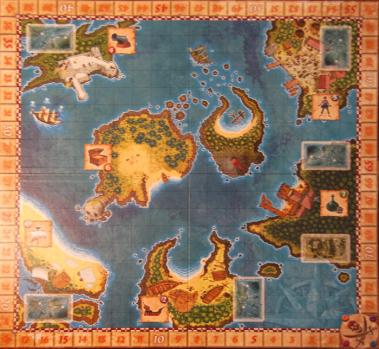
The game board’s a pirate map full of opportunity for plunder, brawling, the exchange of cannon fire and the hiding of ill-gotten bullion. Players spend some of their prize money on ship improvements, choosing between improving the sails, the cannon or the cargo hold.
Loot
Reiner Knizia, Gamewight
More pirate fun on the high seas, this time played with deceptively simple and cartoonish cards. Players try to sail their country’s navy to safety while they attack one another with pirates. A couple of gold stickers on the box told how the game was certified smart; even Mensa said so. It’s a quick, exciting bout of attack and parry that can be played several times in a sitting.
Cathedral
Robert P. Moore, Brightway Products
The board represents a medieval walled city. Two players, white and black, start with identical building shapes: Tetris-like blocks shaped to represent halls, cloisters, town squares, and other city features. Around a large, neutral cathedral players add their pieces to claim territory in the finite space between the walls.