
Seraphine
Directed by Martin Provost. Written by Marc Abdelnour and Martin Provost. With Yolande Moreau, Ulrich Tukur, Anne Bennent, Genevieve Mnich, Nico Rogner, and Adwlaide Leroux. (NR)
Over the course of two hours, Seraphine manages to take a tour through many of the familiar tropes of a particularly French style of arthouse cinema: verdant fields of wildflowers, picturesque country homes, an enthusiastic embrace of art as an almost religious, transformative force. It is also—again, in the best French style—a grim and often depressing affair that suggests that our most profound loves are sometimes the most damaging.
So it's all the more surprising to find that this quintessential foreign film is actually the true history of one remarkable woman's life: Seraphine Louis, aka Seraphine de Senlis, one of the so-called Sacred Heart painters of the early 20th century. A talented self-taught artist whose panels caught the eye of one of the era's discerning critics—the German-born art dealer Wilhelm Uhde, who was an early booster of Picasso, among others—Seraphine was also a devout Catholic who claimed that her "guardian angel" called her to paint.
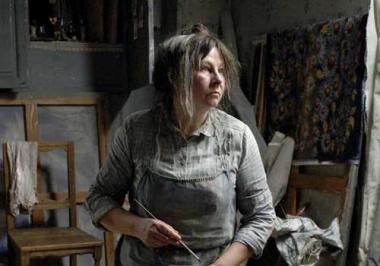
Poor, untrained, and largely uneducated, Seraphine (Yolande Moreau) mixes her own pigments from earth, flowers, wax and blood, using the resulting colors to paint her wondrous and disturbing works. When she is at the height of her powers, her canvases, filled with the repeated shapes of leaves or flowers, vibrate with a seasick life; another character compares them to skittering insects, and, more forebodingly, "shredded flesh."
Uhde discovers his protege during a country sojourn in Senlis; Seraphine is a housecleaner at the villa where he rents a room. But soon after their initial connection, Uhde is forced to flee the country—World War I has begun, and the invading Germans will shoot him as a deserter if he's caught in France. By the time the pair meet again, a decade has passed, and Uhde's reappearance in her life rocks the already unstable Seraphine.
Moreau is miraculous as the painter; it's far too easy to shade into parody when playing a troubled artist, but Moreau portrays Seraphine more as living inside herself than ill—and indeed, much of what we might see as mental illness might simply arise as a way to cope with the crushing circumstances of her everyday life. For Seraphine, painting is a release from earthly bonds, and Moreau embraces that transcendence. The scenes of her painting in Seraphine's tiny apartment, repeatedly scrubbing out the same shapes and stabbing at her canvases, sometimes until she falls asleep atop them, feel so authentic that one forgets that the real Seraphine is long dead.
She gets a great deal of help from Provost and cinematographer Laurent Brunet, whose shots are framed and lit to evoke the cracked surface and cloudy varnish of old paintings. The effect, from the start, is to drop a viewer into a rural France almost a century old, and not let up until the entire sad story has played out, stroke by stroke.
*
One of the few downsides of writing a film column is that there are occasionally too many films to write about, and the demands of deadline mean that promising films must sometimes get pushed aside. Unfortunately, those films are not always around a week later, when a chance for review opens up. (The other big minus comes when trying to rent a DVD with friends; inevitably, I've seen 99 percent of the new releases.)
This happened last week to Francis Ford Coppola's family saga Tetro, which had a brief run at Amherst Cinema before making way for two new films this week. A rich, operatic story set in Buenos Aires and shot in a velvety black and white, it received a mixed response from most critics, many of whom praised Coppola's cinematography but knocked his screenplay (his first original piece since 1974's The Conversation). But if it wasn't perfect, Tetro seemed to be a beautiful mess, and one still worth tracking down.
To see that the same fate doesn't befall Tetro's replacements, a few words about the two new features that arrived in Amherst this week: The September Issue is an unprecedented behind-the-scenes documentary that details the massive undertaking that results each year in Vogue's September issue. To people in the fashion world, it's a serious event—the 2007 edition tipped the scales at over four pounds—and director R.J. Cutler, whose previous work includes documentaries about race relations and the Civil War, is no lightweight.
Also screening is the darkly comic drama Big Fan, starring Patton Oswalt (The King of Queens) as an obsessive fan of the New York Giants who has an unfortunate run-in with one of his favorite players that begins to unravel his life. Writer/director Robert Siegel also wrote the screenplay for The Wrestler—a good sign that the football of Big Fan will be less pastime than lifeline.
Amherst Cinema also has an impressive slate of special events lined up for the coming week, starting with a presentation of Shakespeare's All's Well That Ends Well in a live capture from London's National Theatre. A grown-up fairy tale about sexism, snobbery and love, it screens on Thursday, Oct. 1 at 7 p.m. and Saturday, Oct. 3 at 1 p.m. Later in the week, the theater's collaboration with local radio station WFCR brings the classic jazz documentary Straight No Chaser to town. Charlotte Zwerin's film about legendary pianist Thelonious Monk is now two decades old, yet remains an indelible portrait of a master at work. Of all jazz documentaries, this film remains the gold standard. It screens on Tuesday at 7 p.m., with a pre-show performance by guitarist Rich Goldstein and a post-show discussion with Tom Reney, host of WFCR's Jazz a la Mode.
Speaking of live music, the theater also hosts a screening of Buster Keaton's classic Steamboat Bill, Jr., with an original score performed live by composer Peter Blanchette. Here we have an event where both the film and the score would likely hold up on their own; together they promise to create something truly special. Even if you've never seen the film, you likely know its breathtaking climactic gag, where the entire front of a house falls over Keaton, who, stock still, passes through an open window.
The film screens on Oct. 4 and 14, but as an added bonus for area musicians, the theater and Blanchette are offering a master class with the composer. Limited to six students per class, the 90-minute sessions will be offered twice during the week, when students will have the opportunity to craft their own score for a complete scene from the Keaton film. For more information or to register, visit amherstcinema.org.
Across the bridge, Amherst's sister cinema is hosting its own special event as Shocktober gets underway at Pleasant Street Theater. Part of the Zero Hour Film Series, the five-film event spans October with a variety of classic and cult horror films screening every Saturday at midnight. Starting things off this week is the 1964 Vincent Price flick The Last Man on Earth. The title pretty much sums up the action—not counting zombie vampires—at least until Price's scientist survivor spies what may be another survivor in the wasteland, and tries to save her. Recently remade as the Will Smith vehicle I Am Legend—the title of the Richard Matheson novella both are based on—the original still packs a punch of its own.
Jack Brown can be reached at cinemadope@gmail.com.