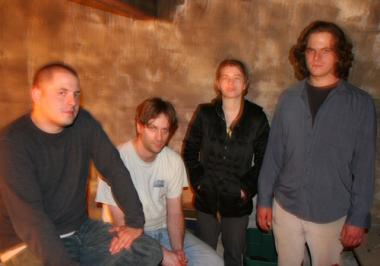
Four years ago, Easthampton-based Red Door Exchange were on the cover of the Advocate, just after releasing their first full-length recording. After touring to support that album, the band went on a lengthy hiatus, but they're back with a new album called August.
The spacy guitar and electronica sounds they used to make have been replaced with rootsier, stripped-down tendencies that place the band more firmly in rock territory. I caught up to the band's songwriter Jesse Pietroniro recently, to ask about the band's evolution.
Advocate: When did Red Door Exchange begin?
Jesse Pietroniro: I met [drummer] Mike [Wyzik] in 2001 working at the Brewery. At that point I had been demoing songs on my own and I played a few for him in the car one day, and he dug, and we were both looking to be in a band, so we came together that way. [Vocalist/keyboard player] Kate [Stephens] and I had been playing a little together around the same time; her background was not in rock band, but in choir and childhood classical piano lessons, so I was teaching her my songs and she was singing and playing to them. Mike came over and the two of us would jam (drums and guitar) and get complaints. At one point [bassist] Jim [Elliott], a friend and bandmate of Mike's at the time, came over too for a session. But it wasn't the four of us at once until after first a year or so of me, Kate, and Mike practicing my fledgling attempts at songwriting, then another year or so of playing and recording live as a trio, and then Jim joined in 2004 and the full band was suddenly alive.
How do you explain your music to people?
I know you're supposed to have some sort of handy, if not witty, response to this question ready to be delivered in any context, and I still haven't come up with anything that great. I know it's important. I want people to buy this record and hear it, so I must be willing to sell it. Recently I've allowed myself to call it "rock music." That seemed so belittling before, but who was I fooling? So inflated that I couldn't call a spade a spade. … Sometimes I cite the psychotherapeutic implications, for me personally, of the process that leads to the creation of this music, but mostly I keep quiet and evade the question. What I really want is a perfect tag line—that I'll never use.
What have you been up to since 2005?
We went on tour in February 2006, down to Florida and back. Shortly after the return—and I'm only going to speak for myself here, because that's all I own—I was finding it hard to pinpoint any continued motivation to be doing what I had been doing with music. A few months passed of writing songs kind of feverishly, peppered with a few solo and duo-with-Kate shows which were all I could attest to as far as live performance directly following the tour. At those shows I began to notice something in me coming out that was not what I wanted to be spewing on stage, or spreading out into the world, especially since I didn't know what it was, and it was so dark.
I was kind of angry, sardonic, salty, mumbly, narcissistic, self-absorbed. It was painful to watch myself. So anyway I kind of knew I had to stop and figure out what my motivation for doing music ever was, and not start again unless I could find a sound reason, or cause. That took about two and a half more years. & In January of 2007 we took to the stage at Yucky Octopus' CD release show at the Apollo Grill.
What would you say distinguishes August from earlier releases?
Some stylistic differences—first, the attention to lyrics, at least with a few of the songs. In some I was starting from scratch, and I really wanted to begin to move things from the entirely ethereal into the at least vaguely rational. I wanted to make sense, at least to myself. I wanted to speak clearly. I wanted to understand, and to not mumble my meaning.
Secondly, the production is a step above. Norm [DeMoura's] Harmonium Studio in Haydenville is quite evolved from the first go-around. It lends a much more open and focused sound.
Third, the rhythm section really shines on this album. And in some ways it's so good that Kate and my instrument playing falls into the mix as part of the rhythm section at times. Mike and Jim really rock on this record. It was good to leave space for that to happen.
The goal, initially, was to create more of a "band sound." All of the basic tracking was recorded live with the full band. Some overdubs of guitars and piano took place, but for the most part the songs started with that foundation. Norm and I only went layer-crazy if a song called for it. And even then I think we kept it fairly sane and tempered the wild multitracking hog.
I think the album is emotionally cohesive, and actually reads like a story. I arranged the tracks that way. It's a loose story that might not be understood without the actual telling, and maybe it's not meant to be told apart from how it stands as a collection of songs. In fact, I'm pretty sure of that. But if someone asked, I'd spill the beans. I put a lot of thought and feeling into this one, I'll say that. There's a lot of reality invested in this album. It's not so grandiose. It favors truth.
I once said your music sounded like "back-porch space rock with a dose of rainy-day Martian cathedral music." This album has a lot less spaciness about it, and I hear nods in the directions of things like, say, Dylan. Then there are things that seem to head in an almost '70s rock guitar direction. What got you here?
My first thought is on how the sound's evolution from spacy and stratospheric to more earthbound and grounded is indicative of an overall psychic shift, personally. I spent a number of years in the clouds, so to speak, and this last year has been about that not-so-slow or gentle descent downward, out of illusion, delusion, fantastical thinking, schizoid patternings, and a whole lot of talk about ideas. It's actually a fairly common process for people around my age.
I was a "Grand Ascender," as Robert Bly called it—I sought escape from whatever turmoil, inner or outer, by flying upwards and away from it, against gravity, splattering myself all over the place, losing focus or a sense of center. & Anyway, the act of returning to the body and the earth was certainly, at least for my part, the story being told in this album, along with the emotions inherent in following a whole chunk of time passing, a whole summer, so to speak, and the subsequent feelings of hopeful melancholy permeate throughout. &
The fact of the matter, too, is that I was bred by a folk-father (my new term). He taught me my first chords and was/is a Dylan enthusiast. He appears on the album as "Wildboy," and is the author of "Archways," a song he wrote in the '60s, in which we sing together on this recording. In some ways this collection of songs is a hearkening back to those beginnings for me.
Are you the primary songwriter? What do you tend to find interesting enough to write songs about?
I am the songwriter. That being said: "All songs on this recording realized in their present actuality by Red Door Exchange in collaboration with Norm Demoura"—that's what the liner notes say. It's sort of a redundant, or obvious, thing to say, maybe. But I wanted to make it clear how I felt about how these two albums came to be. I write the songs, but they don't come "out" in the way that they are without the contributions of everyone involved.
In certain cases too, like "Mate for Life," the song is inpired by a rehearsal jam, or even the lyrical content telling a story about the band. & Songs like "The Seven Trumpets" and "Nu Wei" (a play on the concept of wu wei, or "getting out of your own way") are rife with biblical imagery stemming out of my born-again Christian upbringing. The latter focuses on achieving a distance from that and other aspects of my childhood programming. The former is more of a commentary on the process of individuation—I guess that's sort of the same thing. Both served to relax my grip on ideas around hell, salvation, apocalypse and the like. I wonder if the words say this to anyone but myself. …
I wrote about emotional material. It's always been that way. Part of my breakdown was about breaking down what it is that music serves in my life. For me it's a bridge to the emotions. It's no longer about a need for recognition, although that's nice, too. It's a way of accessing and processing the shit I carry. It's certainly not the only way. It can't bear all of that weight, that's why I stopped. I had to learn new ways of support.
What's on you calendar right now?
Kate's 30th birthday is today. We're going camping tomorrow to celebrate. I've got classes Monday, Tuesday, Wednesday, Thursday in human behavior, social welfare policy, music theory, ear training, dictation and choir. I have to find a job. I have to get a busking license so I can start playing in the subways, if I have the courage. I need new shoes.
Wait, that's more of an agenda.
RDX has no plans to perform any time soon, as geographical differences make such ventures difficult. Jesse lives in New York, Kate in New Hampshire, Mike and Jim in the Valley. Of course, given the right venue, or event, these things could be made to happen. For a nominal fee, of course."
For more about Red Door Exchange, visit reddoorexchange.com.