
A Serious Man
Written and directed by Ethan Coen and Joel Coen. With Michael Stuhlbarg, Richard Kind, Fred Melamed, Sari Lennick, Aaron Wolff, Jessica McManus, and Peter Breitmayer. (R)
In the opening scenes of A Serious Man, a shtetl-dwelling farmer makes the grave mistake of inviting a dybbuk—sort of a Jewish zombie—into his home. Or does he? He and his wife are at odds over their visitor's vitality, at least until she decides to test her hypothesis with an ice pick. Right or wrong, the couple seem to doom their descendants to God's wrath, all the way down to 1960s college professor Larry Gopnik.
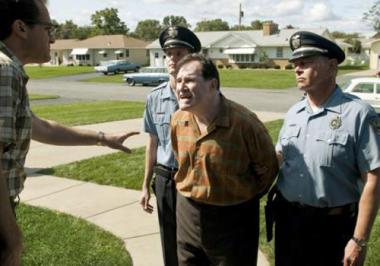
Gopnik (Michael Stuhlbarg) is trying to be a mensch, but fate seems to keep getting in his way. His wife is ready to leave him for widower Sy Ableman, his son is in trouble at Hebrew school, and his daughter wants a nose job. His chance at tenure is being sabotaged by an anonymous letter writer, and a failing student is trying to bribe him and blackmail him at the same time. A perpetually unemployed relative is sleeping in his living room, and a gun-loving neighbor is encroaching on his suburban Minneapolis property.
Part of the joke of this re-imagined Book of Job is that Gopnik is a physics professor whose faith in reason becomes less than useless. The absurdity of modern life is a subject the Coens (Burn After Reading) return to often, their heroes the few souls who don't—can't—give in to it; here that means watching Gopnik argue with a Columbia Records Club rep about an outstanding bill for Santana's album Abraxas. "I didn't do anything," cries Larry, and the rep explains that, indeed, "to receive the monthly selection, you do nothing." What?
Is it God toying with Larry, or is it just America? The rabbis he consults offer a succession of fuzzy parables; they have no real answer for him, and the Coens (who grew up in the Minneapolis suburb St. Louis Park) refuse to give us one, either. But the brothers are filmmakers of the first degree, able to make even the most open-ended of stories an engaging ride. When A Serious Man ends, on a strange and foreboding note, the best advice to follow comes from the father of that failing student: "embrace the mystery."
*
It Might Get Loud
Directed by Davis Guggenheim. With Jimmy Page, The Edge, Jack White, Bono, Michael McKean, Larry Mullen Jr., Robert Plant, and Meg White. (PG)
It Might Get Loud, the new electric guitar documentary from the director of An Inconvenient Truth, is a frustrating experience in What Might Have Been. Filmmaker Davis Guggenheim pulled together three guitarists whose experience with the instrument spans some of rock's greatest years: Jimmy Page (Led Zeppelin), The Edge (U2), and Jack White (The White Stripes). Each flourished during a very different period, and each approaches the instrument with a unique outlook that shows just how varied the guitar can be. The conceit of the film, announced onscreen, is that three sat down one day to talk shop, with Guggenheim there to film it.
It sounds like an interesting film, but it's one we only see in snatches. Instead, we're treated mostly to a patchwork of three biographies, each with its own points of interest (Page, in particular, has a fascinating history as a session musician) but none of which are explored in enough depth to carry the film. (At 97 minutes, one lifetime would be pushing it.) In turn, each musician describes his particular attachment to the guitar as Guggenheim cycles through old photos and film clips.
Page and The Edge seem a bit bemused at the entire idea of appearing in such a movie in the first place, but poor Jack White is afflicted with the awful desire for authenticity. He dresses like a 1930s undertaker, and records onto an ancient reel-to-reel machine. In one of the trio's few scenes together, he describes his ideal guitar: out of tune, with a bent neck—he wants his music to "be a struggle." The older musicians seem ready to laugh him out of the room.
When White is offscreen, the film is less self-conscious, and in its fleeting best moments—footage of the war-torn Ireland of The Edge's youth, or of a young Page playing in a skiffle group—it provides a glimpse of what the electric guitar has always offered: a way out.
*
Also this week: The 1979 documentary The Last of the Blue Devils is playing in Amherst as part of the ongoing WFCR Jazz Series presented by Amherst Cinema and Tom Reney, host of the Jazz a la Mode radio show. Screening Tuesday, Nov. 3 at 7 p.m., the film is a tightly focused look at the history and continuing influence of the Kansas City, Missouri jazz scene. An extraordinarily self-sufficient world, the Kansas City scene was both removed from jazz central New York and a kind of proving ground that spawned a dazzling array of talent—names like Charlie Parker, Billie Holiday and Lester Young—most of whom came up in the band of Count Basie, the scene's undisputed and benevolent king. As always with the series, the film is preceded by a short concert, this one featuring solo jazz guitar from local musician Joe Belmont.
Some very different musical features come to the Academy of Music in Northampton this weekend, beginning on Friday night with Repo! The Genetic Opera. A cult hit, the futuristic musical is set in 2056, when Earth is faced with an organ failure epidemic, and GeneCo agents—"Repo Men"—hunt down people who fall behind on their payments for transplanted organs. Amid the chaos, a young girl searches for a cure.
Adding to the mayhem is Genetic Imperfection, a local troupe that will be "shadowcasting" the film. For those not familiar with the term, it refers to the practice of acting out a film's action in front of the screen—as the film itself is playing. Most often associated with The Rocky Horror Picture Show (see below), the practice has spread to other over-the-top films in recent years, becoming popular enough to support a regular Genetic Imperfection show at South Hadley's Tower Theaters.
The troupe's sister cast The Come Again Players shadowcasts the Halloween night screening of The Rocky Horror Picture Show. The wonderfully bizarre 1975 musical defies summation—suffice it to say the main character is a cross-dressing scientist named Frank N. Furter—but its unapologetic embrace of the transgressive (and a cast that includes Susan Sarandon and Tim Curry) has kept it fresh for decades.
The Academy's midnight screenings also contain a charitable aspect: Repo star and co-writer Terrance Zdunich will be in town both nights for autograph signing, Q&A sessions, and memorabilia auctions to benefit cystic fibrosis foundations. And from Wednesday to Saturday, the venue opens its doors as the Academy Haunted Theater, leading guests on a tour of the rarely seen "secret places" of the 120-year-old building. Stops include the area beneath the stage where Houdini himself made his escape, as well as a variety of more ghoulish vignettes (children under eight, it's noted, may find it too frightening). Part of the proceeds from that event will benefit the Northampton Education Foundation; for more information, visit academyofmusictheatre.com or call (413) 584-9032.
One more midnight screening comes to town when the 1972 Spanish sci-fi thriller Horror Express unreels at Pleasant Street Theater on Saturday night. The last in the venue's Shocktober horror series, it features Christoper Lee as the fossil-hunting Professor Caxton transporting his latest find—a Missing Link-type creature he finds in an icy tomb—on the Trans-Siberian railway. When it returns to life during the trip and begins killing passengers, it's up to Caxton and his old adversary Dr. Wells (Peter Cushing, Lee's old friend from the gothic Hammer horror films) to discover the creature's secret before the train reaches civilization. Along for the ride is a pre-Kojak Telly Savalas as the Cossack soldier Kazan.
Jack Brown can be reached at cinemadope@gmail.com.