
The Messenger
Directed by Oren Moverman. Written by Alessandro Camon and Oren Moverman. With Ben Foster, Woody Harrelson, Samantha Morton, Steve Buscemi, Jena Malone, Eamonn Walker, and Yaya DaCosta. (R)
It's easy, perhaps dangerously so, to think that we know all the war stories that movies have to tell us. We've seen traitors and heroes, captures and escapes, homecoming and heartbreak. In the film world, Nazis—the manifestation of last century's greatest horror—have largely become generic villains, heavily accented cartoons ripped from Captain America comics. And even in the worst of wars, we're led to believe, there will be some excitement—a rush of adrenaline to help blur the despair.
Which makes The Messenger all the more impressive. A movie about war that's set on the home front, it avoids most of the formulaic set pieces we've come to expect. Most conspicuously absent is the war itself: of its two military protagonists, only one of them has even seen action.
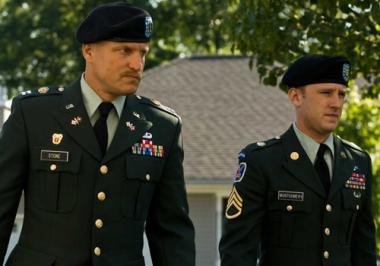
That's Will Montgomery (Ben Foster), a soldier injured during a sniper attack in Iraq. With only a few months left before his enlistment is up, he's sent home and reassigned to duty as a Casualty Notification Officer under the tutelage of Capt. Tony Stone (Woody Harrelson). The CNOs are the soldiers who show up on a family's doorstep when a relative is killed in action; ideally, the family gets the news from them before hearing it on CNN, or from "any soldier with a cell phone."
It's a tough job—reactions to such news, understandably, often include anger at the soldiers delivering it—but Stone expects his student to be a stoic. "I won't be offering any hugs, sir," sneers Montgomery. To underline the point, his injured eye requires the regular application of artificial tears, though Montgomery is a hard enough soldier that we wonder if he ever produced his own. It's a twist, then, to find that Stone—who is something of a boor and a skirt-chaser when off duty—is the more proper soldier, straight-backed and by the book.
Perhaps because he's seen the waste of war firsthand, Montgomery quickly finds himself empathizing with the families of the fallen, even, in a quietly tender scene set in a small town market, offering a policy-violating embrace. It's a shock to the soldier to find that he's good at this new assignment, and even more of a shock to find that he derives some satisfaction from being good at it.
First time director Moverman makes a point of cataloguing the different responses the CNOs receive, which range from denial (families sometimes refuse to answer the door) to an incoherent rage (Steve Buscemi has a small but important role as an angry father ruined by the news). Perhaps the most unexpected comes from Olivia Pitterson (Samantha Morton), who thanks the men for delivering the news that she is suddenly a widow and a single mother. "I know this can't be easy for you," she says, shaking their hands. In the wake of her husband's death, she and Montgomery spark a relationship that defies our expectations right up to the film's understated and perfect ending.
The Messenger has a few glaring flaws, mostly when it insists on following a subplot involving Will's attachment to an ex-girlfriend. During those times it veers into an over-traveled territory where every vet is a troubled vet, getting drunk and making scenes. It feels far more true in its quieter scenes, when the notification officers are adjusting their uniforms in the reflection of a car window; behind them, against a playground fence, are the mothers of all the neighborhood's soldiers, wondering which one of them the men have come to see.
Also this week: If my informal survey is any indication, there are many in the Valley who make it a habit to tune their radios to WFCR's Saturday afternoon broadcasts of the Metropolitan Opera. Even if you're not a full-blown opera buff, there's something edifying about piping in a bit of high culture for a few hours while you catch up on housework—some Elektra with your Electrolux.
Still, everyone likes to get out once in a while, and this weekend offers an opportunity to move beyond the radio and catch the Met broadcast in a glorious high-definition show. Transmitted live from the Met's New York stage to the silver screen in Shelburne Falls' Memorial Hall Theater, the 1 p.m. simulcast features Jacques Offenbach's celebrated 1881 opera Les Contes d'Hoffmann in a production shot through with big names, including Met Music Director James Levine and opera superstar Anna Netrebko.
Tony Award-winning director Bartlett Sher describes his production as "a magical journey" inspired by the work of Kafka, in which the title character "works out different manifestations of his psyche." The libretto is an exploration of the loves of the German Romantic poet E.T.A. Hoffmann (Joseph Calleja), who recounts three stories from his past over the course of a night spent in a Nuremberg tavern while his Muse plots to capture his heart forever.
Also screening this week is Frederick Wiseman's La Danse, a rich and lengthy documentary look at the Paris Opera Ballet. Wiseman is at once poetic and plainspoken—his other films carry no-nonsense titles like Meat, Racetrack and Public Housing—and his four-decade career has produced any number of gems. Here he sets up shop in the sprawling crystal and velvet interior of the Palais Garnier, the grand 19th-century home of the company. Under its Chagall ceiling, he captures with an uncommon intimacy the rehearsals of the dancers preparing the season's new ballets; but unlike many documentary directors, Wiseman makes films that are never about the man who makes them, and it's that self-effacement that lets you feel as though you're the one holding the camera.
And finally this week, an opportunity for a clarification: Cinema Dope occasionally features films that are part of an ongoing series of free Friday night screenings at Northampton's Media Education Foundation. It's a wonderful resource in a town that likes to pride itself on its progressive bent. This week, for example, they host Coal Country, a film about the controversial practice of mountaintop removal mining in Appalachia, and the stories of miners and activists on both sides of the issue. It sounds like a gripping and balanced film, like so many in the series. But while MEF does provide the screening room, the series is actually presented by the Northampton Committee to Stop the War in Iraq; interested filmgoers with questions or comments should visit northamptoncommittee.org for details instead of calling MEF. Mea culpa, MEF!
Jack Brown can be reached at cinemadope@gmail.com.