
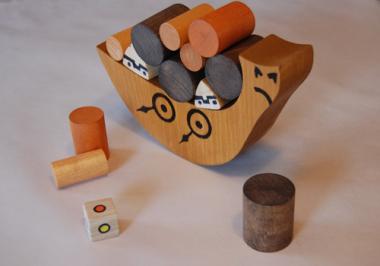
Pillage & Plunder: The Viking Longship Game
Monadnock Region of New Hampshire
chrisvnh.bizland.com/pillageplunder.html
Though the name might suggest otherwise, Pillage & Plunder is appropriate for all ages. In the game, the looting and ravaging is over, and the task at hand is loading the plunder into the ship.
The longship, two Vikings and the treasure are all simple wooden blocks, and players alternately try to balance a new round barrel on top of the teetering boat. The barrels come in three sizes and colors, and the same colors are on the sides of the single die, which is used to determine which size goes on next. It might be good planning to put the big barrels down first, but Vikings are a hasty lot, and you've got to place the loot as it comes. Often, the game ends with someone trying to gently rest a gobstopper on a pile of marble-sized cylinders. Whoever dumps the load in the drink loses.
Unlike some age-specific games, Pillage & Plunder can be enjoyed equally by adults and children, even played by both at the same time. The rules are immediately obvious, and players become invested in stacking the barrels as high as possible so victory or success can feel more collaborative. Getting rid of the die and removing the random element can also make the game more strategic and competitive as each player tries to present a less habitable platform for the other player to place their barrel.
The game plays best on a carpet, this tester has found. When the ship tips and the barrels begin to roll, it's no fun chasing them as they spill off the edge of the table. Parked on the floor, using an atlas or big art book as a playing surface, adult testers have found themselves camped out in the living room even after the kids have been put to bed, playing with the longship and its cargo until late at night.
The Storymatic
Marlboro, Vermont
thestorymatic.com
The Storymatic could be thought of as the reverse of Mad Libs. Instead of filling in the blanks of a generic, lame, page-long narrative with a few witty words of your own, The Storymatic offers you a few choice words around which you can build your own tale, and it can be as long or as short as you want.
The collection of two decks of cards with colorful, evocative vocabulary started out as a teaching tool for creative writing students to help ignite their creative sparks. The gold deck has character traits and occupations (ex-model, arrested executive, ape, person with extremely long fingernails, professional wrestler, vampire slayer, sports team fanatic), and the white deck has a situation or object (caught!, allergic reaction, school play, unexpected delivery, medicine isn't working, lost all identification). There are also wild cards which might determine the story's setting or narrator. Students picked two character cards and one white card, building a protagonist and a narrative that linked the usually disparate, random notions. The collection grew and was refined by dozens of young writers, and The Storymatic's creator, local author Brian Mooney (and, in the interests of full disclosure, college buddy of this reviewer), found that the cards had use and appeal outside his own classroom.
As a teaching tool, the Storymatic comes with a series of suggested guidelines—a) tell a story in which the main character changes in a meaningful way, and b) don't kill off your main character—and a variety of rules for different games and applications.
But like the cards, the rules are intended as a place to start, and free-styling is encouraged. Plucking out a few cards can help lubricate the creative writer's imagination. On long family trips, the collection of cards can help distance evaporate as you spin yarns, and the twin decks offer fertile feed for imaginative minds carousing at parties or nursing beers.
Bone Wars: The Game of Ruthless Paleontology
North Amherst
zygotegames.com
Many of the amazing dinosaur discoveries that grace the nation's oldest natural history museums were unearthed in the late 1800s in the American and Canadian West. The scientists, explorers, and hired hands who hunted for these fossils shared the stage with the cowboys and Indians of the pioneer days after the first gold rush. It was a time when the terms "scientist" and "dinosaur" had only just come into being, and in some instances adding to world knowledge or the advancement of science weren't the only goals that fueled early expeditions.
The discovery of a brand new dinosaur skeleton was worth more than its weight in gold. Beyond wealth, discoveries provided prestige and the hope of everlasting fame. Competition could be fierce, and sometimes scientists were cruel to one another in ways that would have shocked the armed men who protected and sometimes threatened them.
Bone Wars is a card game that captures and celebrates this time of bone banditry. Players assume the roles of one of four early paleontologists—Othniel Chales Marsh, Edward Drinker Cope, Barnum Brown and Charles Sternberg—and, assembling a team of experts, they go dinosaur hunting, hoping to achieve the greatest prestige points when their work is displayed in museums back east.
Bone cards represent the limbs, heads and vertebrae of different dinosaurs, and there are event cards that provide bonuses for players (such as expedition guides who make collecting more profitable), ways to foil other players (prove a discovery is not new, but a repeat of a previous find), and defenses from aggressive bone collecting competitors (a Loyal Clique card prevents prestige loss). Play is in three phases: field work is done to dig up the bones, museum work identifies new skeletons, and the controversy phase lets players critique the opponents' discoveries.
Bone Wars is published by Zygote games, a company that dedicates itself to educational games that are fun to play. Bone Wars succeeds on both levels, the rules are quick to master, but the play is challenging and, as promised, ruthless. Learning is inadvertent. The event cards contain relevant, brief explanatory quotes (Collaboration: "I found at length he was using me …to furnish him with brains." — E. D. Cope), and players need to examine the bones they collect with some attention in order to get them placed on the available skeletons.