
Editor's note: On Monday, Jan. 4, as the Advocate was going to press, police arrested Anthony P. Baye in connection with the Dec. 27 fire at 17 Fair St. that claimed the lives of Paul W. Yeskie, Sr. and his son Paul W. Yeskie, Jr. Baye, 25, a longtime resident of Hawley Street in Northampton and a 2003 graduate of Northampton High School, was arraigned in Northampton District Court on Jan. 5. The following article by Sarah Gibbons, a resident of the neighborhood hit by arson on Dec. 27, focuses on the community response during the week after the fires and has not been updated since Baye's arrest.
It wasn't until I got home from an errand in the late morning on December 27 that I logged on to my computer, signed on to Facebook and learned about the rash of arson that occurred in the Ward 3 neighborhood of Northampton where I live.
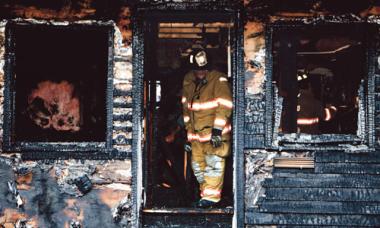
The crime spree claimed two lives—those of Paul W. Yeskie, Sr. and his son, Paul W. Yeskie Jr., residents of 17 Fair St.—and hundreds of thousands of dollars' worth of property between 2 a.m. and 3:15 a.m. that morning. Firefighters from 14 area departments responded to at least nine separate fires set, according to state fire officials, within that 75 minutes.
The fires made national headlines and dominated the local news. In addition to the fires themselves, news media—print and broadcast media as well as a variety of online sources, which demonstrated their power not only to inform but to help organize the community's response to the crisis—focused heavily on the community reaction. That included the online response, the many charities and benefits that have been organized and the presence of more than 500 residents at a community meeting on December 29.
I wasn't the only one who learned about the fires through Facebook. Blogger Josh Stearns noted on his site Groundswell, "Like many of my friends I found out [about the fires] through Facebook and Twitter, not through any established local news source." In the early aftermath of the fires, as traditional media issued brief, barebones reports, the Internet came to life with sources such as the "Friends of Northampton Arson Victims" Facebook group, where, as Stearns put it, residents could share information, offer support and get organized—even clarify remarks they felt were taken out of context in the media reports.
Michael Kusek, who runs a small advertising and public relations agency, and Rebecca Neimark organized the Facebook group, initially as "an easy way to organize our friends," says Kusek. Within 24 hours, the group had 2,000 members. By Jan. 3, a week after the fires, the group had 4,079 members. "I was floored," Kusek says.
*
Fair Street, where the Yeskies lived, is located about half a mile from my home. The top floor of that house, a two-story, mustard-yellow home that looked like a dozen others in that neighborhood, was gone. No smoke remained, no smoldering embers, no violent flames. Just a damp building with the top floor washed away.
From there I walked to the location of another fire on Union Street. The fire there was not a fatal one, but it was destructive. The air smelled pungent, like burnt wood, plastic and other things that are not supposed to burn.
As a resident of Ward Three for the past four years, I knew about numerous arsons very close to where I lived, most of them concentrated around Hawley Street. Like many other residents (and perhaps city officials), I had tried to forget about the earlier fires. Ward 3 resident Jim Neill, who's been a contributor to the Facebook group and learned about the Dec. 27 fires there, echoed my own feelings: "I was detached from the previous fires because I had an admittedly dismissive response … though I read that the more active residents of the ward were communicating. I think as much as people like to be a part of a community, they also like to be left alone and free to live their lives."
In this case, however, it was hard to be dismissive. It was the "widespread assault" of the Dec. 27 fires, Neill said, that brought people together against an "invisible enemy."
One of those Hawley Street fires in 2007 destroyed the home of Naomi Cairns. Shortly afterward, she moved to Seattle—to attend graduate school as well as to escape the memories of that fire. She moved back to Northampton six months ago. During the December 27 arson spree, Cairns' new home was set on fire (the damage from that fire was contained on the porch). As a community social worker and a two-time victim of arson, Cairns says she's grateful for the community response to the recent rash of arson, but with reservations.
After she spoke at a Dec. 29 community meeting, Cairns received much attention online. She was the only two-time victim who spoke, and her words carried no praise for a steadfast community or a responsive city government. "I don't know if I can live here anymore," Cairns said to Mayor Clare Higgins, who ran the meeting along with representatives of the Fire and Police departments.
Though Cairns said she still loves Northampton, she wrote in a subsequent email that "this experience has directly affected my leaving again soon." Cairns says she is currently unable to sleep without wearing her shoes and being near a fire extinguisher and a small packed bag.
Cairns says she and Mayor Higgins had spoken after the 2007 fire that claimed her home, when she approached the mayor to discuss her "concerns and feeling of a lack of communication on part of the city officials." Cairns said that the city officials who have handled her cases have been largely compassionate and attentive. She feels that "the over-arching issue is not the individuals working cases, but the lack of overall structure in the city: the ratio of city officials to the rate of crime … as well as funding for these systems to be effectively in place."
The crowd at the Dec. 29 meeting seemed to sympathize with Cairns, despite her implicit criticisms of the official response since 2007. The crowd was not, however, as warm to another speaker, Jonathan Brody, who spoke of his anger toward the city. Some in the crowd booed, much to Cairns' dismay.
"In my understanding, he was speaking to the notion of privilege, and the idea that folks in the more affected area of the city… have tended to be more working-class, they seem to be perhaps less able to be sure their homes are safe, as they may be renters, young adults beginning careers who do not have renters' insurance, do not have garages to protect their cars … [or] are students living on a small budget," Cairns said in an interview, adding that she doesn't mean that arsonists avoid hitting the homes of people with more resources, but that more affluent victims may not be as deeply affected in the long run. "[This class dichotomy] must be examined if this community is going to truly be united. … I feel that there is a legacy of privilege and inability to dialogue around these issues within this overall 'Valley' community," said Cairns.
Picking up on another comment Brody made on Dec. 29 about Ward 3's history with arson, drug arrests and substance-related deaths in the nearby Meadows, Cairns said incidents like these often get short shrift, in part because of the way people see and talk about the Pioneer Valley. The locale's popular nickname, "the Happy Valley," she said, "does not allow for the reality that there, in fact, are a lot of unhappy folks, struggling with not only poverty and feeling like outsiders in a heavily privileged, white, and academically educated area, but many of whom have mental health issues and/or are homeless [and] whose needs clearly are not being met," said Cairns.
*
Whatever one thinks of the official response to the recent fires, including an investigation coordinated by the Northwest District Attorney's office and comprising several state and local agencies, it's clear that residents aren't waiting for the government to take the lead. A public and real-time record of the community response exists online; one simply needs to log on to Facebook and scroll down the page to see the myriad of posts, comments, news items and pictures people have linked to.
Within two days of the fires, six venues and 36 artists had committed to putting on a series of benefit concerts. Local musician Ella Longpre spread the word on Facebook.
"Hourly, people are posting information on fundraisers, swapping ideas on how make the community safer, brainstorming," said Kusek. The communication regarding specific donations that need to be made has been very effective, and a website (hampshirecountycares.com) has been created as a resource for those who wish to give. On and off-line, bake sales to raise funds and vigils have been organized.
Among the various comments online and at public gatherings, you'll find a few that talk about a possible "silver lining" in this cloud of smoke—the community organization itself. Such sentiments strike folks like Cairns as inappropriate. "Although I do not want to put others down who attempt to find goodness in tragedy as it is … a way to instill hope," she explained, "I do not find 'seeing the bright side' to be appropriate unless one has gone through a similar experience."
In the wake of a tragedy, a community needs to communicate and respond. In past arsons, Northampton hasn't effectively done either. This time, our common "invisible enemy" has become too destructive to ignore or quickly forget.