
I would have enjoyed Avatar a whole lot more if I hadn't said I'd write about it.
Without the obligation of putting words to paper, if you'd asked me what I thought, right after the credits started to roll and the lights came up, I might have said this:
"Pretty fucking cool. James Cameron hit it out of the ballpark again. The 3D stereo photography was amazing: really sucked you into the alien landscapes. And the CGI characters were basically indistinguishable from the real life actors. I forgot all about the technology, and I really thought the story and action were thrilling. The aliens looked more believable than they did in magazine photos I'd seen, and the scenes I liked best included the lead female alien on the prowl in the jungle (not only because she was mostly naked)."
Not at all a bad way to spend a weekday afternoon when I could have been back at the office answering email.
Leaving the theater, though, I made a beeline to Target so I could pick up a few extra toys for my son to open on Christmas day, and I began to contemplate what I was going to write. As I headed into the toy section, I found that the thrill I'd felt wearing my 3D glasses was gone. Even worse, I felt myself beginning to pick James Cameron's all-time most expensive fantasy apart.
For me, nitpicking an adventure flick is damn near a criminal act. Since I was a boy, I've been a fan of blockbuster Hollywood special effect spectaculars, and these days they're about all I go to the theater to watch. If a movie doesn't require a big screen and incredible sound, I'm happier at home with a DVD. But in my day I've downed mountains of popcorn and gallons of Coke as I sat in the dark, absorbed in galactic conquests, dragon duels and historic epics. Like the filmmakers who spin these elaborate yarns, being amazed and having my imagination transported cinematically somewhere wild and different has become a kind of ritual for me.
Action and high adventure is the perfect tonic for utility bills and taking the trash to the dump, and I've always felt that mainstream movie reviewers miss the point when they criticized the dumb dialog or tenuous plot logic in these kinds of movies. To me, it's like riding a rollercoaster and then complaining about the speed and hair-raising turns.
Still, when I began pulling at that one thread, the whole thing began to unravel.
*
Before I continue, a plot summary:
On a distant planet, Pandora, there is a valuable mineral that's only found there. An American corporation has set up shop and is mining the mineral, but since the jungle planet is full of wild creatures and angry natives, it has massive military support protecting its staff as they devastate the planet. Along with intimidation through firepower, humans are trying to infiltrate the alien tribes to win their hearts and minds by using avatars: alien bodies that are incubated and raised in test tubes, but then controlled by humans remotely. The human controller attaches wires to his head, lies down in an isolation chamber and is able to inhabit the avatar's body, wherever it may be. In this movie, one of the human avatars—a former Marine—becomes enamored of the aliens' beauty and their exotic ways, and leads them in a revolt against the humans that sends them packing back to Earth.
At its heart, Avatar is standard James Cameron fare: pig-headed corporate boobs looking for quick, decisive action, but who are in conflict with the wait-and-see, take-stock-of-the-world-around-you modus operandi of the scientists. Man versus nature, nature wins.
*
Other reviewers have compared Avatar aptly to Kevin Costner's Dances with Wolves. During Avatar, most of the two and a half hours is spent with our ex-Marine hero learning the ways of the alien tribe: how their whole world is essentially one tremendous living organism, and how it's only okay to kill if you have deep respect for your victim and are really, really upset about it afterwards.
While these important, laudable sentiments have served many world religions well, and Cameron is a good enough director to make his characters and situation compelling, his mix of philosophy and storytelling work at cross-purposes here. In the movie, he feels compelled to make this holistic interrelation physical instead of philosophical by having all creatures literally able to plug into and communicate with one another using fibrous tentacles that grow out of them. When characters walk through the jungle, their footprints glow in the moss with a phosphorescent luminescence. When our fetching female alien and avatar first meet, she refrains from shooting him with an arrow when glowing, air-borne spoors begin to flock around and stick to him. Clearly, Cameron is doing all he can to make these intangible, spiritual ideas actual and beautiful. But to what end? Because he hopes his audiences will achieve inner peace and harmony with their surroundings? Not quite.
This battle between the evils of modern technology and the beauty of primitive living have been duking it out for decades at the multiplexes. Lucas had his Ewoks giving the evil empire a thrashing they wouldn't soon forget in Return of the Jedi; Spielberg's ET dealt with similar issues; and Peter Jackson played with these dualities throughout the Lord of the Rings movies and in his follow-up production of King Kong. In this post-colonial age where we are no longer permitted to be proud of the conquests western civilization has made, it's a formula that's worked, and I'd wager Cameron was convinced that having his alien savages win against his mechanized Marines would be a sure-fire crowd pleaser. And he's probably right, but it seems to me he stepped over the line those other directors avoided: he likes his bad guys better than his heroes.
Though the human militants embrace a lifestyle Cameron wants to treat as villainous, as with all his movies (other than Titanic), he's clearly smitten with the futuristic military equipment they wield. The 3D tactical read-out screens and menacing robotic walkers are all rendered with much more detail and loving care than is the culture of the alien race they seek to suppress.
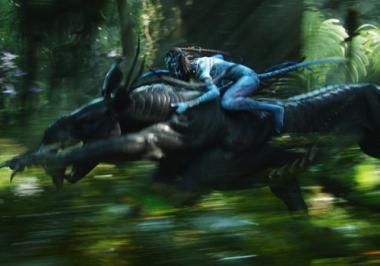
And while that alien race seems to understand how they're connected to their planet, their lifestyle doesn't appear to be very different than the humans'. They value the same things: the aliens are impressed when the humans have sent them an avatar who is not a scientist, but a warrior. While they wear some nicely designed jungle gear, there's no evidence of music, art or storytelling in their lives. Being the most aggressive top dog is what inspires their respect, just as it inspires the respect of the human militants, and the crowning event in the movie is not our hero's adoption of the native people he's come to love but the balls-out fire fight between these two warring nations. Sure, the hero has figured out how to ride the meanest pterodactyl on the planet, but when he fights, he still brings along his sub-machine gun.
And while the aliens win the day, it's only because they had a human amongst them who had been convinced to pull a Benedict Arnold.
Tapping into the misty-eyed regret for conquered aboriginal peoples and their cultures, and using that potent concoction to celebrate military aggression and sell tickets, toys and McDonald happy meals, seems particularly cynical to me—especially when those native peoples are represented by wholly fantastic and imaginary beings generated entirely by computer technology.
Instead of spending the last decade perfecting the equipment with which he was to tell his cinematic spectacle set on a distant planet, it might have been an ultimately more worthwhile and satisfying venture if Cameron had spent his time and money researching an actual people who have been threatened by the cold, calculating corporate attitude he claims to hate so much.