
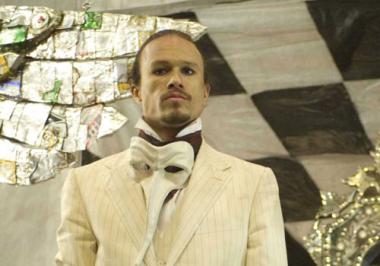
The Imaginarium of Doctor Parnassus
Directed by Terry Gilliam. Written by Terry Gilliam and Charles McKeown. With Christopher Plummer, Heath Ledger, Andrew Garfield, Lily Cole, Verne Troyer, Johnny Depp, Jude Law, Colin Farrell, and Tom Waits. (PG-13)
When Heath Ledger won a posthumous Academy Award for his turn as The Joker in The Dark Knight, it seemed to be the capstone to a short, bright career. We would remember him, certainly, for his other work—Brokeback Mountain in particular—but it was the sociopath with the garish makeup that would be his lasting image.
Except now it might not. As electric as he was in that role, his work in The Imaginarium of Dr. Parnassus—the Terry Gilliam film he was halfway through shooting at the time of his death—is often as impressive, if decidedly less flashy. His character here is, like The Joker, something of a flim-flam man and an almost accidental villain, someone whose lack of morals allows for some monstrous crimes of opportunity. But instead of a comic-book kind of justice, the stakes in the world of Dr. Parnassus are measured in souls.
When we first meet Tony, the charity scam-artist played by Ledger, he's already dead, hanging by the neck from a London bridge. He's stumbled upon by Parnassus (Christopher Plummer) and his traveling theater troupe, a motley crew that includes amateur magician Anton, dwarf stagehand Percy, and Parnassus' daughter Valentina. The troupe has just been run off after causing a disturbance outside a nightclub—if you can call a man disappearing into his own imagination a disturbance. And, oh, by the way, Tony isn't really dead.
Once they haul him up, Tony becomes the linchpin in a centuries old game between Parnassus and Mr. Nick, a tuxedoed Satan in a bowler hat better known to most as Tom Waits. Waits—because, let's face it, in most movies in which he appears, he's essentially hired to play himself—is a betting man who has come to collect on an old wager, the payoff of which was Parnassus' first-born, on her sixteenth birthday. But like any addict, he can't help himself, and makes still another bet that, should Parnassus prevail, could set Valentina free. For two immortals (another benefit of being the Devil's drinking buddy), money is small potatoes; instead, they'll use Tony's soul.
At first, of course, Tony thinks he's pulling the strings. The Imaginarium players travel modern London in a rickety wooden trailer that, once they've parked it in some opportune place, unfolds into the stage and proscenium arch that provides the space for their strange theater of the mind. The slick, smooth-talking Tony is soon drawing the rich and lonely women of England's upper crust to what by most accounts is a circus sideshow booth, where he takes them literally through the looking glass, and where Mr. Nick and Parnassus—those shoulder demons of old cartoons—try to sway their subconscious.
In a strange twist, Ledger's death came after he had filmed the "real world" scenes in Parnassus but before he was able to tackle the "Imaginarium" scenes. (Fans of Gilliam, whose every picture seems to suffer some unimaginable setback during production, probably won't be surprised.) To complete the picture, Gilliam recruited three actors to play Tony in that other world—Johnny Depp, Jude Law, and Colin Farrell all take a crack at it, and succeed mostly in the order listed. Though it sounds like a cop-out—some artistic Three Card Monte—in actuality it's something of a heartbreak; Ledger's stand-ins, to a man, seem to understand that they are there not only to further the story, but also to remind us of something—someone—we've lost. To the best of their ability, they assume aspects of Ledger's Tony; only Farrell seems more like himself, along with Waits' saloon-song Satan.
But in the end that other world is pure Gilliam—riotous invention that mixes different forms of animation with a dark and humorous psychology. The director, who created the famous animations of the Monty Python series as well as films like Brazil and The Adventures of Baron Munchausen, is as close as we have to a real-life Willy Wonka. Unafraid and absolutely dedicated to his own vision, Gilliam takes so many risks that when some fall flat—and, certainly, at least a few do here—one can't help but stand up and cheer him on as he approaches the next hurdle.
The Road
Directed by John Hillcoat. Written by Joe Penhall, adapted from the novel by Cormac McCarthy. With Viggo Mortensen, Kodi Smit-McPhee, Robert Duvall, Guy Pearce, Charlize Theron, and Molly Parker. (R)
In brief: The Road, directed by relative newcomer John Hillcoat (he also made the Australian Western The Proposition) is a stunner. Adapted from the novel by Cormac McCarthy (No Country For Old Men) it's a post-apocalyptic tale unlike most seen on screen of late: first of all, it has no zombies.
What it does have is Viggo Mortensen (A History of Violence) and newcomer Kodi Smit-McPhee as a father and son traveling south in an effort to reach the coast, and some vague idea of a better life. Along the way, they meet cannibals, thieves, and murderers; and loved ones, hoping to spare a future sorrow, plan lonely suicides. But for all the death involved, there's surprisingly little gore on display—Hillcoat, like Hitchcock, knows that less is more, and that the fear of capture is worse than captivity.
Visually, The Road is rightly bleak, full of grays and whites, the ashy palette of a devastated Earth. If it has one weakness, it's that it refuses to allow hope beyond a single, unexpected insect, flying off in lazy circles and gleaming green against the soft, dull light.
*
Also this week: Northampton's Academy of Music continues to screen the month-long Paul Newman retrospective Meet Me at the Movies. On Sunday the 17th they bring in Robert Benton's (Kramer vs. Kramer) 1994 film Nobody's Fool, a warm and low-key comedy that is often—if somewhat understandably, given what it's up against—overlooked in surveys of Newman's career. It's a welcome entry here.
Based on a novel by Empire Falls scribe Richard Russo, the film stars Newman as Sully Sullivan, an aging rogue and rapscallion living the kind of small-town life Russo captures so well. At odds with just about everyone, the cantankerous Sully trades barbs with a well-cast ensemble including Jessica Tandy, Bruce Willis and Melanie Griffith—this is that rare sort of movie in which even Melanie Griffith can come off as good—while trying to connect with his estranged son and grandson. Newman's performance earned him a Best Actor nomination (his last) when the film was released; he lost out to Tom Hanks and the Forrest Gump steamroller, but his work remains.
Opera buffs: if you've found yourself frustrated in your attempts to secure tickets for a local screening of Carmen, you're not alone. The Metropolitan Opera's Live in HD simulcasts have proven to be a popular offering, especially at Hadley's Cinemark theater, where shows on two screens have already sold out in advance of this Saturday's broadcast. But fans of Bizet's most enduring work have another option in scenic Shelburne Falls, where Memorial Hall will present the 1 p.m. show. Conducted by Yannick N?zet-S?guin and directed by Olivier Award winner Richard Eyre, the production stars Elina Garanca in the title role, with Roberto Alagna as the love-crazed Don Jose. More information and tickets are available at shelburnefallsmemorialhall.org.
Note: At press time, the show was also listed at West Springfield's Showcase Cinema, but tickets were either sold out or simply unavailable online; a phone call to the theater resulted in a frustrating and repetitious experience with an automated voice-message system, interrupted only by obnoxious ads selling cell phone ringtones—a scenario, perhaps, to be explored in some tragic opera yet to be imagined.
Jack Brown can be reached at cinemadope@gmail.com.