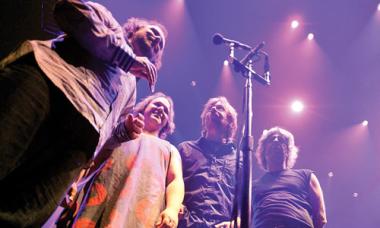
In the fullness of time, Vermont's two greatest exports may not be Ben and Jerry. They may just turn out to be former governor Howard Dean and Phish, the Burlington-based band who, in fact, have their own Ben & Jerry's flavor.
Similarities can be found—if you squint real hard—between Dean and Phish. Both nurtured their visions in Burlington, the low-key city on lovely Lake Champlain and then, slowly and organically, worked their way into the national consciousness. Both valued the grassroots over the top-down model and proved it could lead to victory. Both eschewed cults of personality or pre-fab images and carried on with their game plans despite an initial lack of mainstream acceptance. And, once they hit the big time, both were harshly criticized by those who did not "get" the Deaniac or Phishhead phenomenon.
Parke Puterbaugh, author of a revealing new book about the band, Phish: The Biography (Da Capo), gets it. He can, in fact, personally attest to the disrespect the band seems to generate among the hip cognoscenti. Puterbaugh met Phish, and first really listened to their music, in 1995, when Rolling Stone sent him to Vermont in the dead of winter to write a profile. He filed his piece on deadline and then it "languished in editorial inventory as a new regime in Rolling Stone's music department sat on the story." Meanwhile, hip-hoppers, alterno-pretty-boy bands and caterwauling divas all received their moments in the media sun—and are now, of course, totally forgotten.
But, Puterbaugh noted, "Phish just kept ballooning in popularity," and the hip music press didn't know what to do with a band that had bypassed the hit-making machinery altogether. By the time Rolling Stone finally ran Puterbaugh's profile of the band two years later, Puterbaugh had made several more trips to Vermont and the piece itself ballooned to 5,000 words, a mini-epic by Stone standards. By then, Phish already owned six gold albums (500,000 sales) and two platinum albums (1 million) and consistently drew the biggest crowds on their tours. The once trendsetting magazine looked like Johnny-Come-Latelys to the party.
New England's Best Kept Secret
Less than 10 years before they made the pages of Rolling Stone, Phish were playing happy hours at Doolin's, a Burlington tavern. The four members—guitarist, composer, leader Trey Anastasio; bassist Mike Gordon; keyboard player Page McConnell; and drummer Jon Fishman—all met at the University of Vermont and nearby Goddard College. They were, Puterbaugh said, "four musicians from four states, each possessing unconventional passion, talent and vision, who found each other in Vermont."
For about the first decade of their existence, Phish were New England's best-kept secret. After forming in 1983, they honed their sound for years at frat houses, dorms, parties at friends' Vermont farms. From Doolin's they moved up to Nectar's Lounge, a friendly dive on Main Street in Burlington beloved to townies and college students (now famous, its ubiquitous T-shirts proclaim, as the "Home of Phish"). From there they moved on to The Front, a slightly larger venue.
Nearly oblivious to their growing legion of fans, Phish was focused in these days almost entirely on the music. When they weren't playing gigs, they were rehearsing at a house where they all lived. It would be safe to say that few band members in rock history have spent more time together than the four guys in Phish, who genuinely like each other even after 25 years.
"No marriage could survive the amount of time these guys have spent together," said Puterbaugh, laughing. "It was clear to me after getting to know them that their very deep bond of friendship is the key to the whole thing. They just like being around each other. Trey has often said that his favorite time with Phish is rehearsing with the other three guys, the joking, story swapping, brainstorming, just the four of them. They have a great chemistry."
Not surprisingly, the four musicians also developed a sixth sense about the contours of their improvisations, instinctively knowing when to allow each to take off and when to reel him in. They even devised their own secret language for improvising, an exercise they call "Including Your Own Hey."
Perhaps such inner chemistry and their strong sense of place and community in Burlington was subtly transferred to their fan base. It does indeed seem that once you are a Phish fan, you are a Phish fan for life—a Phishhead.
The band would eventually pay homage to these formative years, putting a photograph of Nectar Rorris, the Greek owner of Nectar's Lounge, on the cover of their third studio album, A Picture of Nectar (1992). In the liner notes, Anastasio wrote, "Nectar was happy to give us a gig despite our lack of experience, organization or a song list long enough to last two sets…. Those nights at Burlington taught us how to play. There wouldn't be a Phish without Nectar's."
For five years, Phish remained a Vermont institution. Though it's hard to believe now, the band's first paying gig outside Vermont was in Amherst, Mass. in 1988. How they came to Amherst is a microcosm of how they became such a phenomenon. That is, John Paluska was dragged by a friend to a Phish gig in Burlington. At the time an English and math major at Amherst College, Paluska recalls, "There was something very incongruous about it to me right from the start because they were playing at this neighborhood bar for no cover on a very cramped, almost nonexistent stage. Yet they were so polished and so good, and they had such a depth of material."
Paluska approached the band between sets and hired them that night to play a gig in Amherst at a co-op house where he was social director. He paid them $600, and they instantly won new converts. After arranging several other gigs in Massachusetts, Paluska took over as tour manager. He and fellow Phishhead Ben "Junta" Hunter created their own company, Dionysian Productions. Paluska essentially became the face of Phish to club owners. A gentleman of the old school, his approach was "not to beat somebody up or get the upper hand but to have a spirit of fairness and mutual respect."
Their early tour schedules look like whistle stops on a road map of New England: Amherst (where they've played 12 times), Northampton (7 times), Keene, N.H. (9 times), Portland, Maine (23 times), Boston (19), Worcester (11), Lewiston, Stowe, Stanhope, Hartford, West Hartford, Naugatuck, Salisbury, New Britain, Middletown, New Haven, and the road goes on forever…
"They started in Burlington and branched out from there," said Puterbaugh, now a consultant to the Rock and Roll Hall of fame and instructor in the music department at Guilford University in Greensboro, N.C. "They didn't play outside of New England until 1988. New England is very important to all of them. They pulled in many of their New England friends to become members of the Phish team. The lighting guy, Chris Kuroda, had never touched a spotlight in his life when Phish asked him to take over as lighting director. They said, 'Come on, we'll learn about this together.' Now he's one of the best at what he does. And they are still a New England band in that they all still live in New England, in the Burlington area."
Phish by the Numbers
Once they reached a national audience via their website and nearly endless touring, Phish grew beyond both their wildest imaginings and their ability to control. By 2000, the burnout forced a hiatus. They had by then stopped practicing, were distracted by personal matters (marriages, divorces, side projects). But because they had generated a staff of 40 fulltime employees, they felt duty bound to return and reunited for New Year's Eve, 2002 in Madison Square Garden. Then they embarked on a frenetic drug-fueled 2003 tour.
Indeed, drugs and alcohol began to take their toll by 2004, when Anastasio announced they were breaking up. They each turned to solo projects: Anastasio formed Oysterhead with Les Claypool and Stewart Copeland. Mike Gordon made films (including one of the best documentaries about Phish) and solo albums (including two underappreciated discs with guitar legend Leo Kottke). Page McConnell formed the band Vida Blue and Mike Fishman played drums with several bands in the Burlington area.
How successful and productive had Phish been up to that point? According to Puterbaugh, the band performed 1,435 concerts between December, 1983 and August, 2004, at which point "they broke up for good." They have, of course, since reunited with renewed energy and focus, completing a successful tour last October and releasing a new studio album, the aptly named Joy. (They will be playing in Boston at the House of Blues on Feb. 12 and at the Oakdale Theater in Wallingford, Conn. on Feb. 13).
Puterbaugh notes, "Given that the average Phish show runs for three hours—two 75-minute sets plus an encore—that's the equivalent of 175 full days, or six entire months" on stage. Consider also that Phish have never had a hit single or received much radio play, yet six of their 13 studio albums earned gold record status and one (Junta) went platinum. Their 43 separate live releases—available at Phish.net—reached various levels on the Billboard charts (with A Live One achieving platinum status and Hampton Comes Alive going gold). Their biggest paydays came from touring. From 1996 to 1999, for example, Phish grossed $93.1 million on concerts alone.
In addition to their success, Phish blazed the trail for a new business model that independent-minded musicians ignore at their own peril. By creating their own festivals in far-flung places (at which they were the only musical guests) and maximizing the potential of the Internet as an organizational tool, Phish paved the way for H.O.R.D.E., Lollapalooza and Bonaroo.
Take Phish's legendary Clifford Ball, held at a decommissioned U.S. Air Force base outside Plattsburgh, N.Y. By word of mouth and Internet dispatches alone (on Phish.net), the Clifford Ball (named for the pioneer of air mail) attracted 70,000 fans, turning a slab of concrete runway on which it was held into the ninth largest city in the state for two days in August, 1996. Seen another way, the largest musical event in the U.S. in 1996—and one of the biggest of the decade—received virtually no media attention before, during or after the fact.
At the same time, Puterbaugh noted, the Clifford Ball "almost seemed antiquarian in its total indifference to the bottom line." That is, the band had a captive audience of 70,000 whom they did not gouge for entrance fees, nor did they bleed them dry for bottled water, provisions or tour merch. Overhead, planes flew past trailing not advertisements but Zen-like messages (e.g. "Hopeless Has Exceptions"). One stunt pilot, toting a banner that read "Running Low on Fuel—No Joke," intentionally sputtered his plane engine as if he were about to crash. Safe and clean campsites were provided and afterwards all identifiable items from the Lost and Found booth were returned to their rightful owners. The Clifford Ball was just the first of eight similar weekend campout festivals of similar scale since then. At these events, the crowds were well behaved, no violence was reported and everyone went home happy.
"Phishheads can get territorial toward the front of the house, but overall they look out for each other more so than at most rock concerts," said Puterbaugh.
Things like that explain why Phishheads are so devoted. That and the music, of course—a tightly played yet improvisational blend of hard rock, psychedelia, jazz country, bluegrass, blues, classical and even a bit of salsa and a cappella.
Hot Bio With a Bullet
Puterbaugh's biography caught a tailwind from Phish's own success, entering the Amazon "Hot 100" before it was even released. Its appeal is even wider to more than just Phishheads. Indeed, because he went into the project with his eyes and ears wide open, but not as a devotee of the band—rather as a journalist with 30 years of experience covering musicians, rock music and its history—his outsider perspective makes his eventual deep appreciation for the band and their music more meaningful to readers, especially those who might be curious about Phish but have never made the leap into the deep end with the Phishheads.
Despite the many books, films, fan sites and newsletters devoted to the band Phish, this book offers a fresh perspective. It doesn't flinch from the darker corners of the Phish world, including the escalation of drug use among Phish fans and band members. What began with relatively benign pot and LSD moved on to ecstasy and, almost inevitably, to cocaine, "Special K" (an animal tranquilizer), nitrous oxide (aka "hippie crack"), meth, Oxycontin. Anastasio got lost in these powders; McConnell was somewhat less impacted, though Fishman and Gordon largely skirted past dependency problems. The real heavy druggies were the stage crews, who used cocaine for "energy boosts," and the backstage fans, who created a scene of mayhem out of a Roman bacchanal.
Puterbaugh puts it this way: "Perhaps the moral of the story is that the lure of drugs and debauchery is irresistible and that the lid to Pandora's box will pop open, as if spring-loaded, once the spoils of rock celebrity insistently present themselves." A line is crossed, in his view, once the "raging started affecting health and welfare, and the forward progress of their music suffered to the extent that the band stopped practicing."
The book offers great portraits of some people almost as important to Phish's success as the four band members, including Ernie Stiles, the music professor at Goddard College in Vermont who inspired both Anastasio and McConnell with his theories of composition (it's in the harmonics, not the melody); Tom Marshall, Anastasio's boyhood pal from New Jersey with whom he has collaborated on songwriting for 25 years; Amy Skelton, loyal fan extraordinaire; Paul Languedoc, who may be the most important non-Phish because he built the band's equipment and helped shape their sound; Brad Sand, tour manager and one of the closest friends to all four members; Chris Kuroda, the lighting technician who creates all those dramatic effects; John Paulska, their manager; and Kevin Shapiro, the band's (and the fans') indispensable archivist.