A Single Man
Directed by Tom Ford. Written by Tom Ford and David Scearce, based on the novel by Christopher Isherwood. With Colin Firth, Julianne Moore, Nicholas Hoult, Matthew Goode, Jon Kortajarena. (R)
Press coverage of A Single Man has been, rightly, somewhat bipolar. On the one hand, it features a stellar performance by Colin Firth, who finally breaks free of his regular role as a doughy Englishman—he's still English here, but the comparison ends there. On the other hand, it was directed and co-written by Tom Ford, a man best known for his reign as the creative director of fashion giant Gucci, during which he put out ads that featured models whose pubic hair was shaved into the label's iconic G logo.
Could such a man make a serious film? The answer is a bit of both yes and no, but the surprise is in just how much he succeeds. Based on a book by gay icon Christopher Isherwood, Ford's film is tender and understanding in its attitude toward its protagonist—Ford, of course, is himself a gay icon whose chest hair alone was once described as "a forest of manliness"—but it falls victim a few too many times to fashion's false promise: that being beautiful is enough.
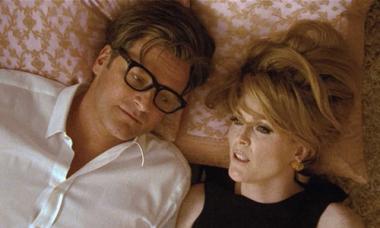
Firth stars as George Falconer, an English professor at a California college who has lost the love of his life (Matthew Goode, seen in flashback) to the kind of stupid, random accident that can change a life. When we meet him, George is planning his suicide; the film is about his last day on Earth, and whether or not he can find a reason to keep living.
Make no mistake, Ford's film is frequently beautiful. There's no reason to think it wouldn't be; you don't spend decades in fashion without learning how to make even the most prosaic of things look ravishing. But fashion is a world of small moments—a page in a magazine, runway walks, or a billboard seen from a passing cab—and film is long. Ford's main trick here is to show George's life in a washed-out palette that comes to life when a moment of real emotion or beauty catches his eye. For a while, it's beautiful and strange—like a developing Polaroid, or blood on snow—but he returns to it so often that it becomes meaningless. Similarly, the endless slow-motion sequences in which Ford fetishizes '60s-era consumerism give his film the feel of a glossy bit of mail-order catalog.
But all that is forgivable when we are faced with great performances, and Firth delivers—the actor is absolutely transformed here, and in many ways hardly recognizable. Leaner than we've ever seen him, and more dapper, Firth pulls off the greatest trick he can: we forget he's a movie star. He's well matched by Julianne Moore, who shows up briefly as George's boozy friend Charley, a sad and aging beauty who still longs for an intimacy she can't ever have.
So it's terribly unfortunate that the film's last third is absolutely ruined by Nicholas Hoult as Kenny, a young student with designs on George. Treated as a cross between savior and seducer, Hoult's character offers dialogue so badly written and delivery so jarring that his eyes couldn't ever have enough blue to make up the difference. That Ford hung his film on this performance was a huge misstep, and, because it comes so late in the story, it is, unfortunately, the biggest piece of our memory.
And yet, I still think about A Single Man often, remembering the impact of its imagery. The power of advertising? Perhaps, but tears are tears, and can't be denied.
*
Also this week: You may have read recently that the board of directors running Pleasant Street Theater is considering relocating the neighborhood fixture to a larger, more modern (but still undetermined) location. In an interview with The Daily Hampshire Gazette, chairwoman Lucy Wilson Benson called the Northampton theater "too small to be adequate for the long term," while board member David Mazor noted that "the mom-and-pop neighborhood theater has died out." Though fellow board member Meg Gage assured the Gazette that there was no chance of Northampton being left without a theater of its own, the move is sure to raise some eyebrows, coming just two years after the local community raised some $100,000 to keep the projectors running.
Whatever the long-term prospects of Pleasant Street—and we'll keep our ears to the ground—for now the lights are shining, and this week brings another installment in the theater's Emerging Filmmakers Showcase. The two-hour program, which runs on the first Wednesday of most months, provides a big-screen opportunity for anyone willing to submit their work to the scrutiny of the series' bookers. (For more information, drop a line to emerging@amherstcinema.org.)
On Feb. 3, two directors bring new work to the 9 p.m. screening. Matthew Newman's short experimental film The Hunting of Wayne is a study of a man afflicted with Huntington's Disease mixed with the memories of a lost child and, improbably—or inevitably, as it might seem these days—a vampire story. Paired with that is Lena Dunham's film Creative Nonfiction, about a college student who finds the line between life and art becoming decidedly blurred as she pursues an unreciprocated love. Still in her early 20s, Dunham was named one of Filmmaker Magazine's 25 New Faces of Independent Film in 2009.
If Newman and Dunham are emerging, there can be few more established than Garrison Keillor, whose radio variety show A Prairie Home Companion has beamed into American living rooms for over three decades. Filled with corny jokes (which mask an occasionally acid wit), mid-tempo music and a reliable slate of regular skits, Keillor's show has proved as popular as a live show as it has over the air, regularly filling theaters on its ongoing world tour. On Thursday, Feb. 4, it comes to Hadley's Cinemark theater in a live 8 p.m. broadcast from the show's Minnesota home at St. Paul's Fitzgerald Theater.
Another special show comes to Northampton this Saturday night when the Mamma Mia! Audience Sing-Along returns to the Academy of Music, back by popular demand—unbelievably, the show sold out its March screening at the 800-seat hall. The movie itself is a campy misfire that is redeemed only by the undeniably infectious sing-along format. Pay no attention to the plot (Meryl Streep, one-time floozy, tries to figure out which old flame fathered her about-to-be-married daughter); just grab your boas and your platform shoes, keep your eyes on the captions, and belt it out.
A final note this week: because of format changes at the Advocate, this is the final week this column will run in its current form. Going forward, CinemaDope will appear in a shorter form primarily focused on local events (send me your tips and press releases at the address below), and longer film features and reviews will run frequently.
Jack Brown can be reached at cinemadope@gmail.com.