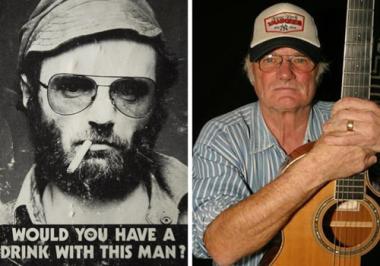
On a rainy night in Cornwall, England in 1966, a young Michael Chapman offered to play guitar in lieu of an admission price he couldn't afford. The pub offered him a regular paying gig and he's been at it ever since.
Starting with the release of Rainmaker on Harvest Records in 1969, the guitarist and singer/songwriter has produced more than 30 full-length albums and played countless shows across the globe.
February finds Chapman returning to the Valley to pay homage to his dear friend and colleague Jack Rose, who died in 2009.
Chapman took time out recently to chat by phone from his home in England about his life in music and his impending gig Feb. 12 at Amherst's Unitarian Meetinghouse with PG Six and Glenn Jones.
What brings you back to Western Mass?
I've been out that way before and I liked it very much. I played the Bookmill a few years back, and played the Unitarian Church in Amherst—a lovely place to play—and had a great time.
The main reason I'm coming over is I'm going to do a couple of memorial concerts for Jack Rose. We had plans to tour the States and Europe this year, before he passed away.
I was talking to Glenn Jones a couple of days after Jack died—to be honest, I think I was in shock—and I think Glenn put it best when he said, "I don't really want to think about a world without Jack Rose in it," and I think that goes for me, as well.
Tell me about your memories of Jack and his music.
Me and Jack toured together for almost a month the back end of last year. It's quite rare, you know—people who play solo, guitar players, it's kind of an insular and self-contained group, and they all have a great recognition for their own self-importance, and so me and Jack just got along together like a house on fire.
I met him first in Chicago at the Two Million Tongues Festival; I didn't hear him play that day, but we were staying in the same house afterwards, and we just got on. It's somewhat rare, because we can all be quite prickly with each other, because we guitar players view everybody as this competition, and I don't really [view it that way]. I have been known to, but it's not often, and Jack is just not like that at all. He knew my music from years ago, and we just got on like a house on fire from the word go. We also had the same interests—drink and food—and we love old guitar players, of which I now am one.
Respect is a great word to use between me and Jack.
I imagine there will be some of Jack's music that night, some songs dedicated to him.
I mean, Jack came out of the tradition of John Fahey and Robbie Basho, the so-called "American primitive guitar players." I don't think they're primitive at all, really, but this is the nomenclature. I toured with John Fahey in Europe and the States in the '70s and early '80s, so I knew John, which is why I think some of the John Fahey tradition-carriers felt a kinship with me, because I actually knew John quite well and worked with him quite a lot, especially over in Europe. So I'm kind of included in that group. It's a kind of continuing lineage, playing in this traditional style, which makes it sound simple, but it's not. It's a continuing and developing thing, this simple and elegant way of playing the guitar.
Did you think you'd be doing this for almost half a century?
Oh God, no. I never thought I'd get to 40, never mind be on the road for 40-odd years. I mean, I'm the guy that lit the candle at both ends and set fire to the middle, you know. I don't push as hard these days, but I'm still here. But we're guitar players, we're not athletes. We don't burn out at 40. Andres Segovia was playing well into his 80s. Jim Hall is nearly 80.
They say, "How many children have you got?" and I say I haven't got any, and they say, "Why not?" and I say that I've never been home long enough. I'm not one of these guys that records and then tours on an album every three years. I just like getting in the car and going and going, getting to the airport and catching a flight. Dylan's doing the never-ending tour—well, I started that in '66.
Who were some of your own influences when you were starting out?
I kind of got hit by everything. I got my first guitar in '56, and you think of the kind of music that was happening then—jazz was exploding, rock and roll happened, folk music was starting to happen—I was listening to it all, because I had a guitar and I was fascinated. But I would say take a look at my record collection from then. Jim Hall is in there, and I listened to Big Bill Broonzy, obviously, and Lightnin' Hopkins, some of the blues players, then got stuck on Django Reinhardt, then moved onto Wes Montgomery and Grant Green, you know. But the guy I really wanted to be like was Jimmy Smith, because he played the Hammond organ and was his own bass player. I was trying to do that with the guitar, which is how I got into using different tunings, trying to find the bass line.
And, like jazz musicians, you're known for taking standards or more traditional songs and using them as a launching pad.
I really don't think I've ever played a song the same way twice. They might have certain things in common, but I'm not good at—people come up to me and say, "You didn't play it like that last time I heard you play that," and I say, "When was that? That was then and this is now."
Do you prefer touring to the studio, or is there a balance?
Both. Putting me in the studio is like putting a fish in water. I love being in the studio. I've done quite a bit of producing as well over the years for people I admire and younger people I wanted to work with. I love it. There's a studio eight miles from my house that I've taken an interest in, and can basically go in whenever I'm off the road, which is good for me.
It's like two different things, though. It's like playing the acoustic and the Hammond organ: the notes are in the same place, but they're completely different things.
Ever take time to go back and listen to those old records or are those in the past?
Very rarely. My wife is an artist and does exhibitions and is away. So I'm at home, and [I listen] if I have one or two glasses of wine too many and think, "What was it like in '68?"
How do you find those old records? Okay?
I do, actually. A lot of it is okay. I mean, I've lost count of how many albums I've made. I lost track years ago. There are bound to be a few fillers here and there which you could be ashamed of, but you can't be at the top of your game all the time, whether it's guitar playing or being an athlete or a race car driver or whatever. You can't be on top every day. I think that's forgivable, in a way. I'm not trying to avoid the blame for this. [Laughs] I just think it's forgivable.
Do you ever get inspiration or ideas from younger acolytes and folks you tour with?
Not really. After all this time I've kind of reached my—I'm kind of where I want to be in the world. It's like a kid starting to learn to talk. You have to learn the vocabulary from other people, and then you start to put your own sentences together. And then if you're a writer you have a certain style, you know—you can read a page of Hemingway and know it's Hemingway without reading the title page. And I like to think that I've got something near that with my guitar playing.
Michael Chapman appears with PG Six and Glenn Jones at Amherst's Unitarian Meetinghouse Friday, Feb.12 at 8 p.m. For more info and song downloads, visit http://michaelchapman.co.uk.