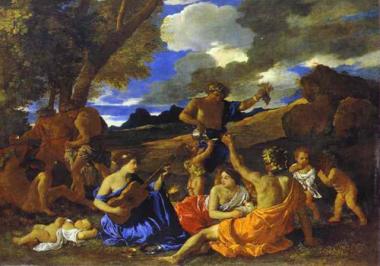
If you peruse the painting of Renaissance masters, you’ll frequently spot misty-eyed musicians languishing in rapturous poses, plucking at lutes in a sylvan glade or some such. It’s easy to imagine the sonorous tones that must have wafted out of those formidable instruments with their many strings, to imagine why listeners in those paintings stretch, half-clad, dreaming of satyrs and nymphs while munching always-plump grapes.
The truth of the matter is that, were most of us to wake up in Nicolas Poussin’s “The Great Bacchanal with Woman Playing a Lute,” our first instinct would be to pluck a couple of grapes and stuff them as far as possible into our ears.
That’s because of a curious, if little-mentioned, fact regarding Western music since the age of recording began: the equal temperament tuning our modern ears recognize as “in tune” is a pretty recent convention. When the likes of Poussin, Titian and Caravaggio put brush to canvas, the notion of “correct” tuning was a much less exact thing. Determining the sonic distances between notes and intervals on an instrument is always a trade-off—get one kind of interval more exact, and another suffers. Many kinds of tuning have been tried, and the current compromise in Western music is merely the most established version.
The differences can be subtle in some ways—listen to a tuning of historical vintage and it’s not a caterwauling mess. Usually, just certain pairs or groups of notes sound sour, sometimes very sour. But calling them “sour” is itself proof of a well-developed preference for modern tuning. It’s an unsurprising preference, since the competition almost never gets a chance anymore.
That’s why it’s refreshing to note that truly old-fashioned and just plain unusual instruments are getting easier to find. Locally, musicians employ all sorts of unusual choices, especially in the stringed instrument department. Peter Blanchette designed his own lute-like “archguitar”; Hadley’s Jim Matus may well be the only wielder of a laouto in the region; Gypsy jazz band Swing Caravan sometimes employs an oud. At Mount Holyoke College, a summer program in Arabic music brings lots of oud players to town.
It’s in part the Internet-fueled renaissance in homemade music that’s responsible for increasing music fans’ exposure to unusual instrumentation, and in part the increasing popularity of music from corners of the globe where tuning remains a much different enterprise. (Indian classical music, Balinese gamelan and many other forms of world music make regular use of tunings that venture into combinations of frequencies that sound “wrong” to Western ears).
Regardless of the precise tuning methods involved—instruments like the lute, which makes use of movable frets, can accommodate many ways of tuning—you can hear two examples of old-fashioned musicmakers March 7 at UMass’ Renaissance Center. One, the fretless oud, is central to the musical traditions of the Middle East and considered by many to be the precursor to the lute, itself an emissary from the era of competing tuning methods in Europe.
At the Renaissance Center, Kevin Germain (oud) and Christopher Stetson (lute) bring together quite different musical traditions—Turkish and Italian—in a concert called Uneasy Neighbors: 16th Century Music for Turkish Oud and Italian Lute. The press release explains, “While both cultures were experiencing artistic and philosophical regeneration at the time, deep religious and political differences appear to have precluded any significant musical cross-pollination.”
The concert includes music from Ottoman composers (in the 16th century, the Turkish Ottoman Empire sprawled over much of the region), performed on instruments that may not have been played together an awful lot, close cousins or no, but the combination of (perhaps messier) tones from a different age ought to prove particularly enlightening to modern ears.