
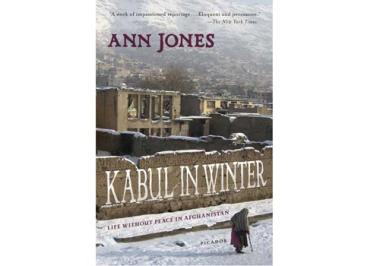
In the months after the collapse of the World Trade Center, longtime Manhattan resident Ann Jones found herself experiencing a strange form of disorientation.
“I’d turn a corner and draw a blank,” Jones, a veteran journalist and human rights activist, wrote at the beginning of her 2006 book Kabul in Winter: Life Without Peace in Afghanistan. “I’d have to stop and look around and think a minute—which way is home?—as if all these years I’d relied on some subliminal sense of the mass of the towers behind me, or perhaps a shadow over my shoulder, so that I knew which way was which.”
Jones wasn’t the only one thrown off kilter by the events of 9/11—so, she writes, was the entire nation. “I’d seen George W. Bush come to town to strut and bluster among the ruins, and as I watched him lug the stunned country into violence, my sorrow turned to anger and a bone-deep disappointment that hasn’t left me yet. Surely America was capable of some act more creative than bombing a small, defenseless, pre-destroyed country on the other side of the world, or so I believed.”
Kabul in Winter chronicles Jones’ time, over a period of several years, volunteering with humanitarian groups in Afghanistan “to try to help pick up the pieces” after the U.S. bombing campaign on that country. On March 25, she’ll speak about her experiences there in a talk sponsored by the Alliance for Peace and Justice, a Valley organization founded after the Obama administration’s decision to expand war efforts in Afghanistan and Pakistan.
Jones’ book offers a heartbreaking, powerful look at life in war-ravaged Afghanistan. In keeping with her earlier work—Jones’ previous books include feminist classics on sexism and violence against women, including Women Who Kill and Next Time, She’ll Be Dead—the author looks closely at the lives of Afghan women, who, even after the fall of the Taliban, are often treated as little more than property, to be sold, abused and disposed of. Perhaps most affecting is her description of a women’s prison, where many of the girls and women have been locked up for “offenses against public morality”—a category that includes being a victim of rape.
Conditions at the prison were bleak, but perhaps preferable to the alternative faced by women whose transgressions were, as Jones writes, “judged and punished at home, by their families. … This was the inescapable burden of Afghan girls and women: the family honor. Under the terms of ‘tradition’ and of ‘Islamic’ practices that ‘protect’ them, girls and women had come to bear responsibility for the moral life and reputations of the families that owned them. … The fallen Afghan woman loses her life in an ‘honor killing’ unofficially condoned to preserve the morality of women. No one knows how many girls and women, said to have brought shame upon the family, are killed by their fathers and brothers. How many are driven to suicide. How many are locked away. How many are ‘disappeared.'”
Alongside her close examination of contemporary Afghan life, Jones offers a larger historical context, one that looks at the various outside forces—America included—that have inserted themselves into the country with little regard for the long-term consequences. The morning after the U.S. began bombing Baghdad, Jones writes of the anger expressed by her Afghan driver, Sharif.
“You bomb Afghanistan. Many people killed. But we also happy Taliban go away,” he told her. “You say you help us. Now you bomb Iraq. Go get oil. Maybe next Iran? Syria? Will you bomb our brothers elsewhere? …
“Already you forget Afghanistan. Just like before. Russians go. Americans go. What you care about Afghanistan? Nothing. Let them fight. Let them kill each other. You can watch. Like chicken fight in Babur’s Garden.”
Jones attempted to defend herself, telling Sharif, “Please don’t be angry with me, Sharif. This man Bush who does this, he is not my president.”
She writes, “He turned to me, wordlessly, a face full of sorrow and disdain, and I knew that he saw me plainly for what I was: another American who would not take responsibility for what my country did to the world. I saw him too: another very old young Afghan man, standing alone … in a wintry garden where who knows what might fall out of the sky.”
Ann Jones will speak on Thursday, March 25, at the Parish Hall at Grace Church, 14 Boltwood Ave., Amherst, at 7:30 p.m. The talk is free and will be followed by a book singing and reception. For information, call 413-584-8975 or see www.westernmassafsc.org.