Editor’s Note: This story has been updated as of March 25. Please be certain to check the author’s comment at the bottom of the page.
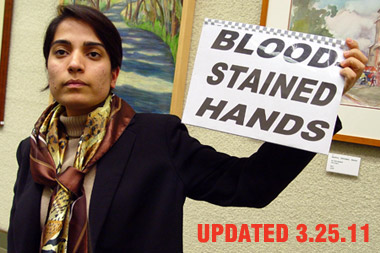
Malalai Joya was one of 160 women chosen to participate in the 2003 Afghan Loya Jirga, a national council assembled to debate a proposed new post-Taliban constitution—a significant enough moment, given the oppression, including political exclusion, that Afghan women have long experienced.
But it’s what the then-25-year-old Joya, who had been selected as the representative from the Farah province, said at that meeting that was truly remarkable. Complaining that the voice of the young people in the room was being ignored, Joya asked to be recognized and was granted three minutes to speak by the assembly chairman.
Standing in front of a microphone, wearing a heavy black-and-white striped robe and black head scarf, she criticized the inclusion of certain members of the assembly. “Why would you allow criminals to be present at this Loya Jirga? Warlords responsible for our country’s situation?” she asked, according to a translation attached to a YouTube video of the event.
Her comments received some applause from the room, and she continued: “Afghanistan is the center of national and international conflict. They oppress women and have ruined our country. They should be prosecuted.
“They might be forgiven by the Afghan people, but not by history,” she warned.
The earlier applause for Joya’s remarks was now drowned out by jeering from some members of the group, who stood, shouting and waving their fists in the air. “The sister has crossed the line of what is considered common courtesy,” the chairman said from his spot at the front of the room. Joya, he announced, was banished from the assembly. “Guards, throw her out,” he said. “She doesn’t deserve to be here.”
Joya was later elected to represent her province in Afghanistan’s National Assembly, or Wolesi Jirga, where she again spoke out against the insidious influence of “warlords,” drug smugglers and other criminals in the shaping of the new government—criticisms that prompted her colleagues to vote to suspend her from the body for three years. Joya has been called an infidel and a prostitute, been physically assaulted and threatened, survived several assassination attempts, and been forced to travel with armed guards.
She’s also been called “the bravest woman in Afghanistan,” and has won a slew of honors and awards for her courageous advocacy for human rights (particularly for the rights of Afghan women) and for her willingness to point out the abuses of both the Taliban and the Karzai government. Last year, Joya was named to Time magazine’s annual “Time 100” list of “the people who most affect our world,” and to Foreign Policy Magazine‘s “100 Top Global Thinkers” list.
Joya writes of her life and her activism in a memoir, A Woman Among Warlords: The Extraordinary Story of an Afghan Who Dared to Raise Her Voice. Next week, she’s scheduled to speak in the Valley at two events, as part of a U.S. speaking tour. The Valley events are sponsored by a broad coalition of academic, social justice and peace groups, including the Western Mass. American Friends Service Committee, the Alliance for Peace and Justice, the Five College Program in Peace and World Security Studies, the Northampton Committee to Stop the War and the Western Mass. Coalition for Palestine.
But last week, a potential wrinkle emerged: according to organizers of Joya’s speaking tour, the United States has denied Joya a travel visa, citing the fact that she’s “unemployed” and “lives underground.”
“The reason Joya lives underground is because she faces the constant threat of death for having had the courage to speak up for women’s rights—it’s obscene that the U.S. government would deny her entry,” Sonali Kolhatkar of the U.S.-based Afghan Women’s Mission, a sponsor of the tour, said in a press release.
The announcement also included this comment from Alexis Gargagliano, Joya’s publisher at Scribner: “The right of authors to travel and promote their work is central to freedom of expression and the full exchange of ideas.”
Sponsors of Joya’s two Valley appearances stress that those events have not been cancelled. At deadline, organizer Lois Ahrens told the Advocate that sympathetic members of Congress and others are working to persuade the State Department to grant Joya a visa so her tour can proceed.
Should Joya be allowed to enter the U.S., she will speak in the Valley at two events, both on Monday, March 28. At 4 p.m. that day, she’ll speak at UMass’ Thompson Hall, Room 106. That evening at 7:30, she’ll speak again at the Smith College Neilson Library Browsing Room. The events are free and open to the public.
As the Advocate went to press, there was still no resolution to the visa issue. To find out of the events will take place as planned, call the American Friends Service Committee at 413-584-8975.