
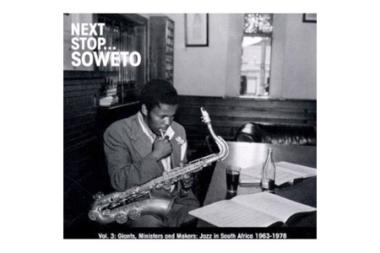
Various Artists
Next Stop… Soweto, Vol. 3: Giants, Ministers and Makers: Jazz in South Africa 1963-1978
(Strut)
The latest in this series focuses on the “silent years” of South African jazz. Starting in the 1960s, increasingly dire apartheid policies kept musical cross-pollination to a minimum and drove many artists into exile. Despite this, some remarkable music was created in the margins. This beautifully packaged two-disc collection showcases modernist jazz spiked with elements of traditional music, afro-rock, funk and fusion. The selections range from tightly coiled songs to expansive sonic workouts. There are fine tracks by local legends Dudu Pukwana and Chris McGregor, but obscure acts provide the true highlights, with inventive compositions that mix bright rhythms, infectious melodies and adventurous solos. A few pieces are pale versions of American jazz, but mostly this is an enjoyable and revelatory survey of important lost history. —Jeff Jackson
*
William Fitzsimmons
Gold in the Shadow
(Netwerk Productions)
The Pittsburgh native’s fourth album is mostly standard singer-songwriter fare. With high, quavering vocals, Fitzsimmons sings of lost loves, family issues and introspective confessions over acoustic guitars and the occasional electronic noise. The drums, piano, and strings are mainly in the background, where they get lost in the mix while the guitar swells up to meet Fitzsimmons’ haunting vocals. On tracks such as “Pyschastenia” and “Let You Break,” there is an electronic element layered with the usual acoustic guitar. The album is melancholy and meandering, and tracks such as “The Winter from Her Leaving” bring promise of a more upbeat sound but end up bogged down in Fitzsimmons’ vocals, which show a limited range as the album progresses. Fitzsimmons plays the Iron Horse April 3. —Josh Ernst
*
J Mascis
Several Shades of Why
(Sub Pop)
Amherst’s J Mascis is best known for laying down tangled thickets of electric guitar with Dinosaur Jr., but Several Shades of Why reveals a very different set of proclivities. Instead of noisy tangles, the disc is full of acoustic guitar and introspective lyrics. The fingerpicked strings owe more to Nick Drake than to rock, and Mascis’ low-key, almost drawled vocals work to markedly different effect. Over the top of slabs of distortion, they move at a dream-like remove, detached, sometimes sounding tongue-in-cheek. Over such sparse instrumentation, Mascis’ vocals become a weary ache, irresistible as the wiggle of a loose tooth. Fans of Mascis’ noisier work will find a wealth of stripped-down songwriting talent, and those who don’t care for the noise might well discover that an often deft sense of melody and arrangement forms the foundation of Mascis’ musical explorations. —James Heflin