There is a fungus called Cordyceps that works its way inside an ant, controls its brain, and then bursts out of its skull, sending infectious spores out. It can kill an entire colony.
Not only is this an interesting entomological fun fact, it’s also the subject of a song by Valley metal mavens Krakatoa.
“We made the choice not to write about serial killers, Satan or Vikings,” says vocalist Thomas Peake. “Not because there’s anything wrong with that, but because we saw so much material in the world worth writing metal about that hasn’t been done.”
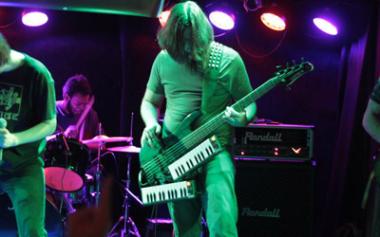
That’s not the only thing the quintet—Peake, drummer Aaron Laroche, guitarist Louis Motamedi, keyboardist/bassist Stephen O’Leary, and guitarist Kat Richardson—does differently. O’Leary’s instrument is a Frankensteinian creation: a bass guitar with two 25-key mini-keyboards jerry-rigged onto it.
“Believe it or not, he is capable of playing both the keyboards and the bass at once,” Peake boasts.
Krakatoa rose from the ashes of an earlier studio band started by Laroche, O’Leary and Peake.
“[The earlier project] was faster, more technical, but we decided to go with a more crushing, heavy, stripped-down approach with Krakatoa,” explains Peake. “We thought the name was appropriate because the volcano Krakatoa was destroyed in an enormous eruption that was heard thousands of miles away and changed weather patterns for years.”
The trio spent the better part of a year recording, recruiting Motamedi and Richardson along the way, and played its first proper show last summer.
Krakatoa began as a self-described “melodic death metal” band. Peake describes the subgenre as a style that emanated from Scandinavia—specifically in and around Gothenberg, Sweden—in the late ’80s and early ’90s as a sort of fusion of the new wave of British heavy metal (think Iron Maiden) and American death metal (think Cannibal Corpse).
He says the group has sonically evolved since then, and that few would still place them in that niche category that includes artists like In Flames, Soilwork, At the Gates and Amon Amarth. The musicians do still draw inspiration from these groups, along with heavy hitters like Mastodon, Opeth, High on Fire, Behemoth and Death. But Peake contends that Krakatoa exists in a genre of its own.
“Really, I don’t think anyone sounds quite like us,” he says. “If I had a criticism of metal today, it would be that it has become so Balkanized that a lot of fans scoff at anything that doesn’t exactly fit the parameters of a given sub-sub-subgenre.”
Peake says that there are a lot of adjectives traditionally used to describe metal acts: fast, brutal, aggressive, vicious. The one Krakatoa likes to focus on is heavy.
“To be as heavy as we are requires being a bit slower and less technical than other bands,” he says, “but it’s the sound we are shooting for, and I think the trade-off is worth it.”
The band is a big proponent of concept albums, which it insists keeps the writing process focused and free of “dull riffs.” It self-released Microbellum, an opus about insect life, last year. This year will see the release of Aberrations, “a strange, psychedelic tale of a guy dying of malaria in the antebellum South.”
“I had the idea while watching all the lunacy on last year’s healthcare debate,” says Peake. “But I don’t know if that will be clear through all the shrieks and guitar solos.”
For songs and show information, visit www.myspace.com/krakatoametalband.