
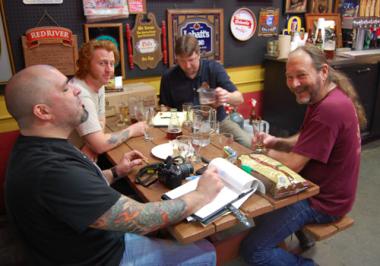
When I arrived at Berkshire Brewing in South Deerfield to take co-owner Gary Bogoff’s photograph for this year’s edition of the Best of the Valley, I hadn’t initially realized I was interrupting him in the middle of some delicate, exacting work.
After we’d snapped a couple standard shots of him standing in front of his gleaming stainless-steel brewing equipment, he asked me if I’d like a beer. This is not a question I can ever remember responding to in the negative, and so I eagerly followed him into the company break room. There’s nothing like drinking beer on the job, I thought, and clearly the folks at Berkshire Brewing feel the same way.
The break room consisted of two picnic benches and a small bar with nine beer taps, offering samples of Berkshire Brewing’s latest brews. Adorning the walls and hanging from the ceilings were all manner of promotional materials, mostly from other breweries: mirrors, neon signs, serving trays, flags, banners and a giant inflated Corona bottle.
Bogoff poured me a glass of the company’s seasonal Maibock (a style of beer with a pronounced malty flavor first brewed in Germany for special occasions) and returned to his seat with three other gentlemen who were sitting at one of the tables, deeply focused on the glasses and pitchers before them. I was briefly introduced, and then they returned to the work I’d interrupted.
It looked like a scene from a medieval tavern. The two men across the table from Bogoff were heavily tattooed and under other circumstances could be mistaken for tough customers. One had a mane of intense red hair, styled like Elvis, with thick mutton chops, and the other burly man was shaved bald, his thick eyebrows knotted in concentration. I’d gotten there around lunch time, and at first assumed these roguish-looking characters were employees taking a break, but amongst the beer and pretzels, they were all taking notes on legal pads.
As the bald gentleman cleansed his palate with a swig of water and reached for a slice of cheddar, he added to the medieval ambiance (and my uncertainty of what was happening in this scene I’d stumbled upon) by expressing some dismay at a task he needed to perform over the weekend. He’d be visiting a rabbit farmer he knew and helping him slaughter several dozen of the animals.
I guess my poker face isn’t all that I hoped, and catching my eye, he felt the need to explain. “I’m a chef. The rabbits are for my restaurant.”
*
His name was Alec Lopez—he was the chef from the Armsby Abbey and Dive Bar in Worcester—and the man sitting next to him with the mighty red mutton chops was Brian Oakley, the manager of Julian’s, a restaurant and bar in Providence, R. I. Jason Hunter of the Berkshire Brewing sales staff sat next to Bogoff and was preparing blends of their sour brew with different beers.
Brewed in oak barrels for nine months, sour brew is a kind of lambic, a Belgian invention. As the beer ferments, it mixes with the microflora found in the oak, and it results in (not surprisingly) a rather dry, somewhat musty, sour beer. On its own, it can be a pungent, almost overpowering assault to the senses, but mixed with other beers—usually sweet, fruit-flavored ones—the sourness can be balanced and offer an almost zesty flavor. Bogoff explained that the blend they were creating was a riff off another Belgian invention, a Gueuze. These beers are typically made up of a combination of a young and an old lambic, but that day the brewers were blending the sour with other Berkshire Brewing products.
When I got there, Hunter was carefully measuring out different ratios of sour to Maibock, which the others were swirling, sniffing and sampling. Together they debated their findings. Or, as Bogoff explained, “We’re pooling our sensory inputs to come up with the ultimate beer.”
As I finished off my glass of unadulterated beer, Bogoff handed me a sample of the blend they were trying, and I admired the more nuanced taste. As a longtime beer enthusiast, I delighted in discovering a level of flavor finesse and beer chemistry I’d never before imagined. I sat with them for about a half an hour as they worked their way through a series of different concoctions, discussing and recording their reactions. In the end, they came up with two sour brew blends Lopez and Oakley enjoyed the most, one with the Maibock and another with their Imperial Stout.
For me, though, the mix that captured my attention was that of these beer experts from beyond the Pioneer Valley engaged in a deep appreciation of fermented grains with the craftsmen of the local brewery perennially voted the best by Advocate readers. Lopez and Oakley—gentlemen who don’t appear to court the approval of mainstream America—seemed to concur with our readers’ assessment.
Later, looking at the websites for the Armsby Abbey and Julian’s, I was taken by the wide range of distinctive brews their establishments had assembled from across the world and nation. It led me to consider the Valley’s place in their selection. While Boston may forever blur us with our neighbors in the Berkshires as that area “beyond Worcester,” and the rest of the country will never discern a difference between us and the state to which we belong, there are some outsiders for whom the Pioneer Valley is a place set apart.
Perhaps instead of yearning for biotech corporations to relocate here, or hoping for biomass plants to be built here, or praying for casinos to appear and siphon other people’s losings back into our towns and cities, maybe, instead, our future depends upon the world-class quality of that which we already produce.