
Once every 10 or 12 days, I find myself hauling a couple of bags of household trash down to the dumpster behind our building. It’s a longish walk, and by the time it ends those bags can start to feel awfully heavy; when I finally reach my destination, I often stop to rest a moment before lifting the heavy lid of the garbage bin.
I’m surprised to realize—now that I’ve taken the time to reflect on it—how often I think about my neighbors’ trash during that moment. If my small household can produce the surprising amount of refuse that we do, what, I wonder, do the families around us—some two or three times as large—throw away every week? Where does it all end up? And when I start to do the math, I always end up asking the same question: how in the world have we not run out of room for it all yet?
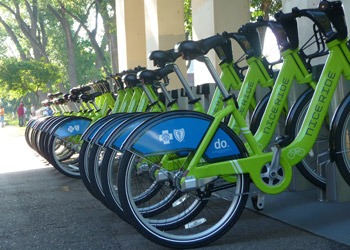
I wish I could tell you that those thoughts have made me a crusader, but it would be largely a lie. I don’t recycle everything I could. I don’t compost. I certainly don’t “let it mellow.” When I drive past a worker from Pedal People—the bicycle-based hauling and delivery service that operates in the Northampton area—I feel a mix of admiration and guilt (especially when it’s raining). There is, in short, room for improvement.
But all those feelings of remorse point to a larger truth: not long ago, there was no coherent green movement to make me feel ashamed—my guilt, in a roundabout way, is a good sign. This week, we commemorate the anniversary of the day that, for much of the country, started it all: Earth Day.
The brainchild of Senator Gaylord Nelson (though largely organized by then 25-year-old Harvard student Denis Hayes), the first Earth Day was celebrated in 1970. Inspired by anti-war demonstrations then taking place on college campuses, Nelson envisioned a large-scale protest that would force issues of conservation and industrial pollution onto the national political stage. It worked: in the years that followed, the nation saw the passage of the Clean Air Act and the Endangered Species Act, and the establishment of the Environmental Protection Agency.
To mark the day, the Academy of Music in Northampton will host the WGBY Earth Day Film Festival on April 23. The day starts at 11:30 a.m. with free screenings of ecologically themed films from PBS, including episodes of the animated series for children Martha Speaks. Also on tap are the hour-long special Fixing the Future, which looks at innovation in the American workplace; and Power Surge, a Nova special that explores the possibility of a clean energy revolution.
Capping off the night is Carbon Nation (7:30 p.m., $7 admission), a “non-partisan, big-tent film” which suggests that promoting climate change initiatives can also promote economic growth and national security. For the filmmakers, recent changes in public opinion prove that people are losing focus, and to bring them back into the green fold, they focus on a simple mantra of pragmatism: green is not only good, they say, but good business as well. In other words, Carbon Nation hopes to sway with a more old-fashioned kind of green.
Also this week: Sharing in the holiday bounty, The Northampton Committee Peace and Justice Film Series continues its free Friday night film series with Earth Days, an American Experience, a film about the dawn of the environmental movement. Using the stories of the movement’s leading lights as a narrative thread, it charts the awakening and explosive growth of a cause.
Reaching back over a decade before the first Earth Day, director Robert Stone’s film follows environmental worry back into the early 1950s, when our post-war embrace of science and technology as building blocks of the American Dream began to seem like a rushed romance. Soon after, Rachel Carson’s landmark book Silent Spring would begin to stir public awareness of industrial pollutants—the title recalls the decimation of the bird population around a local chemical plant—in a way nobody had before.
I may still feel guilty—but at least today I have hope.
Jack Brown can be reached at cinemadope@gmail.com.