In 1997 I was visiting with some new friends on Williams Street in Northampton when one of them mentioned she had recently starred in a music video for a local band. A screening immediately commenced. The video itself was cool: quick cuts of grainy footage depicting the story of a guy who falls for a girl on a bus.
But it was the music that blew me away. Churning guitars, amped-up vocals, pummeling drums: they were The Marshes. And they were punk.
The group began life when Emile (formerly Emil—he changed the spelling to avoid pronunciation confusion) Busi (bass, vocals), Colin Sears (drums), and Steven Wardlaw (guitar, vocals)—veterans of legendary punk outfits like Down by Law, Dag Nasty, Grave Goods and Rumblepuppy—converged in a Northampton practice space.
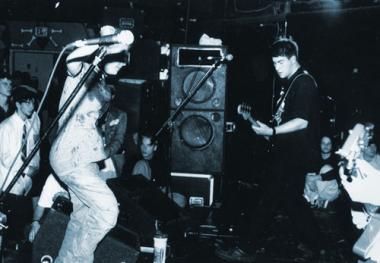
They were just as impressive live as on record: three talented and exuberant pieces rocking as a unified whole. This week finds the trio cranking up the machine for a handful of local performances to celebrate the release of a brand new seven-inch—yes, vinyl record—on Dr. Strange Records.
*
The Marshes were one of a handful of bands from the Valley’s vibrant ’90s music scene that should have made it big. Mega-big, like Green Day or Pearl Jam. Why not? The Marshes rocked harder and smarter than most every “alternative” group that found commercial success in the wake of a certain Pacific Northwest band’s meteoric rise.
“Watching major labels create subsidiaries to promote bands which would be hurt by the stigma of being sold by ‘the man’ was interesting,” recalls Busi. “But the slide towards cack seemed to continue apace after a momentary ‘What the…?’, which came with Nirvana’s uber-success.
“Business people naturally tried to bottle that mojo and monetize it, and to some extent succeeded in releasing vocal doppelgangers that pleased many [people]. We got signed to a major label [Grass/BMG] to help complement their ‘punk’ quota, but they never knew what they were doing. Fantastic example of how just having gobs of money doesn’t mean you’re not a complete moron& We happily parted ways and found Dr. Strange Records with open arms and a clear vision of how not to be a douchebag, and the big label changed their name to Wind-Up to escape their crappy reputation and they cultivated popular bands, while still charging The Marshes for their nose candy. Everyone wins!”
Radio was equally unhelpful to the group.
“We had no place in commercial radio, because I have a blasted potty mouth,” Busi says. “And we tended to write shorter songs, which means less money for the label, and less chance to drive the hook into someone’s noggin. Also, the subject matter is a hard sell. Thirteen-year-old girls with their whole lives in front of them don’t really want to hear about humanity being some kind of accidental fungus that grew to prominence between ice ages, and the human condition is ultimately to rot. Go figure.”
“I think our place in punk rock at that time was to ignore what every one else was doing and just amuse ourselves with our creations,” adds Wardlaw. “It did little for garnering a large fan base, but it did a lot to build a small community of very loyal fans throughout the USA and Europe. It seems that people who love The Marshes really love The Marshes.”
*
All told, The Marshes released numerous seven-inch singles and three full-length albums, each filled with bite-sized chunks of buzzsaw guitars propelled by an unparalleled, teeth-rattling rhythm section. They toured the US and Europe, giving folks an up-close-and-personal taste of their brand of pop punk.
“The Marshes shows were always a ton of fun,” recounts local musician and promoter Chris Dooley. “I recollect one show they played in Worcester at WPI [Worcester Polytechnic Institute] where they weren’t paid, but scored like a hundred free plastic cups, like the type you’d get at Burger King in the ’80s. They also used to bust out a cover of the “Juicy Fruit” commercial song sometimes as many as three times in a set. Good times!”
All three members are still active musically: Sears currently plays in Handgun Bravado in Portland, Oregon; Wardlaw helms Holyoke’s So Very Small; Emile is in New York “working on a surprise project with details to come.” It is also encouraging that, despite their current geographical separation, the band still writes—and has fun together.
“We only write when we are together now,” Wardlaw says. “We take a germ of an idea or come up with one on the spot and go from there. It’s been that way ever since our third album, Pox on the Tracts [1997, Dr. Strange]. We develop more interesting interplay between all of the instruments that way. The arrangements are more unique, and it’s amusing to watch Emile struggle to sing and play bass at the same time after he writes some rhythmically complex bass line and a completely opposing vocal line.
“When we’re with each other, it hasn’t changed at all. We just don’t currently live in a stinky van together.”
*
Despite not taking their success to the next level, the band is rightfully content with its accomplishments and place in history.
“I have no idea what our legacy is or even if there is one,” Wardlaw says. “The only thing I hope is that the people who might get a kick out of The Marshes have the opportunity to be exposed to us in one way or another. If there is one legacy that I see from fan comments and my own personal opinion it’s that Emile’s words and vocals are fucking awesome, totally unique, inspiring, timeless—and did I say fucking awesome? Apologies to Emile. If we ever wanted to be huge, however, we should have stopped singing about amphibious sea creatures attempting to take over the world so much.”
“I would never presume a legacy for The Marshes,” adds Busi. “But if I could offer any advice to someone playing or writing a song, I’d just say write it for yourself. And don’t get too big a head about your own talent. [I] lost count very early on of the number of times I was told my vocals weren’t up to par on a single part& Musicians are touchy by nature, but there is always, always room for improvement. If two out of three people don’t think the song is done, or good or whatever, it isn’t. It probably doesn’t matter what your girlfriend/mom/dog says. Don’t insult the audience by assuming they won’t notice.”
I ask Wardlaw if his own children ever listen to old Marshes material. “I can only say this,” he answers. “I find them listening to it—and they certainly don’t listen to all of the music I’ve ever done.”
*
Years after that impromptu Marshes video screening in my friends’ living room, I hosted a late-night radio show on WRNX that featured nothing but local music. Just about every other week I would play a Marshes cut—one without curses, of course. I loved the idea of launching these perfect blasts of punk rock into people’s cars and living rooms and out into the chill night air. I hoped to afford this great band a little bit more of the credit I always thought they deserved.
And on May 1, I—and everyone else—will be able to catch them again live at the newly reopened Flywheel in Easthampton. They will have a limited number of copies of their new seven-inch, “Vicious Beast,” available on blue vinyl.
Will this be our last to chance to catch the trio together, rocking the same stage?
“The Marshes don’t have a beginning and an end,” Wardlaw says. “There will be more. Maybe only a little. Maybe a lot. I certainly would not try to predict it.”
For show and other information, visit www.myspace.com/themarshesworld.